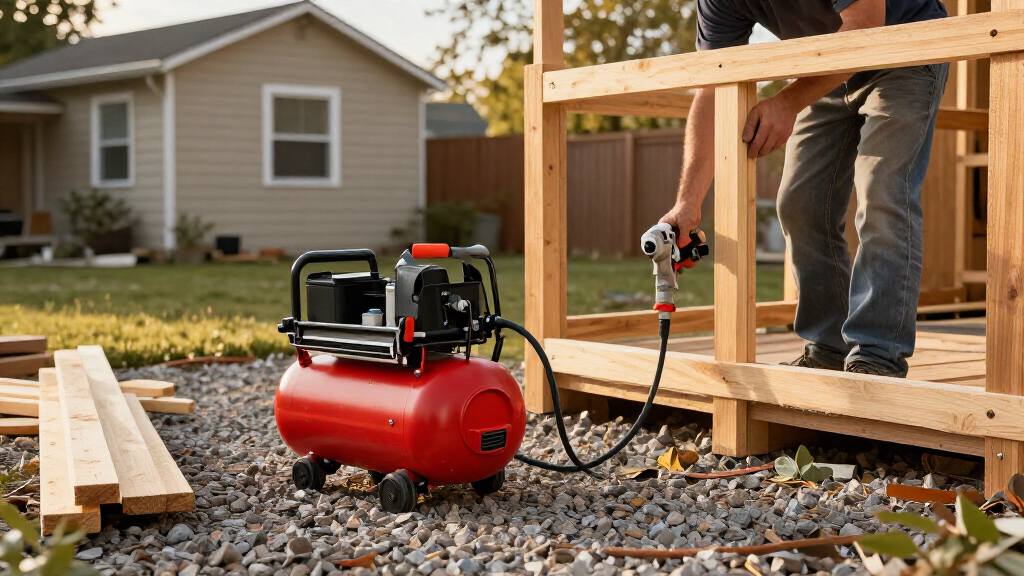
The best portable jobsite air compressor for most crews is the Metabo HPT EC914S, whose 6-gallon tank and 200 PSI rating suit a broad range of pneumatic tasks. For quieter work near occupied spaces, the California Air Tools 4620AC stands out, while the Klutch 4-gallon pontoon model offers stronger airflow for demanding tools. The key tradeoffs are airflow versus carry weight, tank capacity versus how often the pump cycles, and quiet electric operation versus gas-powered mobility. I compared all 14 options by jobsite usefulness, portability, and the work their published specifications suggest they can handle. Read on for the full breakdown and guidance on matching a compressor to your tools.

Get business pricing on tools and workshop supplies
- Business-only prices and quantity discounts
- Tax-exempt purchasing
- Multiple users, one account, clear invoices
Complete the kit


Key Takeaways
- The Metabo HPT EC914S is the broadest-fit pick: its 6-gallon tank and 200 PSI rating offer more flexibility than the compact 1- and 2-gallon models.
- Quiet operation favors the California Air Tools 4620AC and Makita MAC210Q: they suit noise-sensitive work, but their smaller tanks make them less suited to sustained high-demand use.
- Airflow matters more than tank size for demanding tools: the Klutch’s listed 5 CFM at 90 PSI gives it a stronger case for higher-consumption tasks than many pancake options.
- Portable does not always mean easy to carry: the wheeled, gas-powered Metabo HPT EC2510E addresses sites without convenient electrical access, while compact electric models are easier to move by hand.
- Accessory bundles and high PSI are not substitutes for tool compatibility: compare a tool’s required CFM at its working pressure with a compressor’s delivered airflow before choosing.




| portable jobsite air compressor | Tank capacity | Maximum pressure | Weight | Noise level |
|---|---|---|---|---|
| California Air Tools 4620AC 2. | 4.6 gallons | 125 bar (as listed) | 68 lbs | 70 dB |
| Metabo HPT EC28M Quiet 1-Gallo | 1 gallon | 125 bar (as listed) | 25.2 lbs | 59 dB |
| Klutch 4-Gallon Pontoon Air Co | 4 gallons (two 2-gallon tanks) | 150–155 PSI listed | 88.2 lbs | — |
| Metabo HPT 6-Gallon Portable P | 6 gallons | 200 PSI | 41 lbs listed; approximately 42 lbs in description | 73 dB |
| Ingersoll Rand 2 HP Portable T | 4 gallons | 135 PSI | 77 lbs | 79–80 dBA |
| Makita MAC210Q Quiet Series 1 | 2 gallons | 135 PSI | 44 lb (product description) | 60 dB |
| VEVOR 6.3-Gallon 2 HP Oil-Free | 6.3 gallons | 116 PSI | 43 lb | 70 dB |
| CRAFTSMAN 6-Gallon 150 PSI Oil | 6 gallons | 150 PSI | 30.8 lb | 82 dB |
| ECOMAX 6-Gallon 150 PSI Portab | 6 gallons | 150 PSI | 34.17 lb | 75 dB |
| DEWALT DWFP55130 2.5-Gallon Po | 2.5 gallons | 200 PSI | 36 lb | 71.5 dBA |
| CRAFTSMAN 2-Gallon Portable Oi | 2 gallons | 125 PSI | — | 78 dB |
| Ironton Oil-Free Pancake Air C | 3 gallons | 110 PSI | 20.6 lb | — |
| Metabo HPT EC2510E 8-Gallon Ga | 8 gallons | 145 PSI | 144 lb | — |
| Makita MAC2400 2.5 HP Big Bore | 4.2 gallons | 130 PSI | 77 lb | 79 dBA at 3 ft |
More Details on Our Top Picks
California Air Tools 4620AC 2.0 HP Ultra-Quiet Oil-Free Air Compressor, 4.6-Gallon Tank
The California Air Tools 4620AC pairs a 4.6-gallon twin tank with 6.4 CFM at 40 PSI and 5.3 CFM at 90 PSI, giving it more airflow for sustained tool use than the small-tank Metabo HPT EC28M. Its 70 dB rating and low-speed, oil-free pump also make it a better fit for noise-sensitive indoor work than the louder Metabo HPT EC914S. The aluminum tanks and 110 V corded power keep the setup suited to sites with accessible outlets, while thermal protection adds a safeguard during demanding sessions. The tradeoff is portability: at 68 pounds, it is not an easy carry between floors, and its 14 A draw calls for a suitable circuit. I’d choose it for quieter electric jobs, not remote work or frequent hand-carrying.
Pros:- 5.3 CFM at 90 PSI provides more working airflow than the Metabo HPT EC28M.
- 70 dB operation is quieter than the Metabo HPT EC914S.
- Oil-free dual-piston pump reduces routine lubrication needs.
- Aluminum twin tanks and thermal overload protection support jobsite use.
Cons:- At 68 pounds, it is cumbersome for frequent carrying.
- The 14 A draw requires a compatible 110 V circuit.
- Corded operation rules out locations without electrical access.
Best for: Finish carpenters and remodelers who need comparatively quiet electric power for pneumatic tools and can roll or stage a 68-pound compressor near an outlet.
Not ideal for: Crews working off-grid or carrying equipment up stairs; it needs a 110 V outlet and is heavy to lift.
- Motor:2.0 HP
- Pump:Oil-free dual-piston
- Tank capacity:4.6 gallons
- Airflow at 90 PSI:5.3 CFM
- Noise level:70 dB
- Maximum pressure:125 bar (as listed)
- Power and current:110 V, 14 A, corded electric
- Weight:68 lbs
Our verdict“Choose the 4620AC when quiet operation and stronger airflow matter more than light carry weight or off-grid flexibility.”
Metabo HPT EC28M Quiet 1-Gallon Oil-Free Air Compressor
For punch-list work and trim installation, the Metabo HPT EC28M puts quiet operation and easy carrying ahead of tank capacity. At 25.2 pounds and 59 dB, it is far easier to move and less intrusive than the 68-pound California Air Tools 4620AC. Its 1-gallon tank is a deliberate limitation: it suits nailers and short bursts, but offers less reserve for tools that demand steady airflow. The universal quick coupler and integrated PSI controls make tool changes and pressure adjustments straightforward on a small crew. Like the 4620AC and Metabo HPT EC914S, it needs an outlet, so it cannot serve remote off-grid jobs. I’d pick it over larger compressors when the work is mostly nailing and mobility matters more than running several tools for long stretches.
Pros:- 59 dB operation makes it the quietest option among these five.
- At 25.2 pounds, it is much easier to carry than the California Air Tools 4620AC.
- Universal quick coupler supports convenient nailer changes.
- Integrated PSI controls and overload protection simplify operation.
Cons:- The 1-gallon tank is poorly suited to sustained airflow demands.
- Corded power requires access to a suitable outlet.
- Its stated maximum horsepower is limited to 0.5 HP.
Best for: Finish carpenters, cabinet installers, and punch-list crews who carry a compressor between rooms and mainly run compatible nailers.
Not ideal for: Crews using high-demand pneumatic tools or needing long air-tool run time; its 1-gallon tank has limited reserve.
- Model:EC28M
- Tank capacity:1 gallon
- Noise level:59 dB
- Weight:25.2 lbs
- Maximum horsepower:0.5 HP
- Maximum pressure:125 bar (as listed)
- Power:120 V corded electric
- Included fitting:Installed 1/4-inch brass coupler
Our verdict“Choose the EC28M for quiet, portable nailing work, but select a larger-tank model for sustained tool use.”
Klutch 4-Gallon Pontoon Air Compressor, 6.5 HP, 6.9 CFM at 40 PSI, 5 CFM at 90 PSI, 155 PSI Maximum
The Klutch 4-Gallon Pontoon is the lineup’s clear choice when a jobsite has no dependable electrical supply: its 212cc gas engine runs independently of an outlet, unlike the California Air Tools 4620AC or Metabo HPT EC914S. Its listed 5 CFM at 90 PSI is close to the California Air Tools model’s 5.3 CFM, so it can support meaningful pneumatic work rather than only brief nailing bursts. Two pontoon tanks keep the 4-gallon capacity in a compact arrangement, and the oil-free pump avoids routine pump lubrication. That freedom comes with a substantial handling penalty: at 88.2 pounds, it is heavier than every other compressor reviewed here. Product information also differs on maximum pressure, listing both 150 and 155 PSI, so I would verify the exact rating before buying.
Pros:- Gas engine operates without access to electrical power.
- 5 CFM at 90 PSI offers substantially more airflow than the Metabo HPT EC28M.
- Oil-free pump reduces routine lubrication requirements.
- Two-tank pontoon layout provides 4 gallons of capacity.
Cons:- At 88.2 pounds, it is the heaviest model in this group.
- The listed maximum pressure conflicts between 150 and 155 PSI.
- Gas-powered operation is a poor fit for indoor or noise-sensitive work.
Best for: Framing, repair, and construction crews working at remote sites without reliable electrical access who need useful airflow for pneumatic tools.
Not ideal for: Indoor crews, noise-sensitive work, or anyone who must frequently lift the compressor; it is gas-powered and weighs 88.2 pounds.
- Engine:212cc OHV
- Maximum horsepower:6.5 HP
- Tank capacity:4 gallons (two 2-gallon tanks)
- Airflow at 40 PSI:6.9 CFM
- Airflow at 90 PSI:5 CFM
- Maximum pressure:150–155 PSI listed
- Pump:Oil-free
- Weight:88.2 lbs
Our verdict“Choose the Klutch when off-grid airflow is the priority and you can manage its weight and gas-engine operation.”
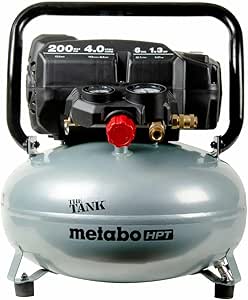
Metabo HPT 6-Gallon Portable Pancake Air Compressor, 200 PSI, EC914S
The Metabo HPT EC914S makes the strongest case here for a shared pneumatic setup: its 6-gallon tank and 4 CFM at 90 PSI are aimed at running multiple nailers, unlike the 1-gallon Metabo HPT EC28M, which is better for one person doing short bursts of nailing. Its 200 PSI maximum pressure adds stored-air capacity, while the pancake form and roughly 41-pound listed weight make it more manageable to transport than the California Air Tools 4620AC. The compromise is that its 73 dB noise level is not as quiet as either of those alternatives, and corded power keeps it tied to a suitable outlet. Product details give its weight as both 41 pounds and approximately 42 pounds, a small discrepancy worth noting when planning transport.
Pros:- 4 CFM at 90 PSI is suited to multiple nailers.
- Six-gallon tank offers more reserve than the 4-gallon California Air Tools and Klutch models.
- 200 PSI maximum pressure is the highest specified in this group.
- Pancake format and ergonomic handle aid transport and storage.
Cons:- At 73 dB, it is louder than the California Air Tools 4620AC and Metabo HPT EC28M.
- Corded operation requires access to a suitable outlet.
- Listed weight varies between 41 and approximately 42 pounds.
Best for: Framing and finish crews who need a corded compressor with enough tank capacity and airflow to support multiple nailers.
Not ideal for: Remote crews without power or users who need very quiet operation; it is corded and louder than the California Air Tools 4620AC and Metabo HPT EC28M.
- Model:EC914S
- Tank capacity:6 gallons
- Maximum pressure:200 PSI
- Airflow at 90 PSI:4 CFM
- Maximum power:1.3 HP
- Noise level:73 dB
- Weight:41 lbs listed; approximately 42 lbs in description
- Power:120 V corded electric
Our verdict“Choose the EC914S for a crew sharing air between nailers, provided the job has power and moderate noise is acceptable.”
Ingersoll Rand 2 HP Portable Twin-Stack Air Compressor, 4 Gallon
The Ingersoll Rand P1IU-A9 stands apart from the oil-free picks with an oil-lubricated, 100% continuous-duty design and a cast-iron cylinder. That makes it a better match for longer work sessions than the small-tank Metabo HPT EC28M, while its two quick-disconnect couplers let a crew connect two tools without sharing a single outlet. Its 3.2 CFM at 90 PSI is below the California Air Tools 4620AC’s 5.3 CFM and the Klutch’s 5 CFM, so it is not the strongest choice for airflow-hungry tools. It also weighs 77 pounds and runs at a listed 79–80 dBA, making it less pleasant to carry or use near occupied spaces. The payoff is a durable, continuous-duty setup, with oil maintenance as the clear tradeoff.
Pros:- 100% continuous-duty rating suits extended operating sessions.
- Two quick-disconnect couplers allow connection of multiple tools.
- Cast-iron cylinder and synthetic lubricant support a durable, serviceable setup.
- 135 PSI maximum pressure exceeds the listed maximum for the California Air Tools 4620AC.
Cons:- At 77 pounds, it is difficult to carry frequently.
- Oil lubrication adds maintenance that the oil-free models avoid.
- 3.2 CFM at 90 PSI is lower than the California Air Tools 4620AC and Klutch.
Best for: Professional or serious DIY users who need a continuous-duty compressor, dual tool connections, and can accommodate regular oil maintenance.
Not ideal for: Buyers prioritizing low weight, quiet operation, or minimal maintenance; it weighs 77 pounds, is comparatively loud, and requires oil.
- Model:P1IU-A9
- Motor:2 HP
- Tank capacity:4 gallons
- Airflow at 90 PSI:3.2 CFM
- Maximum pressure:135 PSI
- Duty cycle:100% continuous duty
- Lubrication:Oil-lubricated; All Season Select synthetic lubricant
- Weight:77 lbs
- Noise level:79–80 dBA
Our verdict“Choose the Ingersoll Rand for continuous-duty work and dual tool hookups, not for lightweight or quiet portability.”
Makita MAC210Q Quiet Series 1 HP, 2-Gallon Oil-Free Electric Air Compressor
The Makita MAC210Q is the indoor-work pick: its 60 dB operating level is quieter than the VEVOR 6.3-Gallon compressor’s listed 70 dB and the CRAFTSMAN pancake compressor’s 82 dB. That makes it a better fit when noise carries through a home or occupied workspace. Its oil-free dual-piston pump and protective roll cage also suit crews who want less routine pump maintenance and added protection during transport.
The tradeoff is capacity. With a 2-gallon tank and 1.6 CFM airflow, it is better suited to intermittent nailing and inflation than sustained air-tool use; the DEWALT DWFP55130 offers 3.0 SCFM at 90 PSI in a similarly compact format. I’d choose the Makita for quieter, lighter-duty indoor work, not for tasks that demand frequent high airflow.
Pros:- Listed 60 dB noise level suits noise-sensitive indoor work.
- Oil-free dual-piston pump avoids routine oil lubrication.
- Roll cage helps protect the pump and motor in transport and storage.
- Compact dimensions and portable design suit moving between work areas.
Cons:- Two-gallon tank limits stored air for longer tool cycles.
- Maximum airflow of 1.6 CFM is modest compared with higher-output options.
Best for: Finish carpenters and maintenance crews working indoors who prioritize low noise and a protective, portable design for intermittent tool use.
Not ideal for: Crews running air-hungry tools for extended periods; its 2-gallon tank and 1.6 CFM airflow offer less capacity than the larger VEVOR and CRAFTSMAN models.
- Motor power:1 HP
- Tank capacity:2 gallons
- Maximum pressure:135 PSI
- Airflow:1.6 CFM
- Noise level:60 dB
- Pump:Oil-free dual-piston
- Power:120 V corded electric
- Weight:44 lb (product description)
Our verdict“Choose the MAC210Q for quiet indoor tasks and intermittent nailing, but pick a higher-airflow model for sustained tool use.”
VEVOR 6.3-Gallon 2 HP Oil-Free Air Compressor
The VEVOR 6.3-Gallon compressor stands out for its 3.35 CFM at 90 PSI, the strongest stated airflow among the five products here. That gives it an advantage over the CRAFTSMAN 6-gallon model’s 2.6 SCFM at 90 PSI when a job involves repeated nailing or other moderate-demand air-tool work. Its larger tank also stores more air than the compact Makita MAC210Q, reducing how often the pump needs to replenish a small reserve.
That output comes with a bulkier footprint: it weighs 43 lb and measures 25.2 × 13 × 28.7 inches, so it is less convenient to carry and stow than the 30.8-pound CRAFTSMAN pancake compressor. Its 116 PSI maximum is also lower than the 150 PSI models. I’d favor it for airflow, while skipping it when easy hauling or higher maximum pressure matters more.
Pros:- 3.35 CFM at 90 PSI is the highest stated airflow in this five-product group.
- 6.3-gallon tank provides more stored air than the compact Makita MAC210Q.
- Oil-free pump reduces routine lubrication needs.
- Silencers and automatic overheating and pressure protections are included.
Cons:- At 43 lb, it is less convenient to move than the lighter CRAFTSMAN pancake compressor.
- 116 PSI maximum is lower than the 150 PSI CRAFTSMAN and ECOMAX models.
Best for: Jobsite crews needing stronger stated airflow for nailing, inflation, or moderate air-tool work and able to manage a 43-pound compressor.
Not ideal for: Workers who frequently carry equipment up stairs or need a compact, easy-to-store unit; its size and weight are greater than the CRAFTSMAN pancake model’s.
- Tank capacity:6.3 gallons
- Motor power:2 HP (1450 W)
- Airflow:3.35 CFM at 90 PSI
- Maximum pressure:116 PSI
- Noise level:70 dB
- Pump:Oil-free
- Power:120 V corded electric
- Weight:43 lb
Our verdict“Pick the VEVOR when its higher stated airflow matters more than carrying weight or maximum pressure.”
CRAFTSMAN 6-Gallon 150 PSI Oil-Free Pancake Air Compressor with 25-Foot Hose
The CRAFTSMAN CMXECXA0210641C pairs a 6-gallon pancake tank with a listed weight of 30.8 pounds, making it easier to move than the VEVOR 6.3-Gallon compressor at 43 pounds. Its 150 PSI maximum and 2.6 SCFM at 90 PSI make it a practical match for intermittent nailing, tire inflation, and woodworking, while the included 25-foot hose can reduce the need to reposition the compressor around a work area.
It is not the strongest airflow choice: the VEVOR is rated at 3.35 CFM at 90 PSI. The CRAFTSMAN’s 82 dB noise listing also makes it a weaker fit for quiet indoor jobs than the Makita MAC210Q at 60 dB. Dual couplers and gauges help with setup and tool connections, but the tank still limits longer air-tool sessions. I’d choose it for portable general-purpose work, not noise-sensitive or sustained high-demand tasks.
Pros:- 30.8-pound listed weight is lower than the VEVOR’s 43 pounds.
- Six-gallon tank and 150 PSI maximum suit common intermittent jobsite tasks.
- Includes a 25-foot hose and two quick couplers.
- Dual gauges and a regulator support pressure monitoring and adjustment.
Cons:- Listed 82 dB noise level is much higher than the Makita MAC210Q’s 60 dB.
- 2.6 SCFM at 90 PSI is below the VEVOR’s stated 3.35 CFM at 90 PSI.
- Six-gallon tank may need frequent recovery during extended air-tool use.
Best for: Carpenters and homeowners who need a manageable-weight pancake compressor for intermittent nailing, inflation, and woodworking, with a hose included.
Not ideal for: Crews working in noise-sensitive indoor spaces or using air tools continuously; its listed 82 dB noise level and 6-gallon tank are limiting factors.
- Tank capacity:6 gallons
- Maximum pressure:150 PSI
- Airflow:2.6 SCFM at 90 PSI
- Motor:1 HP, 120 V
- Pump:Oil-free
- Noise level:82 dB
- Weight:30.8 lb
- Included hose:25 ft
Our verdict“Choose this CRAFTSMAN for easier-to-carry general-purpose work with a hose included, but look elsewhere for quiet operation or higher airflow.”
ECOMAX 6-Gallon 150 PSI Portable Pancake Air Compressor with 10-Piece Accessory Kit
The ECOMAX 6-gallon pancake compressor is the bundle-focused option: it includes a 25-foot hose and inflation accessories, plus dual gauges and quick couplers. That can make it a convenient starting point for crews who handle tire inflation and varied light-duty tasks without assembling fittings separately. Its 150 PSI maximum matches the CRAFTSMAN pancake compressor, and the flip-up handle gives this model a different storage and carrying setup.
The airflow figure needs care: the supplied spec lists 3 cubic inches per minute at 90 PSI, not the CFM units used for the CRAFTSMAN and VEVOR ratings. I can’t make a like-for-like output comparison from that figure, so buyers relying on sustained tool airflow should verify the rating before choosing it. The listed 75 dB noise level is quieter than the CRAFTSMAN’s 82 dB but louder than the Makita MAC210Q. Its 34.17-pound weight also exceeds the CRAFTSMAN’s.
Pros:- Includes a 25-foot hose and a range of inflation and air-tool accessories.
- Flip-up handle supports carrying and storage.
- Dual quick couplers allow two connections.
- Listed 75 dB noise level is below the CRAFTSMAN pancake compressor’s 82 dB.
Cons:- Airflow is listed as 3 cubic inches per minute at 90 PSI, making output comparisons uncertain.
- At 34.17 lb, it is heavier than the CRAFTSMAN 6-gallon pancake model.
- Corded operation requires access to a 120 V outlet.
Best for: DIYers and jobsite workers who need a portable compressor with a hose and assorted inflation accessories for varied, light-duty tasks.
Not ideal for: Buyers choosing by verified airflow for demanding air tools; the listed airflow unit is unusual and cannot be directly compared with the CFM ratings of the other models.
- Tank capacity:6 gallons
- Maximum pressure:150 PSI
- Motor power:1.5 HP
- Listed airflow:3 cubic inches per minute at 90 PSI
- Noise level:75 dB
- Pump:Oil-free
- Weight:34.17 lb
- Included hose:25 ft
- Power:120 V corded electric
Our verdict“Choose the ECOMAX for its included hose and accessories on light-duty jobs, but verify its airflow rating before relying on it for air tools.”
DEWALT DWFP55130 2.5-Gallon Portable Air Compressor, 200 PSI
The DEWALT DWFP55130 is the strongest match here for buyers who want 200 PSI maximum pressure and useful airflow in a compact tank. Its 3.0 SCFM at 90 PSI is higher than the Makita MAC210Q’s 1.6 CFM, while its 2.5-gallon tank keeps the format smaller than the six-gallon CRAFTSMAN and ECOMAX models. The ability to operate or store it vertically or horizontally also gives it more flexibility in a crowded vehicle or shop.
That compactness does not mean it is the lightest choice: at 36 lb, it is heavier than the CRAFTSMAN pancake compressor. The 2.5-gallon tank can also limit runtime on sustained jobs, despite its airflow rating. Dual quick couplers are useful when running two nailers, and the listed 12 A draw may help on circuits where startup load is a concern. I’d select it for space-conscious crews, not for buyers who need a larger air reserve.
Pros:- 200 PSI maximum is higher than the other four products in this batch.
- 3.0 SCFM at 90 PSI exceeds the Makita MAC210Q’s stated 1.6 CFM.
- Can be stored or operated vertically or horizontally.
- Dual quick couplers and a listed 12 A draw support practical jobsite use.
Cons:- 2.5-gallon tank limits stored air for extended tool operation.
- At 36 lb, it is heavier than the 30.8-pound CRAFTSMAN pancake compressor.
- Corded electric operation requires a 120 V outlet.
Best for: Finish carpenters and mobile crews who need a compact 200 PSI compressor, flexible storage orientation, and airflow for intermittent tool work.
Not ideal for: Workers running air tools for long stretches without recovery pauses; the 2.5-gallon tank stores less air than the six-gallon pancake models.
- Tank capacity:2.5 gallons
- Maximum pressure:200 PSI
- Airflow:3.0 SCFM at 90 PSI
- Noise level:71.5 dBA
- Pump:Oil-free
- Power:120 V corded electric
- Maximum current:12 A
- Weight:36 lb
- Couplers:Dual quick couplers
Our verdict“Pick the DEWALT for compact storage and high maximum pressure, but choose a six-gallon model if longer air reserve matters more.”
CRAFTSMAN 2-Gallon Portable Oil-Free Air Compressor, 1/3 HP, 125 PSI, with 10-Piece Accessory Kit
The CRAFTSMAN 2-gallon is a sensible choice for short, varied tasks when carrying accessories with the compressor matters as much as tank capacity. Its 10-piece kit covers common inflation jobs and basic air-tool connections, while the oil-free pump avoids routine lubrication. At about 24.5 lb according to the listed weight, it is easier to handle than the Metabo HPT EC2510E, though the Craftsman’s small tank is not suited to sustained air demand. The 125 PSI maximum gives it more pressure headroom than the Ironton 3-gallon, but that does not make it a high-output compressor. One drawback is conflicting weight information: the description says 19 lb, while the product details list about 24.5 lb. I’d choose it for portable inflation and brief garage or jobsite work, not extended pneumatic-tool use.
Pros:- Compact hot-dog layout and reinforced handle support carrying and storage.
- Oil-free pump avoids routine oil checks and changes.
- Included kit covers several common inflation and air-line tasks.
- Overload protection and heat-dissipation features support practical jobsite use.
Cons:- Two-gallon capacity is limiting for sustained air-tool work.
- Published weight is inconsistent: about 24.5 lb in the specs versus 19 lb in the description.
Best for: DIYers and mobile maintenance workers who want a compact compressor with accessories ready for tires, balls, and occasional short air-tool tasks.
Not ideal for: Crews running nailers or other air tools for long stretches, since the 2-gallon tank limits stored air and recovery interruptions may slow work.
- Tank capacity:2 gallons
- Motor power:1/3 HP
- Maximum pressure:125 PSI
- Power source:120 V corded electric
- Pump:Oil-free
- Listed weight:11.11 kg (about 24.5 lb); description also states 19 lb
- Noise level:78 dB
- Included accessories:10-piece kit including hose, tire gauge, blow gun, air chuck, plugs, coupler, nozzle, tape, and sleeve
Our verdict“Choose this Craftsman for compact, accessory-ready inflation and occasional light tasks, but pick a larger-tank compressor for extended tool use.”
Ironton Oil-Free Pancake Air Compressor, 0.3 HP, 3 Gallon, 110 PSI
The Ironton 3-gallon pancake favors steadiness and uncomplicated setup over high output. Its broad, low-profile tank is less awkward on uneven work surfaces than a compact hot-dog design like the CRAFTSMAN 2-gallon, and the fold-down handle plus cord and hose storage help keep transport and packing tidy. It is aimed at light nailing, stapling, inflation, and cleaning; airflow is only 0.6 CFM at 90 PSI, so the larger tank should not be mistaken for capacity to run demanding tools continuously. Compared with the CRAFTSMAN, it adds a gallon of storage but gives up maximum pressure, topping out at 110 PSI. The oil-free pump cuts routine upkeep, though the manual drain still calls for hands-on tank care. I’d favor it for intermittent fastening where a stable base and simple storage matter more than speed.
Pros:- Three-gallon pancake tank provides more stored air than the CRAFTSMAN 2-gallon model.
- Wide, low-profile base supports stability during setup.
- Fold-down handle and built-in cord and hose storage simplify transport and packing.
- Oil-free direct-drive pump avoids routine oil service.
Cons:- Air delivery of 0.6 CFM at 90 PSI limits sustained tool use.
- Manual drain requires the operator to handle tank draining and upkeep.
- 110 PSI maximum is lower than the CRAFTSMAN 2-gallon’s 125 PSI.
Best for: Home renovators and finish-work DIYers who use a nailer intermittently and want a stable, easy-to-store compressor.
Not ideal for: Roofing or framing crews needing sustained airflow, or buyers who want an automatic tank drain and minimal maintenance.
- Tank capacity:3 gallons
- Motor power:0.3 HP
- Maximum pressure:110 PSI
- Airflow:0.6 CFM at 90 PSI; 0.9 CFM at 40 PSI
- Power source:120 V corded electric
- Pump:Oil-free, direct-drive
- Pressure cycling:On at 85 PSI; off at 110 PSI
- Weight:20.6 lb
- Duty cycle:75%
Our verdict“Pick the Ironton for intermittent nailing and tidy storage, not for tools that need a steady supply of air.”
Metabo HPT EC2510E 8-Gallon Gas-Powered Wheeled Air Compressor
When a jobsite has no dependable electrical supply, the Metabo HPT EC2510E offers a different kind of portability: it runs on gas and rolls on wheels rather than being carried by hand. Its Honda GX engine and 8-gallon tank are better suited to pneumatic work such as framing, siding, and roofing than small electric options like the CRAFTSMAN 2-gallon. The protected control panel keeps key components shielded, while the cast-iron cylinder is built for demanding compression cycles. That capability comes with a serious handling tradeoff: at 144 lb, it is a wheeled compressor for moving across a site, not a machine to lift in and out of a vehicle alone. Gas operation also means fuel and engine upkeep, unlike the plug-in Makita MAC2400. I’d choose it when tool output and power independence outweigh easy transport and quiet operation.
Pros:- Gas-powered Honda GX engine works without an electrical outlet.
- Eight-gallon tank and 145 PSI maximum suit demanding pneumatic jobsite tasks better than small electric compressors.
- Cast-iron cylinder is built for consistent compression and low oil carryover.
- Integrated protected controls and wheels support jobsite operation and movement.
Cons:- At 144 lb, it is difficult to load or carry despite the wheeled design.
- Gas operation requires fuel and engine maintenance.
- A gas engine is unsuitable for enclosed or poorly ventilated work areas.
Best for: Framing, siding, and roofing crews working at remote or unfinished sites without convenient access to electrical power.
Not ideal for: Solo contractors who must frequently lift a compressor into a vehicle, or crews working where gas-engine exhaust is unsuitable.
- Tank capacity:8 gallons
- Power source:Gas
- Engine:Honda GX
- Maximum power:5.5 HP
- Maximum pressure:145 PSI
- Operating pressure cycle:116–145 PSI
- Cylinder:Cast iron
- Weight:144 lb
- Dimensions:42 × 18 × 24 in
Our verdict“Choose the EC2510E for high-demand pneumatic work away from outlets, provided you can manage its weight, fuel, and outdoor operating needs.”
Makita MAC2400 2.5 HP Big Bore Air Compressor
The Makita MAC2400 stands apart from compact compressors by prioritizing usable airflow: its listed output is 4.2 CFM at 90 PSI, and the product description says it can supply two nailers. That makes it a stronger fit for simultaneous or sustained fastening than the Ironton 3-gallon, whose airflow is much lower, while its 4.2-gallon twin-stack tank keeps the footprint smaller than the gas-powered Metabo HPT EC2510E. A cast-iron Big Bore pump and low-RPM motor are designed for durability and reduced wear, and the roll cage protects the unit during transport. Portability is relative: at 77 lb, it is far heavier than the compact CRAFTSMAN, and the oil-lubricated pump needs regular attention. I’d pick the Makita for crews with access to a 115 V outlet who need more air without moving to a gas compressor.
Pros:- Delivers 4.2 CFM at 90 PSI for higher-demand air-tool work.
- Cast-iron Big Bore pump is designed for durability and faster recovery.
- Low-RPM motor is designed to reduce wear and operating noise.
- Roll-cage construction protects the unit and provides a carrying structure.
Cons:- At 77 lb, it is cumbersome to move compared with compact electric compressors.
- Oil-lubricated pump requires regular oil checks and maintenance.
- Requires a 115 VAC power supply, unlike the gas-powered Metabo HPT EC2510E.
Best for: Finish carpenters and small crews who need stronger airflow for nailers and have access to a 115 V power supply.
Not ideal for: Buyers who need a compressor they can carry easily, want oil-free maintenance, or work at sites without electrical power.
- Motor power:2.5 HP
- Power supply:115 VAC
- Air delivery:4.2 CFM at 90 PSI; 4.8 CFM at 40 PSI
- Maximum pressure:130 PSI
- Tank capacity:4.2 gallons
- Pump:Cast iron, oil-lubricated Big Bore
- Motor speed:1,730 RPM
- Weight:77 lb
- Noise level:79 dBA at 3 ft
Our verdict“Choose the MAC2400 when higher airflow for nailers matters more than low weight or oil-free upkeep.”

How We Picked
I compared these portable jobsite air compressors on the factors that shape daily usefulness: delivered airflow, tank capacity, maximum pressure, power source, noise positioning, and how readily each design can be moved around a site. I gave more weight to a balance of usable performance and portability than to a single headline figure. Tank size and maximum PSI can help with particular tasks, but neither alone establishes whether a compressor can keep up with a tool.
The ranking reflects distinct jobsite needs rather than treating every model as interchangeable. Models with broad utility and practical capacity rank ahead of niche picks; compact, quiet units earn their place for close-quarters work, while the gas-powered wheeled model serves sites where electric access is a constraint. I also accounted for meaningful limits, including smaller tanks, lower listed airflow, added bulk, and the need to check a tool’s CFM requirements. Product specifications supplied for this roundup do not include comparable noise, weight, or airflow figures for every model, so I avoid treating those gaps as proof of performance.
| portable jobsite air compressor | Pump |
|---|---|
| California Air Tools 4620AC 2. | Oil-free dual-piston |
| Metabo HPT EC28M Quiet 1-Gallo | — |
| Klutch 4-Gallon Pontoon Air Co | Oil-free |
| Metabo HPT 6-Gallon Portable P | — |
| Ingersoll Rand 2 HP Portable T | — |
| Makita MAC210Q Quiet Series 1 | Oil-free dual-piston |
| VEVOR 6.3-Gallon 2 HP Oil-Free | Oil-free |
| CRAFTSMAN 6-Gallon 150 PSI Oil | Oil-free |
| ECOMAX 6-Gallon 150 PSI Portab | Oil-free |
| DEWALT DWFP55130 2.5-Gallon Po | Oil-free |
| CRAFTSMAN 2-Gallon Portable Oi | Oil-free |
| Ironton Oil-Free Pancake Air C | Oil-free, direct-drive |
| Metabo HPT EC2510E 8-Gallon Ga | — |
| Makita MAC2400 2.5 HP Big Bore | Cast iron, oil-lubricated Big Bore |
Factors to Consider When Choosing Portable Jobsite Air Compressors
Choosing a compressor starts with the tools and the work pattern, not the tank shape or a single PSI number. I’d first match air demand to the tools you plan to run, then decide how much portability, quiet operation, and power-source flexibility the site calls for.
Match Delivered Airflow to Your Tools
Check each tool’s required CFM at its operating pressure, then compare it with the compressor’s delivered CFM at that pressure. Do not use maximum PSI as a stand-in for airflow: pressure describes force, while CFM indicates how much air the pump can supply over time. If you expect to run more than one tool or work continuously, allow headroom rather than buying to the exact stated requirement. A small compressor may be suitable for intermittent fastening but struggle to keep pace with tools that draw air continuously. When published specs omit CFM at a useful pressure, verify the figure with the manufacturer before relying on that unit for a demanding application.
Treat Tank Capacity as a Buffer, Not a Performance Guarantee
A larger tank stores more compressed air, which can help cover brief bursts of demand and reduce how quickly pressure drops between pump cycles. It does not make a low-output pump deliver more air over a long stretch of work. This distinction matters when comparing compact 1- or 2-gallon models with 6-gallon pancakes: the compact unit may be easier to carry, while the larger tank can provide more reserve for intermittent use. For sustained work, pump output is often the tighter limit. Choose tank capacity around the rhythm of your tasks, and judge it alongside airflow rather than on its own.
Plan for the Whole Carry and Setup
Portability includes more than the compressor’s footprint: think about loaded weight, handles, stairs, vehicle storage, and how far the unit must travel from the outlet. A compact tank can simplify solo handling, but a model with wheels may be easier to move across a larger site even if it is less convenient to lift into a vehicle. Also account for the hose, fittings, and any accessories you need, since a bundled kit can reduce setup gaps but may not include the right connections for every tool. Check the available cord reach and the jobsite’s electrical supply before assuming an electric model will work wherever you place it. Buying for the full setup avoids choosing a compressor that is portable only on paper.
Choose Noise and Power Around the Worksite
Quiet-focused electric models can make a meaningful difference when crews work indoors, near occupied spaces, or in areas where repeated pump noise is disruptive. Smaller quiet units still have airflow and tank limits, so quieter operation may require accepting slower recovery or a narrower set of suitable tools. Gas power can address locations without practical electrical access, but it brings different handling and operating requirements than a plug-in compressor. Before choosing gas for an indoor job, follow the manufacturer’s safety instructions and site rules for ventilation and operation. Match the power source to where the compressor will run, not just where it will be stored.
Look Beyond the Headline Specifications
Maximum pressure, horsepower, and tank volume each tell only part of the story. Compare the model’s air delivery at working pressure with your tools, and check whether specifications are reported under comparable conditions. A larger horsepower figure does not automatically mean a compressor will sustain a tool’s demand, just as a high-pressure rating does not guarantee fast recovery. Consider the maintenance requirements, oil-free or oil-lubricated design, and access to replacement parts for the duty cycle you expect. If key data is missing, treat that as a reason to verify the fit rather than fill the gap with assumptions.
Pay for Capacity You Will Actually Use
It can make sense to spend more for stronger airflow, a power source suited to remote work, or a design that reduces noise in a sensitive setting. It makes less sense to buy a bulky, high-capacity unit for occasional finish nailing if a compact model meets the tool’s requirements. On the other hand, choosing a small compressor for a crew that needs continuous air can mean frequent pauses and frustration. List the tools you expect to run, how often they run, and whether multiple users may share the compressor. That short inventory helps separate useful capacity from specifications that will rarely affect your work.
Frequently Asked Questions
How do I know whether a compressor can run my nailer or other air tool?
Check the tool’s air consumption in CFM and the pressure at which that figure is stated, then compare it with the compressor’s delivered CFM at the same pressure. A tank’s gallon rating and a compressor’s maximum PSI do not answer that question by themselves. For intermittent tools, a tank can supply short bursts while the pump catches up, but long or repeated use puts more demand on airflow and recovery. If the compressor’s specifications list only a peak figure or leave out CFM at your working pressure, ask the manufacturer for clarification. Leave some capacity beyond the tool’s minimum when several tools or users may draw air.
Is a 6-gallon pancake compressor a better jobsite choice than a smaller quiet model?
Not for every crew: the better choice depends on tool demand, noise limits, and how often you need to carry the compressor. A 6-gallon model gives more stored air than a 1- or 2-gallon unit, which can help with bursts of work and reduce how quickly pressure falls. A compact quiet model can be easier to place near the work and more suitable where noise is a concern, but its smaller reserve may limit the pace or range of tasks. Neither tank size nor quiet operation proves the unit will sustain a high-demand tool. Compare delivered airflow at working pressure before deciding.
When does a gas-powered compressor make more sense than an electric one?
A gas-powered compressor may fit remote work where a suitable electrical supply is unavailable or inconvenient. That flexibility comes with added considerations around transport, operating requirements, and where the machine can safely run. Follow the manufacturer’s instructions and jobsite rules, particularly for ventilation and operation near enclosed areas. If the site has dependable power and work happens indoors or near occupied spaces, an electric model may be a more practical match. Choose gas for a real access constraint, not simply because it sounds more jobsite-ready.
Should I prioritize a high PSI rating or a higher CFM rating?
Prioritize the specification that matches the tool’s stated requirement, but for many buyers comparing compressors, CFM at the working pressure is the better measure of whether the unit can keep supplying air. PSI is the pressure available and must meet the tool’s minimum, but a high maximum PSI does not automatically mean a high volume of air. For brief tasks, stored tank air can cover short demand spikes; for sustained use, delivered airflow and recovery matter more. Confirm that the compressor meets the tool’s pressure requirement and compare CFM at that pressure. Avoid choosing from the biggest number on the product label alone.
What should I check before buying a portable compressor for a crew?
Start with the air demands of the tools the crew will actually share, including whether more than one tool may run at once. Then check the compressor’s delivered airflow, available power, and whether its tank and recovery suit the crew’s work rhythm. Think through transport as a team: a unit that one person can carry between rooms may not be the easiest choice to roll across an uneven site, and a wheeled model may be awkward to load into a vehicle. Confirm that fittings, hose reach, and electrical access suit the setup. If several workers need continuous air, favor adequate airflow over a convenient accessory bundle.
Conclusion
For the widest range of everyday jobs, I’d start with the Metabo HPT EC914S as best overall, thanks to its 6-gallon tank and 200 PSI rating. The CRAFTSMAN 6-gallon pancake is my best-value direction for buyers who want a familiar portable format and a bundled hose, while the California Air Tools 4620AC is the best premium-style choice for quieter work where its capacity suits the tools. For beginners handling lighter, intermittent tasks, the CRAFTSMAN 2-gallon kit offers a compact starting point with included accessories, though I would check tool airflow needs before buying. Choose the Klutch pontoon model when higher listed airflow is the priority, or the Metabo HPT EC2510E when remote work calls for gas power and wheels. The right pick is the one that meets your tools’ CFM and pressure requirements without adding capacity or bulk your jobsite will not use.