
Choosing insulation for a log cabin is less about finding one material for every surface and more about matching the product to the job. I rank Owens Corning R-19 fiberglass first for framed walls and larger cavities, Loctite Tite Foam Big Gaps as the strongest choice for sealing cracks and penetrations, and Frost King recycled denim for small, low-irritation cushioning and sound-dampening tasks. They do different work: batts cover broad cavities, spray foam targets air leaks, and denim is a convenient, handleable material for modest spaces.

Get business pricing on tools and workshop supplies
- Business-only prices and quantity discounts
- Tax-exempt purchasing
- Multiple users, one account, clear invoices
The main tradeoff is coverage versus precision. Fiberglass offers a stated R-19 rating but needs a suitable cavity and a separate moisture-control plan. Expanding foam can close irregular gaps that batts cannot, but it is not a substitute for insulating an entire wall. Recycled denim is comfortable to handle, yet its one-inch thickness and product dimensions limit where it can serve as meaningful thermal insulation. I compare these options by fit, intended use, handling, and the limits a cabin owner should plan around.
Complete the kit


Key Takeaways
- For framed 2×6 walls, floors, or attic cavities: Owens Corning R-19 batts provide broad-area coverage when the framing and moisture-control details match.
- For drafts around openings and services: Loctite Tite Foam is the specialist pick for gaps up to three inches, not a full-wall insulation layer.
- For easy handling and small jobs: Frost King recycled denim avoids the itchy handling associated with fiberglass, but its one-inch thickness limits thermal use.
- Moisture planning changes the choice: The fiberglass is unfaced, while the foam and denim descriptions do not make either a complete wall moisture-management system.
- These products are complementary, not interchangeable: A cabin may need cavity insulation, careful air sealing, and a separate strategy for moisture and ventilation.
| Owens Corning R-19 Unfaced Fiberglass Insulation, 77.5 sq ft |  | Best Overall for Framed Cabin Cavities | Material: Fiberglass | Thermal resistance: R-19 | Coverage: 77.5 sq ft | VIEW LATEST PRICE | See Our Full Breakdown |
| Loctite Tite Foam Big Gaps Spray Foam Sealant, 12 fl oz Can |  | Best for Drafts, Cracks, and Irregular Gaps | Brand: Loctite | Model: 2975888 | Material: Polyurethane-based expanding foam | VIEW LATEST PRICE | See Our Full Breakdown |
| Frost King No Itch Natural Cotton Multi-Purpose Insulation |  | Best for Small, Comfortable-to-Handle Projects | Brand: Frost King | Material: 100% recycled denim | Dimensions: 16 x 48 in | VIEW LATEST PRICE | See Our Full Breakdown |
| log cabin insulation material | Material | Dimensions | Thickness | Brand |
|---|---|---|---|---|
| Owens Corning R-19 Unfaced Fib | Fiberglass | 15 x 93 in | 6.5 in | — |
| Loctite Tite Foam Big Gaps Spr | Polyurethane-based expanding foam | — | — | Loctite |
| Frost King No Itch Natural Cot | 100% recycled denim | 16 x 48 in | 1 in | Frost King |
More Details on Our Top Picks
Owens Corning R-19 Unfaced Fiberglass Insulation, 77.5 sq ft
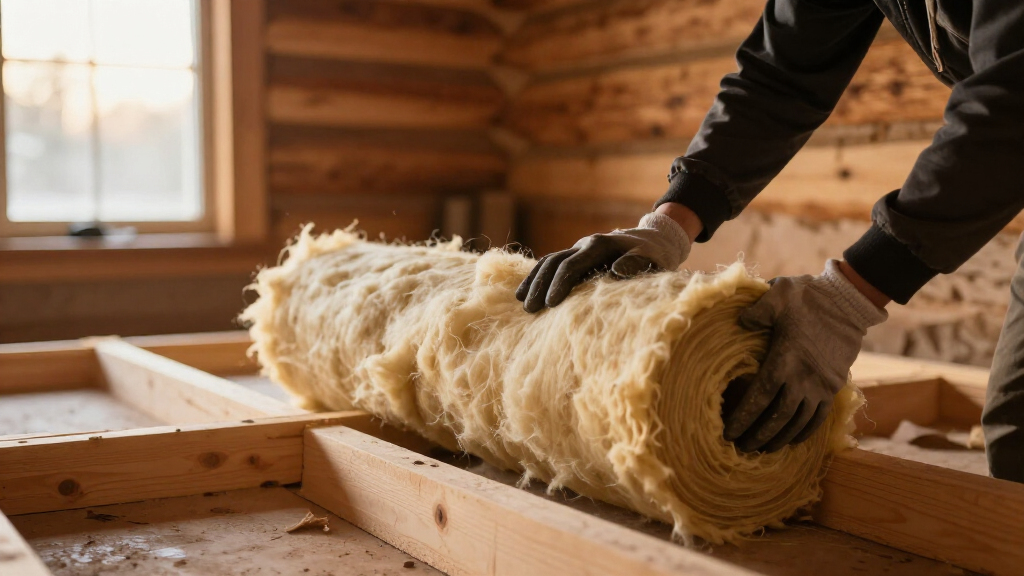
For a cabin with conventional framing, I put the Owens Corning R-19 unfaced batts at the top because they address the broadest insulation task in this group: filling wall, floor, or attic cavities rather than treating only isolated trouble spots. Each package is listed to cover 77.5 square feet, with eight batts sized 15 by 93 inches and 6.5 inches thick. That makes this the most direct fit here for a framed 2×6 assembly, provided the cavity dimensions and building plan call for that thickness.
The stated R-19 thermal resistance gives buyers a useful comparison point that the Frost King denim listing does not provide. The unfaced construction is also a deliberate feature, not a ready-made vapor-control layer. It leaves moisture management to the rest of the wall or roof assembly, which can be useful when the design calls for a separate control layer but adds planning work for a cabin owner. I would not assume an unfaced batt can simply be pressed against any log wall without checking how that assembly handles moisture.
Compared with Loctite Tite Foam, the batts make sense for large, regular spaces, while the foam is better for narrow cracks and awkward openings where a batt cannot make a continuous fit. Compared with the one-inch Frost King denim, fiberglass offers a defined thermal rating and much larger stated coverage, but it is less comfortable to handle. Fiberglass can irritate skin, so protective clothing and careful installation are sensible. Batts also need to be cut and fitted without leaving voids or compressing them in ways the assembly does not support.
This is my lead recommendation when the cabin has framed cavities and the builder or retrofit plan specifies a batt product of this size. It is a poor match for exposed solid logs without an interior framing cavity, and the unfaced format means it does not settle moisture-control questions by itself. For a complete cabin plan, I would pair cavity insulation with careful air sealing and assembly-specific moisture details rather than expecting one bag to do every job.
Pros:- Stated R-19 rating for thermal insulation
- 77.5 square feet of listed coverage across eight batts
- Sized for 2×6 framing and suitable for walls, floors, or attics
- Unfaced format allows moisture-control details to be specified separately
Cons:- No vapor barrier or facing is included
- Fiberglass can irritate skin during handling and installation
- Requires a compatible cavity and careful fitting to avoid gaps or compression
Best for: Cabin owners insulating properly sized 2×6 framed walls, floors, or attic cavities who want a stated R-19 batt and can plan separate moisture control.
Not ideal for: Buyers insulating exposed solid-log walls without framed cavities, or anyone seeking a faced batt that includes a vapor-control layer.
- Material:Fiberglass
- Thermal resistance:R-19
- Coverage:77.5 sq ft
- Number of batts:8
- Dimensions:15 x 93 in
- Thickness:6.5 in
- Application:Walls, floors, and attics
- Facing:Unfaced
Our verdict“I recommend these batts first for framed cabin cavities because they combine broad coverage with a stated R-19 rating, but only when the assembly has a separate moisture-control plan.”
Loctite Tite Foam Big Gaps Spray Foam Sealant, 12 fl oz Can
When the problem is a visible gap rather than an empty wall cavity, Loctite Tite Foam Big Gaps is the most targeted option in this lineup. The polyurethane foam is described as filling, sealing, and insulating gaps up to three inches. That makes it a useful complement to cavity insulation around irregular openings, joints, and penetrations where a batt is difficult to fit snugly. Its stated compatibility includes wood, metal, PVC, brick, concrete, and stone, materials a cabin repair may bring together at an opening or service entry.
The product description also calls out high density, flexibility, adhesion, and UV resistance, with interior and exterior use listed. Those qualities matter when a seal needs to bond to varied surfaces and tolerate some movement rather than acting like a loose filler. It is still a gap sealant, not a broad-area insulation system. The single 12-fluid-ounce can and three-inch gap limit make it a much narrower purchase than the 77.5-square-foot fiberglass package.
Against Owens Corning R-19, this foam wins on precision and loses on coverage: it can address a crack a batt cannot reach, but it cannot replace insulation across a framed wall. Compared with Frost King denim, it is suited to sealing a void and limiting air movement, while denim is easier to cut and handle for cushioning or modest sound-dampening jobs. The foam calls for a measured hand because it expands; excess material can create a messy finish or interfere with nearby components. Buyers should also follow the product label for application, curing, and safety instructions rather than treating a short description as a full installation guide.
I rank it second overall because air leaks are a distinct cabin comfort problem and this option is built for that task. It can be especially useful as part of a larger insulation project: fill suitable gaps, then insulate the actual cavity with a material designed for that space. Skip it if the goal is to cover a large wall area, if the gap exceeds the stated limit, or if a precise, easily removable filler is needed.
Pros:- Designed to fill, seal, and insulate gaps up to three inches
- Adheres to a range of common building materials, including wood and metal
- Flexible and described as UV resistant for interior or exterior use
- Useful for air-leak details that bulk batt insulation cannot address
Cons:- Limited to gaps up to three inches
- Expansion can create excess foam if application is not controlled
- A single can is not a practical substitute for broad-area cavity insulation
Best for: Cabin owners sealing irregular gaps up to three inches around openings, joints, and penetrations where a batt cannot fit closely.
Not ideal for: Anyone looking to insulate full walls or large cavities with one product, or buyers who need a filler for gaps beyond the stated size range.
- Brand:Loctite
- Model:2975888
- Material:Polyurethane-based expanding foam
- Can size:12 fl oz
- Maximum stated gap:Up to 3 in
- Color:White
- Use:Interior and exterior
- Compatible materials:Brick, concrete, metal, PVC, stone, and wood
- Water resistance:Water resistant
Our verdict“I choose this foam for targeted air sealing around cabin gaps, but not as the primary insulation for walls, floors, or roofs.”
Frost King No Itch Natural Cotton Multi-Purpose Insulation
Frost King No Itch Natural Cotton takes a different route from the other two picks: it is made from 100% recycled denim and is described as nonirritating, easy to cut or tear, and useful for insulation, cushioning, and noise dampening. That makes it the friendliest option here for small adjustments where a buyer wants a material that is comfortable to handle. The listed piece measures 16 by 48 inches and is one inch thick, so I see it as a modest, versatile material rather than a primary thermal layer for a cabin wall.
Its strongest contrast is with fiberglass batts. The denim avoids the skin irritation noted for fiberglass and can be shaped for smaller spaces, but the supplied product details do not give it an R-value or a large package coverage figure. That makes it harder to compare as a whole-wall thermal solution, and the one-inch thickness is a clear limit for substantial cavity insulation. Against Loctite Tite Foam, cotton is easier to trim and does not expand into a crack, but it is not described as an air-sealing foam and should not be expected to close irregular gaps in the same way.
The recycled material can suit buyers who prefer denim-based insulation for a smaller DIY task, sound-softening, or cushioning. The ability to cut or tear it makes fitting less intimidating than handling itchy batts, although the fixed dimensions mean custom spaces may require extra pieces or careful joins. Its listed weight is 9.6 ounces, and the product is not suitable for high-temperature insulation. That limitation matters near heat sources, where a material’s intended use and installation instructions must be checked rather than guessed.
I rank this third for log cabin thermal insulation because the supplied details support versatility and ease of handling more strongly than broad, high-resistance coverage. It remains a sensible pick for a different buyer: someone filling a small, suitable area or adding cushioning and sound dampening without fiberglass handling concerns. I would skip it for a full framed wall, a high-heat location, or any project where a known R-value is a firm requirement.
Pros:- Made from 100% recycled denim
- Described as nonirritating and comfortable to handle
- Can be cut or torn for a range of small fitting jobs
- Can serve insulation, cushioning, and noise-dampening purposes
Cons:- One-inch thickness is limited for substantial thermal insulation
- Fixed 16-by-48-inch dimensions may require cutting or joining pieces
- Not suitable for high-temperature insulation
- The supplied details do not state an R-value
Best for: DIY buyers who want a small piece of recycled denim insulation for suitable low-temperature spaces, cushioning, or noise dampening with comfortable handling.
Not ideal for: Cabin owners insulating extensive wall cavities, buyers who need a stated R-value, or anyone placing insulation near high-temperature sources.
- Brand:Frost King
- Material:100% recycled denim
- Dimensions:16 x 48 in
- Thickness:1 in
- Weight:9.6 oz
- Model:CF1
- Handling:Described as nonirritating
- Other stated uses:Cushioning and noise dampening
Our verdict“I favor this recycled denim for small, comfortable-to-handle projects, but its limited thickness and unstated R-value make it the weakest choice here for whole-cabin thermal coverage.”

How We Picked
I ranked these materials by how well their stated features answer common log cabin insulation needs: insulating broad framed cavities, reducing drafts at gaps, and handling small spaces where comfort or sound control matters. I gave the highest overall position to the product with the clearest role in covering substantial wall, floor, or attic areas: the R-19 fiberglass batts. That ranking does not make them a universal answer for solid-log construction; their dimensions and intended fit point to framed assemblies.
I placed Loctite Tite Foam second because air leakage can undermine comfort even when a cabin has cavity insulation, and the foam is specifically described for gaps up to three inches. Its narrower job keeps it below the batts as an overall material, while making it the better specialist for irregular cracks and penetrations. Frost King cotton insulation ranks third for whole-cabin thermal coverage because the listed piece is only one inch thick and measures 16 by 48 inches. Its strengths are safe, comfortable handling and versatile cushioning or noise damping, not high-performance wall insulation.
I also weighed installation fit and limitations rather than treating a product label as a complete building plan. The fiberglass has a stated R-19 rating but no facing, so the assembly needs appropriate moisture control. Spray foam calls for measured application and is limited to gaps within its stated range. Denim is simple to cut or tear, but the available size can mean piecing material into a space. I do not infer an R-value, code approval, or suitability for a particular cabin assembly where the supplied product information does not state one.
| log cabin insulation material | Brand |
|---|---|
| Owens Corning R-19 Unfaced Fib | — |
| Loctite Tite Foam Big Gaps Spr | Loctite |
| Frost King No Itch Natural Cot | Frost King |
Factors to Consider When Choosing Best Log Cabin Insulation Materials
I would choose a log cabin insulation material by identifying the assembly and the specific problem first. A framed wall with open cavities is a different job from a draft at a window, and both differ from a small area where sound dampening or easy handling matters. These three products cover those separate needs, but none should be treated as a universal cabin insulation system.
Start by identifying solid logs versus framed cavities
The Owens Corning R-19 batts are sized for 2×6 framing, so their strongest fit is a framed wall, floor, or attic cavity that can accept a 6.5-inch batt. If the cabin has exposed solid-log walls without an added stud cavity, this product is not a direct drop-in solution. Cabin owners may need a design suited to that construction, and should not assume that a batt can be placed against the inside face of logs without considering moisture movement and finish details.
For a framed assembly, check cavity depth and spacing before selecting material. Batts need an appropriate fit without being forced into a narrower space or left with voids at edges. A close fit supports more consistent coverage; cutting errors and gaps can reduce the benefit of adding insulation. If the building plan specifies a different thickness or assembly, follow that plan instead of treating the R-19 label alone as proof of compatibility.
Separate air sealing from cavity insulation
Loctite Tite Foam addresses gaps up to three inches, which is a different role from insulating a complete framed cavity. Drafts may enter around penetrations and irregular joints even when the main cavity contains insulation. A suitable sealant can address those localized openings, while batts or another cavity material cover the larger area. I would treat them as complementary steps, not as competing products for the same surface.
Before using expanding foam, check the gap size and the surfaces involved, then follow the can’s directions for application and curing. The product is described as expanding, so applying more than the opening needs can leave excess material. It is not the right pick for an opening larger than its stated limit or for projects requiring a broad, smooth layer across an entire wall.
Plan for moisture control as part of the assembly
Unfaced fiberglass is not a complete vapor-control strategy. The R-19 batts leave room for a separate approach, but the appropriate details depend on climate, wall layers, ventilation, and how the cabin is used. Moisture can affect comfort and building durability, so a material choice should fit the whole wall or roof assembly rather than being made in isolation. When the cabin has unusual construction or a history of condensation, seek assembly-specific guidance before closing a cavity.
The foam’s stated water resistance and the denim’s recycled content do not answer every moisture question either. Neither detail establishes that a product is suitable as a full moisture barrier. Think of insulation, air control, vapor control, and water management as connected but distinct parts of the job, and check manufacturer instructions and local building requirements for the intended use.
Match coverage and handling to the scale of the job
For larger framed areas, the fiberglass package gives a stated 77.5 square feet of coverage and eight batts. The foam comes in a single 12-fluid-ounce can and is better suited to individual gaps than broad work. Frost King denim is a 16-by-48-inch piece, making it the smallest-format option here. Comparing these package formats with the area you need to insulate can prevent buying a specialty product for a job that needs broad coverage.
Handling can change which material feels practical. Fiberglass may irritate skin, so plan for protective clothing and careful cleanup. The denim is described as nonirritating and can be cut or torn, a benefit for small DIY tasks. Foam requires controlled application because it expands. Each material has a different installation rhythm: fit and trim batts, place denim for its suitable use, and seal foam carefully at targeted openings.
Use stated performance details without filling in missing ones
Only the fiberglass listing supplies an explicit thermal resistance value: R-19. The cotton listing does not provide an R-value in the supplied specifications, and the foam description focuses on sealing and gap size. I would not assign an R-value or infer whole-wall performance for either product from its material name. If a project requires a particular thermal target, compare published product data for the exact assembly and confirm that the selected material meets the design requirements.
Likewise, do not assume that a product advertised for insulation automatically meets every local code or cabin condition. Check the product label, installation instructions, heat limitations, and any requirements for coverings or clearances. This is especially relevant for foam around services and for denim near heat sources, since the denim product is specifically described as unsuitable for high-temperature insulation.
Choose the role before choosing the product
My short decision rule is simple: choose R-19 fiberglass for compatible framed cavities, Loctite foam for suitable isolated gaps, and recycled denim for small jobs where easy handling or sound-dampening versatility matters more than a stated high thermal rating. If you are addressing several problems, a combination may be more sensible than asking one material to cover every need.
For example, a framed cabin wall may use cavity insulation alongside careful sealing around openings, with moisture-control details designed for that wall. A small utility nook may call for a cut piece of denim only if its temperature and purpose suit the product. The best choice is the one that fits the construction, scope, and performance target—not simply the one with the broadest-sounding description.
Frequently Asked Questions
Which of these materials is best for insulating a log cabin wall?
For a framed wall with 2×6 cavities, the Owens Corning R-19 batts are the clearest fit in this comparison because they are sized for that framing and have a stated R-19 rating. They are not a direct answer for exposed solid-log walls without a cavity. In that case, the wall assembly needs a solution designed for its construction, along with suitable air and moisture control.
Can spray foam replace fiberglass batts in a cabin?
Not for the broad-area job described here. Loctite Tite Foam Big Gaps is intended to fill, seal, and insulate gaps up to three inches, while the fiberglass batts cover much larger framed cavities. The foam can complement cavity insulation by addressing suitable cracks and penetrations, but a single can is not a substitute for insulating an entire wall or attic.
Does the unfaced fiberglass include a vapor barrier?
No. The product is listed as unfaced, and its description says separate moisture control may be needed. The right moisture strategy depends on the cabin’s climate, construction, and wall layers, so I would check the full assembly design rather than adding a barrier by default. Product instructions and local requirements should guide the installation.
Is recycled denim a good choice for a full cabin insulation project?
The Frost King piece is better suited to small, specific jobs than whole-cabin coverage. It measures 16 by 48 inches and is one inch thick, and the supplied specifications do not state an R-value. Its easy handling and recycled material can be appealing for suitable small spaces, cushioning, or noise dampening, but buyers seeking broad thermal coverage should compare products with explicit performance data and dimensions suited to the full assembly.
What should I use to reduce drafts around a cabin opening?
For a suitable gap up to three inches, the Loctite Tite Foam is the most directly matched option in this group because it is designed to expand, seal, and adhere to several common building materials. It calls for controlled application, and it should not be used as a general wall covering or for gaps beyond its stated range. Follow the product label and check that the opening and surrounding materials are appropriate for the foam.
Conclusion
For framed 2×6 cabin cavities, I would start with Owens Corning R-19 fiberglass, while planning a separate moisture-control strategy and protective handling. For owners tackling drafts at openings or irregular joints, Loctite Tite Foam is the more focused choice, provided the gaps fall within its stated size limit. For small projects where comfortable handling, recycled material, cushioning, or noise dampening matters most, Frost King denim has a useful niche.
I would not use any one of these as a universal answer for every log cabin surface. The fiberglass leads for broad framed-area insulation, the foam earns its place as an air-sealing specialist, and the denim is a limited-size alternative for modest tasks. Match the product to the construction and the job, then confirm that moisture, heat, and installation details suit the cabin.
Halloween Picks

Spirit Halloween 4 ft 6 in Scary Sitting Scarecrow Animatronic

Max Fun 10-Foot Halloween Dragon and Pumpkin Inflatable Archway with LED Lights

Spirit Halloween 54-Inch Sitting Scarecrow Animatronic
As an affiliate, we earn on qualifying purchases.