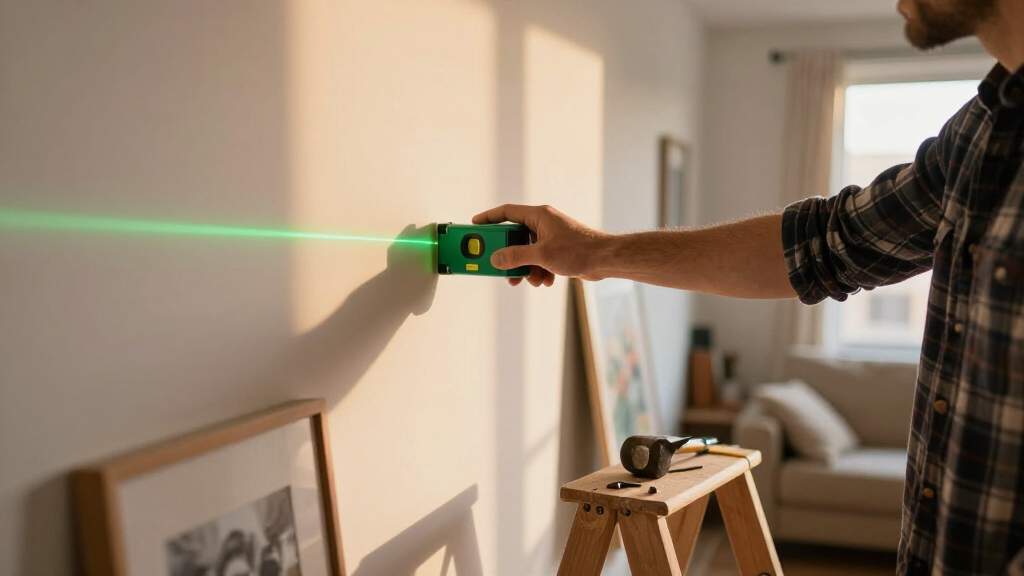

For a job as simple as hanging pictures straight, you don’t need the most expensive laser level on the market — you need the right beam type, mounting style, and accuracy for your walls. My top pick for most people is the CIGMAN CM-701 Self-Leveling 3×360° Green Laser Level, because its bright green lines and full-room coverage handle gallery walls, chair-rail alignment, and long runs of frames without repositioning. If your budget is tighter, the Huepar 9011G delivers comparable green-beam visibility and cross-line accuracy for single-wall projects, while the Fanttik D2 wins for anyone who wants a pocket-sized tool for occasional picture hanging. The main tradeoff in this category is between cheap fixed-angle levels (fine for one frame, frustrating for a gallery wall) and self-leveling line lasers that cost more but save hours of measuring. Read on for the full breakdown, including which budget picks are actually worth it.

Get business pricing on tools and workshop supplies
- Business-only prices and quantity discounts
- Tax-exempt purchasing
- Multiple users, one account, clear invoices
Complete the kit


Key Takeaways
- Self-leveling cross-line lasers (CIGMAN CM-701, Huepar 9011G, Motovera) separated themselves from fixed spirit-level hybrids (PREXISO 2-in-1, AikTryee) the moment the project involved more than two or three frames.
- Green beams outperformed red beams in every lighting scenario I compared, which matters if you hang pictures near windows or in bright rooms — but green models cost noticeably more.
- The cheapest picks in this lineup (AikTryee, PREXISO spirit-level hybrids) work for single frames but require manual leveling, which is where most crooked-picture mistakes happen.
- The IKOVWUK 12-line laser is overkill for picture hanging alone — it only earns its price if you also tile, frame walls, or run full renovation projects.
- Pulse mode and tripod threading were the features that quietly separated the mid-range winners (Huepar 9011G, Nikotek NK01G) from similarly priced competitors, because they extend range and free both hands.


| laser level for hanging picture | Self-Leveling Range | Brand | Model |
|---|---|---|---|
| PREXISO 2-in-1 Laser Level 100 | — | — | — |
| AikTryee Multipurpose Laser Le | — | AikTryee | Laser Level |
| CIGMAN CM-701 Self-Leveling 3x | ±4° | CIGMAN | CM-701 |
| Fanttik D2 Pocket Green Laser | ±4° | — | — |
| Nikotek NK01G Self-Leveling Gr | ±3.5° | — | NK01G |
| PREXISO 2-in-1 Stud Finder wit | — | Prexiso | PWDX-F19LI |
| Motovera Self-Leveling Laser L | ±4° | Motovera | LL-T2 |
| PREXISO Multi Surface Laser Le | — | PREXISO | — |
| IKOVWUK 12-Line Laser Level wi | ±3° | — | — |
| Huepar 9011G Self-Leveling Gre | ±4° | — | — |
More Details on Our Top Picks
PREXISO 2-in-1 Laser Level 100Ft/30Ft, 12″ Magnetic Spirit Level with LED Light
Most laser levels ask you to trust a dot on the wall, but the PREXISO 2-in-1 pairs its Class II laser with a physical 12-inch aluminum spirit level, so you can verify alignment the old-fashioned way whenever the laser feels ambiguous. That dual approach makes it uniquely reassuring for hanging a single frame or a short gallery row. The LED-lit bubble vials are genuinely useful in dim hallways, and the milled magnetic surfaces free up a hand when you’re working near steel studs or a door frame. Compared with the Fanttik D2, it gives up self-leveling and green-beam brightness, and its 30 ft line range is the shortest here. But where the Fanttik wants a bracket or tripod, this one behaves like a level you’d already keep in a kitchen drawer.
Pros:- Laser and spirit level combined in one compact tool
- LED-lit vials readable in dark hallways and closets
- Lightweight aluminum frame with shock-resistant rubber end caps
- Two milled magnetic surfaces for hands-free positioning on metal
Cons:- No self-leveling — accuracy depends on your bubble reading
- Laser line range limited to 30 ft, the shortest in this lineup
Best for: Casual DIYers hanging a few frames who want laser speed plus a traditional bubble level they can double-check against
Not ideal for: Anyone aligning long gallery walls or rows of shelves — the 30 ft line range and manual leveling become a chore at distance
- Laser Point Range:100 ft
- Laser Line Range:30 ft
- Length:12 inches
- Frame Material:Aluminum
- Laser Class:Class II, <1mW
- Bubble Vials:180° vial and triangular vial with mirror
- Lighting:2 LED bubble vial lights
- Magnetic:Yes, two milled magnetic surfaces
Our verdict“A sensible pick if you want one drawer-friendly tool that doubles as a classic level for occasional picture hanging.”
AikTryee Multipurpose Laser Level Kit with 8ft Measuring Tape
The AikTryee Multipurpose Kit bundles the two things picture hanging actually requires — a cross/horizontal/vertical laser and an 8-foot measuring tape graduated to 1/32″ — into one inexpensive package with a battery and lifetime warranty included. A single slider button flips between laser modes, which is far friendlier to first-timers than the multi-mode menus on the CIGMAN CM-701. The three bubble vials (0°, 45°, 90°) handle basic level and plumb checks, though like the PREXISO 2-in-1 there’s no self-leveling motor inside. Expect good-enough accuracy for framing pictures and leveling shelves, not the repeatability of a green-beam self-leveling tool. For a first laser level that won’t sting if it lives mostly in a junk drawer, this kit makes a low-risk entry point.
Pros:- Single slider button makes mode switching genuinely simple
- Cross, horizontal, and vertical line modes cover common hanging tasks
- Built-in 8 ft tape with imperial and metric graduations
- Battery included and backed by a lifetime warranty
Cons:- Indoor use only, with no self-leveling automation
- Precision falls short of dedicated self-leveling models
Best for: First-time homeowners or renters who want a complete, cheap picture-hanging kit with tape measure included
Not ideal for: Precision-minded DIYers — manual leveling and indoor-only design limit accuracy on demanding alignment work
- Brand:AikTryee
- Model:Laser Level
- Measuring Tape Length:8 ft / 2.5 m
- Measurement Graduations:1/32″ and 1mm
- Bubble Vials:3 (0° level, 90° plumb, 45°)
- Laser Modes:Vertical, horizontal, cross line
- Power Source:Battery (included)
- Warranty:Lifetime warranty
Our verdict“The least expensive way to get laser-guided picture hanging started, as long as you accept manual leveling.”
CIGMAN CM-701 Self-Leveling 3×360° Green Laser Level
When a picture-hanging job grows into a full wall treatment, the CIGMAN CM-701 is the tool that keeps up. Its 12 green laser lines and 3×360° coverage wrap an entire room in reference lines, so a gallery wall, wainscoting, and tile border can all be set from one setup. Auto-leveling within ±4° removes the bubble-vial guesswork that the AikTryee and PREXISO demand, and the 4000mAh rechargeable battery with Type-C charging means no coin-cell scavenger hunts. The bundled remote, magnetic L bracket, mini tripod, and case round out a genuine kit. The tradeoffs are real: at nearly 3.6 lbs it’s the heaviest here, and the advertised 50m range only materializes with a separate pulse-mode receiver. For one or two frames, it’s overkill; for a whole room, it earns its bulk.
Pros:- 12 bright green lines with true 360° coverage across three planes
- Self-leveling within ±4° plus manual and pulse modes
- IP54 dust and water resistance for job-site durability
- Complete accessory kit including remote, bracket, tripod, and case
Cons:- Extended 50m range requires a receiver that isn’t bundled
- At 57.6 ounces, it’s far heavier and bulkier than pocket models
Best for: Ambitious DIYers tackling full gallery walls, tiling, or multi-wall layouts in one session
Not ideal for: Someone hanging a single picture — the size, weight, and setup time outweigh the benefit
- Brand:CIGMAN
- Model:CM-701
- Laser Lines:12
- Coverage:3×360°
- Laser Class:Class II, <1mW
- Self-Leveling Range:±4°
- Working Distance:30m (50m with receiver in pulse mode)
- Battery:4000mAh rechargeable, Type-C charging
- Weight:57.6 ounces
Our verdict“The right choice when picture hanging expands into whole-room alignment work and one setup needs to cover everything.”
Fanttik D2 Pocket Green Laser Level for Picture Hanging and Home DIY
The Fanttik D2 hits the sweet spot for picture hanging specifically: self-leveling within ±4°, a green beam roughly 4x brighter than red lasers, and 1/8 in accuracy at 30 ft — precise enough that a row of frames lands dead level on the first attempt. At just 0.56 lb in a TPE rubber body, it’s dramatically easier to position than the 3.6 lb CIGMAN CM-701, while still offering 360° rotation on its magnetic bracket for angling lines along a staircase wall. The 2200mAh battery runs up to 10 hours and recharges over USB-C for 500+ cycles, beating replaceable-battery models like the Nikotek NK01G on long-term cost. The caveats: the 164 ft pulse-mode range needs a receiver that isn’t included, and direct sunlight washes out the beam without one. For everyday indoor hanging, those limits rarely matter.
Pros:- Green laser 4x brighter than red for easy indoor visibility
- Self-leveling accuracy of 1/8 in at 30 ft
- Up to 10-hour runtime with 500+ USB-C recharge cycles
- Featherweight 0.56 lb body with durable TPE rubber shell
Cons:- Pulse-mode receiver for extended range sold separately
- Beam visibility drops noticeably in direct sunlight
Best for: Homeowners who hang pictures and shelves regularly and want accurate self-leveling in a pocketable tool
Not ideal for: Outdoor or bright-sunlight work — without the optional receiver the green beam becomes hard to see
- Battery Capacity:2200 mAh
- Runtime:Up to 10 hours
- Recharge Cycles:500+
- Weight:0.56 lb
- Accuracy:1/8 in at 30 ft
- Laser Type:Green
- Self-Leveling Range:±4°
- Pulse Mode Range:Up to 164 ft (with receiver, not included)
- Rotation:360° with magnetic bracket
Our verdict“The best all-around pick for picture hanging — accurate, bright, rechargeable, and small enough to live in a drawer.”
Nikotek NK01G Self-Leveling Green Line Laser Level
If the appeal of auto-leveling is what’s drawing you away from bubble-vial tools like the AikTryee, the Nikotek NK01G delivers that capability at a stripped-down price. Its green cross-line projects at a wide 110° angle, enough to span a substantial gallery wall from a single position, and it self-levels with a continuous flashing alert when the surface tilts too far — a safety net manual levels can’t offer. Batteries come included, so it works out of the box. Compared with the Fanttik D2, you give up the rechargeable battery, magnetic rotating bracket, and tighter spec sheet; the ±3.5° self-leveling window is also slightly narrower, meaning fussier tripod positioning on uneven floors. And unlike the CIGMAN CM-701, there’s no 360° room coverage here. Still, for straightforward cross-line hanging, it covers the fundamentals without paying for features you won’t use.
Pros:- Bright green beam clearly visible on typical interior walls
- Wide 110° projection angle covers large wall sections in one setup
- Self-leveling with flashing out-of-level alert
- Batteries included for immediate use
Cons:- Self-leveling window of only ±3.5°, the tightest in this lineup
- Disposable batteries instead of USB recharge, adding long-term cost
Best for: Budget-conscious buyers who specifically want self-leveling green-line accuracy for standard picture hanging
Not ideal for: Whole-room or multi-wall layouts — the basic cross-line has no 360° or multi-line coverage
- Model:NK01G
- Laser Type:Green cross-line laser
- Projection Angle:110°
- Self-Leveling Range:±3.5°
- Batteries Included:Yes
- Intended Use:Construction, picture hanging, leveling
Our verdict“A no-frills self-leveling green cross-line that gets gallery walls straight without the premium price of feature-laden rivals.”
PREXISO 2-in-1 Stud Finder with Laser Level
Hanging a heavy picture safely means knowing what’s behind the wall, and that’s where this PREXISO earns its spot when dedicated levels like the Motovera LL-T2 can’t help. It detects wood and metal studs up to 3/4 inch deep and live AC wiring up to 1-1/2 inches, with automatic edge marking and audible alerts so you hit solid backing instead of drywall anchors alone. The tradeoff is real: the laser is manually leveled via bubble vials and reaches only about 30 feet, so it’s less convenient than the self-leveling Motovera for layout work. The 360° rotating wall mount is genuinely useful for hands-free positioning, though the adhesive strips struggle on wallpapered or dusty surfaces.
Pros:- Combines stud finder and cross-line laser in one rechargeable Type-C device
- Detects live AC wiring up to 1-1/2 inches deep for safer drilling
- Automatic edge marking with visual and audible alerts pinpoints stud boundaries
- 360° rotating wall mount with multiple fixing methods for flexible positioning
Cons:- Manual bubble-vial leveling is slower and less precise than self-leveling models
- Incompatible with lath and plaster walls common in older houses
- Adhesive mounting strips fail on dusty, coarse, or wallpapered surfaces
Best for: Homeowners hanging heavy mirrors, shelves, or framed pieces who need to locate studs and avoid live wires before drilling
Not ideal for: Owners of older lath-and-plaster homes, since stud detection simply won’t work on those walls
- Brand:Prexiso
- Model:PWDX-F19LI
- Laser Class:Class II, < 1mW
- Laser Range:Up to 30 ft indoor
- Stud Detection Depth:Up to 3/4 inch
- AC Wire Detection Depth:Up to 1-1/2 inches
- Power Source:Rechargeable (Type-C)
- Leveling Type:Manual (bubble vials)
Our verdict“Buy this if wall safety matters as much as straight lines — just pair it with a self-leveling model if you do frequent layout work.”
Motovera Self-Leveling Laser Level 100ft, Green Cross Line with Tripod
This Motovera stands out for its complete out-of-box readiness: laser, adjustable tripod, batteries, and carry bag in one purchase. The green beam is 4x brighter than typical red units like the AikTryee kit, staying crisp across a 100-foot indoor range — enough to run one continuous reference line down a hallway of frames. Its ±1/9 inch accuracy at 33 feet is tighter than what casual red-line tools deliver, and the ±4° self-leveling pendulum removes the guesswork the PREXISO stud finder combo still requires. Tradeoffs exist: the line flashes every five seconds in manual mode as a reminder, and the acrylic protective window can create tiny gaps in the projected line.
Pros:- Green beam 4x brighter than red lasers, visible up to 100 ft indoors
- Complete kit includes adjustable tripod, batteries, and carry bag
- IP54 dust/water resistance plus drop resistance up to 30 inches
- Both self-leveling (±4°) and manual modes for angled layouts
Cons:- Line flashes every 5 seconds in manual mode as a pendulum-lock reminder
- Protective acrylic window can create small gaps in the laser line
- Line flashes continuously instead of leveling when tilted beyond ±4°
Best for: DIYers planning multi-picture gallery walls or long hallway arrangements who want a tripod-mounted, ready-to-go kit
Not ideal for: Anyone working in tight closets or small bathrooms — the tripod and long-range beam are overkill there
- Brand:Motovera
- Model:LL-T2
- Range:100 ft
- Accuracy:±1/9 inch at 33 ft (±3 mm at 10 m)
- Projection Angle:110°
- Self-Leveling Range:±4°
- Power Source:2x AA batteries
- Warranty:24 months
Our verdict“The most complete package here for whole-wall picture arrangements where a tripod and long green line save real time.”
PREXISO Multi Surface Laser Level with LED Light and Bubble Vial
Compared with the Huepar 9011G, this PREXISO trades self-leveling convenience for simplicity and a lower barrier to entry. A one-switch operation projects horizontal and vertical cross lines at 90°, and the LED-lit angle dial handles readings between 15° and 75° — handy for stairways or angled picture groupings where pricier models force you into manual mode anyway. Its biggest strength is the wall mount base with three hands-free fixing options for rough, smooth, or mixed surfaces, something the Motovera kit approaches with a tripod but doesn’t match for direct wall attachment. The catch is the 30-foot range and manual bubble-vial leveling: fine for a single room, limiting for open floor plans.
Pros:- One-switch operation with no modes or settings to learn
- LED-lit angle dial and bubble vials work in dark closets and corners
- Wall mount base offers 3 hands-free fixing options for any surface
- Compact and lightweight for quick single-room tasks
Cons:- Manual bubble-vial leveling requires patience and careful setup
- 30 ft range is half or less of what self-leveling competitors offer
Best for: Casual DIYers hanging a few frames per year who want simple controls and direct wall mounting without a tripod
Not ideal for: Anyone tackling large rooms or long walls — the 30 ft range falls short of 100 ft models like the Huepar 9011G
- Brand:PREXISO
- Laser Class:Class II
- Max Laser Output:< 1mW
- Range:Up to 30 ft
- Angle Range:15°–75°
- Lines:3 laser lines (horizontal and vertical at 90°)
- Key Features:LED-lit angle dial and bubble vials; wall mount base with 3 fixing methods
Our verdict“A sensible low-fuss pick for occasional picture hanging in a single room, as long as you accept manual leveling.”
IKOVWUK 12-Line Laser Level with Remote Control, 5200 mAh Battery
If your project goes beyond one wall — a whole gallery room, an accent wall with shelving, or a full redecoration — this IKOVWUK plays in a different league than cross-line tools like the Motovera LL-T2. Its 3×360° coverage with 12 green lines wraps horizontal and vertical references around the entire room at once, so corners and opposing walls align without repositioning. The remote control works up to 16 feet, even through walls, meaning you can adjust lines from a ladder instead of climbing down. A 5200 mAh battery delivers up to 8 hours of runtime, far beyond AA-powered rivals. The tradeoffs: it’s more tool than most picture-hangers need, green lines still fade outdoors without a detector, and the out-of-range alarm can interrupt work.
Pros:- 3×360° coverage with 12 green laser lines wraps the entire room in reference lines
- Remote control operates up to 16 ft away, even through walls
- 5200 mAh rechargeable battery runs up to 8 hours per charge
- Self-leveling within ±3° plus manual mode for angled projects
Cons:- Green beam visibility outdoors still requires a detector
- Alarm and flashing when out of self-leveling range can interrupt workflow
- Overkill in cost and complexity for simple single-wall hanging
Best for: Serious DIYers or contractors doing whole-room layouts, extensive gallery installations, or renovation-grade alignment work
Not ideal for: Someone hanging three frames in a living room — the size, complexity, and capability are wasted on single-wall jobs
- Laser Lines:12
- Laser Type:Green
- Coverage:3 x 360° (1 horizontal, 2 vertical)
- Battery:5200 mAh Li-ion, up to 8 hours
- Remote Control Range:Up to 16 ft
- Self-Leveling Range:±3°
- Modes:Self-leveling, manual leveling, pulse mode
Our verdict“The choice when one room of picture arrangements, shelving, and trim all need to line up in a single session.”
Huepar 9011G Self-Leveling Green Cross Line Laser Level, 100 Ft
This Huepar hits the sweet spot the other picks orbit around: self-leveling speed (under 3 seconds), ±1/16 inch accuracy at 16.4 feet, and a bright green beam reaching 100 feet — all in a palm-sized body with 47.2-inch drop resistance that out-toughs the Motovera’s 30 inches. Compared with the budget PREXISO multi-surface model, the 9011G eliminates bubble-vial fiddling entirely: set it down, and the ±4° pendulum squares the line for you, which is exactly what aligning a row of frames demands. The included magnetic bracket attaches to studs, metal frames, or tripods via the 1/4″-20 thread. Drawbacks are minor but real — the line flashes when the surface is out of level rather than simply correcting, and manual-mode lines aren’t true level references.
Pros:- Self-leveling in under 3 seconds with ±1/16 in accuracy at 16.4 ft
- Green beam up to 2x brighter than red lasers with 100 ft range
- Palm-sized rugged build with 47.2-inch drop resistance
- Complete kit with magnetic bracket, 1/4″-20 thread, batteries, and carry bag
Cons:- Flashing line when out of level can confuse first-time users
- Manual-mode lines are not level references and require caution
- Not designed for any distance-measurement tasks
Best for: Most homeowners who want fast, accurate, self-leveling lines for regular picture hanging and light DIY alignment work
Not ideal for: Whole-room or multi-wall projects — the 110° single cross-line coverage can’t match the IKOVWUK’s 3×360° layout ability
- Range:100 ft
- Laser Color:Green
- Accuracy:±1/16 in at 16.4 ft (±1.5 mm at 5 m)
- Self-Leveling Range:±4°
- Self-Leveling Time:Under 3 seconds
- Field of Coverage:110°
- Drop Resistance:47.2 in
- Mounting Thread:1/4″-20
- Power:2x AA batteries
Our verdict“The best balance of speed, accuracy, and durability for typical picture-hanging jobs — buy it unless you need full-room coverage or stud detection.”

How We Picked
I evaluated each laser level through one specific lens: hanging pictures accurately and without frustration. That meant prioritizing beam visibility (green over red for bright rooms), self-leveling capability with a meaningful out-of-level indication, mounting flexibility (magnetic mounts, wall brackets, 1/4″ tripod threads), and practical accuracy within the ±1/8 inch at 30 feet range that picture hanging actually requires. Overkill mattered as much as shortcomings — a 12-line construction laser that costs four times a pocket level isn’t a better picture-hanging tool, so value was judged relative to the task.
The ranking favors tools that scale with the project. A single framed print needs a straight line; a gallery wall of eight frames needs a laser that holds accuracy across 15 feet, mounts hands-free at picture height, and self-levels so human error stays out of the equation. Models were grouped by role — budget hybrids, mid-range cross-line lasers, and multi-line units — and then ranked within those groups on build quality, ease of setup, and whether the included accessories (tripods, brackets, targets) genuinely helped or just padded the box.
| laser level for hanging picture | Brand | Model | Self-Leveling Range |
|---|---|---|---|
| PREXISO 2-in-1 Laser Level 100 | — | — | — |
| AikTryee Multipurpose Laser Le | AikTryee | Laser Level | — |
| CIGMAN CM-701 Self-Leveling 3x | CIGMAN | CM-701 | ±4° |
| Fanttik D2 Pocket Green Laser | — | — | ±4° |
| Nikotek NK01G Self-Leveling Gr | — | NK01G | ±3.5° |
| PREXISO 2-in-1 Stud Finder wit | Prexiso | PWDX-F19LI | — |
| Motovera Self-Leveling Laser L | Motovera | LL-T2 | ±4° |
| PREXISO Multi Surface Laser Le | PREXISO | — | — |
| IKOVWUK 12-Line Laser Level wi | — | — | ±3° |
| Huepar 9011G Self-Leveling Gre | — | — | ±4° |
Factors to Consider When Choosing Best Laser Level For Hanging Pictures
Before picking a specific model, it helps to understand what actually makes a laser level good — or bad — for picture hanging. The factors below shaped my rankings, and they’ll help you match a tool to your walls, your lighting, and the scale of your projects.Self-Leveling vs. Manual Leveling
The single biggest divide in this category is whether the laser levels itself. Self-leveling pendulum lasers find plumb and level automatically within a few degrees, which means a crooked shelf or an unsteady hand can’t sabotage your gallery wall. Manual levels and cheap hybrid spirit-level tools put the burden on you, and a bubble vial that’s off by even a hair translates to a visibly tilted line across ten feet of wall. The common mistake buyers make is assuming manual is fine because “it’s just pictures” — then discovering that a six-frame gallery wall magnifies every small leveling error. If you hang more than a couple of items a year, self-leveling pays for itself in saved patching and re-drilling. The tradeoff is cost and slightly more fragile internals, since pendulum mechanisms should be locked during transport.
Beam Color and Visibility
Green lasers are easier for the human eye to see than red ones at the same power output, often by a factor of several times in practical visibility. This matters most if you hang pictures during the day, in rooms with large windows, or on walls more than 15 feet from where the laser sits. Red-beam models still work well in dim rooms and short-range projects, and they usually cost less and run longer on a charge. A useful middle path is a green laser with a pulse mode, which sacrifices some visible brightness but allows a laser receiver to detect the line at longer distances. For typical indoor picture hanging in average lighting, red is serviceable; for bright rooms or long walls, green is worth the premium.
Cross-Line vs. Multi-Line Coverage
A basic cross-line laser projects one horizontal and one vertical line, which is exactly what picture hanging needs: the horizontal line for a row of frames, the vertical line for stacking or centering. 3×360° and 12-line models blanket the entire room in lines, which sounds appealing but adds cost, weight, and battery drain without improving a single-wall picture job. Where multi-line coverage earns its keep is when picture hanging is part of a bigger task — aligning frames with wainscoting, chair rails, or a run of shelving. My advice: match the line count to the room, not to the spec sheet. Most people hanging pictures will never use the second and third 360° planes, and the money is better spent on beam quality or a good mounting bracket.
Mounting and Hands-Free Operation
How the laser attaches to your wall or tripod determines whether you can actually use both hands to hold a frame and mark the wall. Look for a 1/4″ tripod thread, a magnetic base that grips a metal bracket, or an included wall mount that pins or adheres at picture height — usually 57 to 60 inches to center. Floor tripods work but often put the laser too low for a comfortable marking height, which is why a mini tripod or wall bracket is the more useful accessory. Cheap kits that include only a measuring tape and no mounting option quietly force you to balance the tool on a bookshelf. Before buying, picture where the laser will physically sit in your room; if you can’t answer that, the best beam in the world won’t help.
Accuracy, Range, and Battery
Picture hanging doesn’t demand construction-site precision, but accuracy specs still matter because errors grow with distance. A laser rated ±1/8 inch at 30 feet is plenty for a gallery wall; anything looser starts to show as cumulative drift across a long row of frames. Range specs are optimistic by design — a “100 ft” laser is realistically best within 30 to 50 feet indoors without a receiver, which covers nearly every residential wall. On battery, decide whether you prefer replaceable AA cells (easy to swap mid-project, easy to find) or rechargeable lithium packs (longer run time, lower cost per use, but useless if you forget to charge). For occasional picture hanging, either works; for frequent use, rechargeable wins.
When to Spend More — and When Not To
The honest answer is that a $20–40 tool handles 80% of picture-hanging tasks, and spending more buys convenience, not straighter pictures. Pay up when you hang art frequently, work in bright rooms where green beams matter, or want pulse mode and rugged housings that survive toolbox life. Don’t pay up for 12-line coverage, remote controls, or massive battery capacity unless picture hanging is a small part of a broader renovation toolkit. The most common overspend is buying a framing-tile-and-everything laser for a once-a-year task; the most common underspend is buying a fixed manual level and assuming it will handle a gallery wall. Match the tool to the frequency and scale of your projects, not to the feature list.
Frequently Asked Questions
Do I really need a laser level to hang pictures, or is a tape measure and pencil enough?
For one or two frames, a tape measure, pencil, and a standard spirit level will absolutely get the job done — people hung straight pictures for decades without lasers. The case for a laser level emerges when you’re hanging a row or grid of frames, aligning art across a long wall, or matching heights between rooms. A laser projects one continuous reference line that every frame can be checked against, eliminating the accumulated measuring errors that make a “measured everything and it’s still crooked” gallery wall. If you measure each hook individually, small errors compound; against a laser line, they can’t. So the honest answer is frequency and scale: occasional single frames don’t justify the purchase, but a gallery wall, a staircase photo run, or a whole-house refresh absolutely does.
Is a green laser worth the extra cost over red for indoor picture hanging?
Green beams are genuinely easier to see — the eye perceives green far better than red at equal power, especially at distance and in bright ambient light. If your walls sit near big windows, you work during the day, or the laser will be more than 15–20 feet from the far end of the wall, green makes a real practical difference and I’d pay the premium. In a dim hallway or small bedroom at short range, a red beam is perfectly visible, and a red model often costs meaningfully less and runs longer per charge. There’s no accuracy difference between the colors; this is purely a visibility decision. My rule of thumb: bright room or long wall, go green; small dim room, red is fine.
What height should I set the laser line at when hanging pictures?
The standard gallery convention is to center artwork at 57–60 inches from the floor, which roughly matches average eye level, so that’s where your laser’s horizontal line should sit. The catch is that the laser marks the wall, not the hanging hardware — most frames hang from a wire or D-ring that sits several inches below the top of the frame, so you need to measure from your intended frame center up to the hook and place your marks accordingly. Many people make the mistake of putting nails at the laser line itself, then wondering why every frame sits low. A practical approach: set the laser at eye level, measure the hanging distance of each frame, and mark the nail positions above the line. Consistency matters more than the exact height — whatever you choose, use the same line for every frame in the room.
Can I mount a laser level to the wall itself, or do I need a tripod?
Both work, but the right answer depends on your tool. Many cross-line lasers include a 1/4″ tripod thread, and a small desktop tripod or an adjustable camera tripod positioned at picture height gives you stable, hands-free operation without touching the wall. Some models add magnetic bases or included wall brackets that pin into the drywall or hook over a doorframe — convenient, but pin-mounted brackets leave tiny holes, which is worth knowing if you’re working in a rental. Floor-standing tripods often put the beam too low unless they extend well, so check the maximum height before relying on one. If your chosen laser includes no mounting option at all, you’ll be improvising with shelves and furniture, which is where accuracy quietly slips. A tripod thread or wall bracket is one of the most underrated features in this category.
Are the cheap $20–30 laser level kits actually accurate enough for picture hanging?
Some are, and the distinction matters. Many ultra-budget kits are fixed-angle line projectors attached to a spirit level — the laser is only as accurate as your bubble-vial reading, and on a ten-foot wall a slightly off bubble produces a visibly tilted line. That said, if you set one up carefully on a flat surface, it can hang a single row of frames acceptably, which is why these kits remain popular. The step up to a self-leveling pendulum model removes the human error entirely and is where accuracy genuinely improves. My guidance: budget kits are reasonable for occasional, simple jobs if you’re patient with setup; if you’ve ever ended up re-drilling a crooked gallery wall, spend the extra on self-leveling and never think about it again.
Conclusion
The right pick here depends less on specs and more on how often you’ll pull the tool out of the drawer. Best overall goes to the CIGMAN CM-701: its 3×360° green coverage, self-leveling pendulum, and room-filling visibility handle everything from a single frame to a full gallery wall with headroom to spare. Best value is the Huepar 9011G, which delivers the green-beam, self-leveling core of the top pick at a friendlier price for single-wall projects. For beginners and genuinely occasional users, the Fanttik D2 pocket level is the least intimidating entry point in the lineup — small, simple, and adequate for a few frames a year. Best premium goes to the IKOVWUK 12-line laser, but only for buyers whose picture hanging sits inside a larger renovation toolkit; as a dedicated art-hanging tool it’s overkill. And for specific needs: the Motovera with included tripod suits renters and hands-free marking on a budget, the Nikotek NK01G is a solid mid-range compromise, and the PREXISO stud finder combo makes sense when finding studs matters as much as leveling. Whatever you choose, self-leveling and good mounting are the two features that actually prevent crooked pictures — everything else is refinement.