
The best garage ceiling heaters balance useful heat, installation demands, and the size and insulation of your workspace. My best overall pick is the Dr. Infrared Heater DR-975, a hardwired 7,500-watt electric model that offers a strong middle ground between output and practicality. For gas-heated spaces, the Heatstar MH25NG is a distinct radiant option, while the Mr. Heater Big Maxx suits buyers seeking much higher forced-air output. The main tradeoffs are electric versus gas installation, radiant versus fan-forced warmth, and simple controls versus connected features. Read on for the full breakdown and help matching a heater to your garage.

Get business pricing on tools and workshop supplies
- Business-only prices and quantity discounts
- Tax-exempt purchasing
- Multiple users, one account, clear invoices
Complete the kit



Key Takeaways
7,500-watt electric heaters are the lineup’s middle ground: the DR-975, InoKraft, VEVOR, and TEMPWARE share a broad output class, but their controls and feature emphasis differ.
Gas models serve a different installation path: the Heatstar MH25NG uses radiant natural-gas heat, while the Big Maxx is a much higher-output forced-air unit; neither is a direct swap for a 240-volt electric heater.
Maximum wattage is not the whole decision: the 10,000-watt CTSC and GASLAND models need suitable 240-volt circuits, so electrical capacity may matter more than their higher output.
Controls separate otherwise similar electric picks: VEVOR adds a remote, TEMPWARE offers Wi-Fi app control, and simpler models may suit buyers who prefer fewer connected features.
Small-zone and whole-garage heating call for different formats: the Shinic two-pack offers modest 120-volt units for localized warmth, while the larger hardwired and gas-fired models target more demanding spaces.



| garage ceiling heater | Voltage | Amperage | Mounting | Model |
|---|---|---|---|---|
| Heatstar by Enerco MH25NG Radi | — | — | — | — |
| Dr. Infrared Heater DR-975 750 | 240V | 31.25A | Wall or ceiling | DR-975 |
| Omberr 4000W Electric Garage H | 240V | 16.6A | — | GHA40 |
| Mr. Heater 5,000W Ceiling Moun | 240V | 30A | Ceiling mount | 2VAHG5000 |
| Shinic 2-Pack 120V Ceiling-Mou | 120V | — | Ceiling mount | — |
| CTSC 10,000W Electric Garage H | 240V | 42A | Ceiling or wall | — |
| Comfort Zone 5,000-Watt Hardwi | 240V | — | Ceiling | CZ220BK |
| InoKraft 7,500W Electric Garag | 240V | 31.25A | Wall or ceiling | IK05088001 |
| Mr. Heater Big Maxx 50,000 BTU | — | — | Ceiling | F260550 |
| VEVOR 7500W Electric Garage He | 240V | 31.25A | Wall or ceiling | — |
| TEMPWARE 7500W Electric Garage | 240V | 31.25A | — | — |
| GASLAND 10,000W Electric Garag | 240V | 50A | — | — |
More Details on Our Top Picks
Heatstar by Enerco MH25NG Radiant Overhead Garage Heater, Natural Gas
For a garage with an existing natural-gas connection, the Heatstar MH25NG stands apart from the electric ceiling heaters here: its 25,000-BTU radiant system needs no electricity, so it can keep providing heat during a power outage. Radiant heat warms people and surfaces directly rather than relying on a fan to move warm air, which suits a work area where you want warmth focused below the unit. Its quiet operation and lack of moving parts also mean fewer components to maintain than the Mr. Heater 5,000W fan-forced model. The tradeoff is installation: this is not a plug-in option and requires a professional gas connection and wiring. Its listed coverage is 500–600 square feet, and output needs derating above 2,000 feet of elevation. I would skip it for sleeping spaces, mobile homes, and RVs.
Pros:- Operates without electricity, providing heat during power outages
- Radiant infrared heat warms people and objects directly
- Quiet operation with no moving parts to service
- Non-corrosive construction is suited to long-term garage use
Cons:- Requires a professional gas connection and wiring installation
- Needs output derating at elevations above 2,000 feet
- Not intended for sleeping quarters, mobile homes, or recreational vehicles
Best for: Owners of a 500–600-square-foot garage or workshop with natural gas who want radiant heat that can operate during power outages.
Not ideal for: People without a natural-gas line, anyone seeking a simple DIY installation, or buyers heating sleeping quarters, mobile homes, or RVs.
- Fuel type:Natural gas
- Heat output:25,000 BTU
- Coverage area:500–600 sq. ft.
- Heating method:Radiant infrared
- Power requirement:Gas-powered; no electricity required
- Dimensions:12 × 29.75 × 9 in.
- Included components:Thermostat and mounting brackets
Our verdict“Choose the Heatstar if your garage has natural gas and outage-ready radiant heat matters more than easy electric installation.”
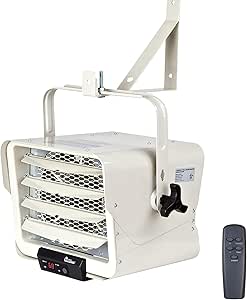
Dr. Infrared Heater DR-975 7500-Watt Hardwired Electric Garage Heater
The Dr. Infrared DR-975 is the stronger fit when you want a hardwired ceiling heater to circulate warm air across a larger garage, with stated coverage up to 800 square feet. Its forced-air design and five adjustable louvers let you direct airflow, unlike the radiant Heatstar MH25NG, which heats people and surfaces more directly. A remote-controlled thermostat adds convenience once the heater is mounted out of reach, and the included bracket supports either wall or ceiling installation. Those advantages come with electrical planning: it runs on 240 volts, requires hardwiring, and does not include a power cord. The listed power is 4,700W/7,500W, so buyers should confirm their circuit and installation needs rather than assume it is a plug-in appliance. Compared with the Mr. Heater 5,000W, this model claims broader coverage, but has a one-year limited parts-and-components warranty.
Pros:- Stated coverage reaches up to 800 square feet
- Five adjustable louvers help direct warm airflow
- Remote-controlled thermostat is convenient for a mounted unit
- Can be mounted on a wall or ceiling
Cons:- Requires 240V hardwiring and does not include a power cord
- An optional external wall thermostat is sold separately
- Warranty is limited to one year for parts and components
Best for: Homeowners with a suitable 240V circuit who need forced-air heat and adjustable airflow in a large garage or workshop.
Not ideal for: Renters, buyers seeking a plug-in heater, or anyone who cannot arrange hardwiring and verify electrical capacity.
- Model:DR-975
- Power:4,700W / 7,500W
- Voltage:240V
- Amperage:31.25A
- Heating method:Forced air
- Coverage:Up to 800 sq. ft.
- Mounting:Wall or ceiling
- Thermostat range:50–85°F in description; 70–85°F in specifications
- Louvers:Five adjustable
Our verdict“Pick the DR-975 for a large garage needing remote-controlled forced-air heat, provided you can handle its hardwired 240V installation.”
Omberr 4000W Electric Garage Heater with Graphene Heating
The Omberr GHA40 offers more control and placement choices than the ceiling-focused Mr. Heater 5,000W: its mounting options include ceiling, wall, tabletop, and floor, while the remote and digital display make temperature and timer adjustments accessible. The 4,000W output and 240V supply suit buyers who want a compact electric heater for a garage or workshop, and its 40–90°F range plus a timer of up to nine hours can help tailor operation to a work session. Graphene heating elements are presented as a fast-conduction feature, but the product data does not provide a coverage rating, so I would not assume it matches larger units’ reach. It also requires hardwiring and is listed for indoor use only. The versatile mounting is useful, but buyers wanting a straightforward ceiling-only installation may find the extra placement options less relevant.
Pros:- Remote control and digital display simplify adjustments
- Timer can be set from 0.5 to 9 hours
- Ceiling, wall, tabletop, and floor mounting options
- Built-in overheat protection and automatic cooling fan
Cons:- Requires 240V hardwiring and has no plug included
- No coverage-area figure is provided in the product data
- Listed for indoor use only
Best for: Workshop owners with a 240V supply who want remote temperature and timer controls plus the option to change mounting location.
Not ideal for: Buyers who need a stated large-area coverage rating, a plug-in setup, or a heater for outdoor spaces.
- Model:GHA40
- Power output:4,000W
- Voltage:240V
- Amperage:16.6A
- Temperature range:40–90°F (4–35°C)
- Timer:0.5–9 hours
- Mounting options:Ceiling, wall, tabletop, or floor
- Dimensions:7.6 × 21.73 × 5.43 in.
- Weight:13.3 lb.
Our verdict“Choose the Omberr when adjustable placement and timed remote control matter more than a documented coverage range or higher heat output.”
Mr. Heater 5,000W Ceiling Mount Garage Utility Heater
For buyers who want a dedicated ceiling installation without moving up to the DR-975’s stated 800-square-foot coverage, the Mr. Heater 5,000W offers a useful middle ground. Its fan-forced heat serves spaces up to 590 square feet, and three settings—5,000W, 4,000W, and 3,000W—let you reduce output when full power is unnecessary. The tilting head and adjustable louvers help aim airflow toward a workbench or vehicle, a more direct setup than the Omberr GHA40, which offers more mounting positions but lower output. All-metal construction suits a utility-room environment, though this is still a fixed 240V/30A hardwired heater, not a portable option. It also needs indoor installation. I would favor it over the Shinic pair for heating a larger area, but the Shinic heaters are easier to plug in on a standard 120V circuit.
Pros:- Three heat settings provide output choices from 3,000W to 5,000W
- Tilting head and adjustable louvers direct airflow
- Ceiling mounting frees floor space
- All-metal construction is suited to garage and utility-room use
Cons:- Requires a 240V/30A hardwired connection
- Indoor use only
- Coverage is stated up to 590 square feet, below the DR-975’s stated 800 square feet
Best for: Garage owners with a 240V/30A circuit who want a ceiling-mounted fan heater with selectable output and directional airflow.
Not ideal for: People without hardwiring capacity, anyone needing outdoor heat, or buyers who want a portable or standard 120V solution.
- Model:2VAHG5000
- Heat settings:5,000W / 4,000W / 3,000W
- Heat output:17,060 BTU
- Voltage:240V
- Amperage:30A
- Coverage area:Up to 590 sq. ft.
- Mounting:Ceiling mount
- Dimensions:10.75 × 14 × 13 in.
- Thermostat range:40–120°F
Our verdict“Choose this Mr. Heater for adjustable, ceiling-mounted forced-air heat in a mid-sized garage with the required 240V circuit.”
Shinic 2-Pack 120V Ceiling-Mounted Electric Garage Heater, 1500W/750W
The Shinic two-pack is the easiest electrical fit in this group for a garage without a 240V circuit: each heater uses a grounded 120V plug and offers 750W or 1,500W settings. That makes installation less involved than the hardwired Mr. Heater 5,000W, though it also means substantially less heating output per unit. These are radiant quartz heaters, so they warm people and objects in their path rather than circulating air throughout a large garage. The adjustable 90-degree angle helps aim warmth at a bench, and the built-in halogen work light adds practical illumination. Two units give buyers more than one focused heat zone, but they still need ceiling mounting and won’t replace a high-output heater for a cold, expansive space. I’d choose them for localized tasks, not whole-garage heating.
Pros:- Two heaters are included for separate work areas
- Standard 120V grounded plug avoids the 240V hardwiring required by the Mr. Heater 5,000W
- 750W and 1,500W settings with adjustable aiming
- Built-in halogen work light and overheat auto-off
Cons:- Lower output per unit than the hardwired garage heaters in this lineup
- Radiant warmth is focused on people and objects in front of each heater
- Requires ceiling mounting
Best for: DIYers with a standard 120V outlet who want two ceiling-mounted radiant heaters for focused warmth and work lighting near separate benches.
Not ideal for: Owners of large, poorly insulated garages who need whole-space heat or buyers who cannot mount heaters overhead.
- Quantity:Two heaters
- Voltage:120V
- Wattage:750W / 1,500W
- Heating type:Radiant quartz
- Mounting:Ceiling mount
- Adjustability:Rotates up to 90°
- Settings:Five heat and light modes
- Safety:Overheat auto-off, 3-prong grounded plug, metal housing, ETL listed
- Weight:5.51 lb.
Our verdict“Pick the Shinic pair for focused heat and work lighting in small zones when a standard 120V plug matters more than whole-garage output.”
CTSC 10,000W Electric Garage Heater, 240V, Fan-Forced, Ceiling or Wall Mount
The CTSC 10,000W makes the most sense when a 240V electric heater needs to cover a larger garage without moving to gas. Its stated coverage reaches up to 1,000 sq. ft., exceeding the 750-square-foot InoKraft and VEVOR options, while wall or ceiling mounting and adjustable airflow help aim warmth where it is useful. ECO mode, a timer, remote, and panel controls give it more operating flexibility than the simpler dial controls on the Comfort Zone.
The tradeoff is substantial electrical commitment: this unit draws 42A and requires hardwiring, with no power cord included. It also reaches 58 dB, so it is not a quiet choice for a work area where fan noise matters. I would shortlist it for a spacious garage with suitable wiring and professional installation, but not for a small space or a plug-in setup.
Pros:- Rated to heat spaces up to 1,000 sq. ft.
- High and low output plus ECO/auto and fan-only modes
- Remote, digital panel controls, and a 1–10-hour timer
- Ceiling or wall mounting with adjustable airflow
Cons:- 42A draw may require substantial electrical capacity
- Hardwired installation is recommended for a qualified electrician; no power cord is included
- Fan noise reaches up to 58 dB
Best for: Owners of larger garages or workshops with a suitable 240V circuit who want electric heat, adjustable airflow, and remote controls.
Not ideal for: DIY buyers seeking a plug-in heater, or owners of smaller garages who do not need its high electrical draw and output.
- Power:10,000W high / 5,000W low
- Voltage:240V
- Amperage:42A
- Heating output:34,130 BTU
- Heating coverage:Up to 1,000 sq. ft.
- Mounting:Ceiling or wall
- Heat settings:High, low, ECO/auto, fan only
- Installation:Hardwired; power cord not included
Our verdict“Choose the CTSC for a large, electrically equipped garage where its higher output and flexible controls justify hardwired installation.”
Comfort Zone 5,000-Watt Hardwired Ceiling-Mount Garage Heater
The Comfort Zone CZ220BK is the straightforward pick for buyers who want a fixed ceiling heater without the extra modes and remote controls found on the CTSC or VEVOR. Its 5,000W fan-forced output, adjustable louvers, and adjustable mounting angle let you direct heat toward a bench or work zone while keeping the floor clear. Heavy-gauge steel and overheat shutoff suit a practical garage setup, and the power indicator makes it easier to see when the unit is on.
That simplicity also limits flexibility: it has a manual dual-knob control rather than a digital thermostat, timer, or remote. Its 240V hardwired installation needs planning, and ceiling mounting narrows placement choices compared with wall-or-ceiling models such as the InoKraft. I would favor it for targeted heating in a modest workspace, not for large garages needing high output or programmable operation.
Pros:- Ceiling installation keeps floor space clear
- Adjustable louvers and mounting angle help direct airflow
- Heavy-gauge steel construction
- Overheat sensor, thermal cut-out, and power indicator
Cons:- Requires 240V hardwired installation
- Manual controls lack a timer, remote, and digital thermostat
- Ceiling-only mounting can restrict placement
Best for: Garage owners who want a durable, ceiling-mounted heater for a defined work area and prefer simple manual controls.
Not ideal for: Buyers who need remote operation, a timer, digital temperature settings, or flexible wall mounting.
- Model:CZ220BK
- Power:5,000W
- Voltage:240V
- Mounting:Ceiling
- Heating method:Fan-forced
- Controls:Dual-knob thermostat and on/off control
- Construction:Heavy-gauge steel
- Compliance:ETL compliant
Our verdict“Pick the Comfort Zone for durable, targeted ceiling heat with uncomplicated manual operation rather than the added controls of the CTSC.”
InoKraft 7,500W Electric Garage Heater, 240V
The InoKraft 7,500W sits between the Comfort Zone’s simpler 5,000W setup and the higher-output CTSC, making it a balanced choice for garages rated up to 750 sq. ft. Its digital thermostat spans 40–99°F, and ECO mode and a 1–24-hour timer give buyers more scheduling control than the Comfort Zone’s manual knobs. Wall-or-ceiling mounting and adjustable louvers also make it easier to fit the heater to the room and aim the airflow.
That flexibility comes with electrical and installation demands: it runs on 240V at 31.25A, and the supplied data calls for a professional electrician. The listed NEMA 14-50P plug and 8.2-foot cord sit uneasily beside that installation guidance, so I would confirm the intended wiring arrangement before buying. At up to 65 dB, it is also louder than the CTSC’s stated maximum. It suits buyers who value temperature range and scheduling more than quiet operation.
Pros:- 7,500W output rated for spaces up to 750 sq. ft.
- Digital thermostat covers 40–99°F with ECO mode
- Timer can be set for 1–24 hours
- Wall or ceiling mounting with adjustable louvers
Cons:- Requires 240V power and professional installation
- Listed noise level reaches 65 dB
- Plug and cord details should be checked against the installation requirements
Best for: Owners of medium-to-large garages who want a broad thermostat range, a long timer, and the choice of wall or ceiling mounting.
Not ideal for: Buyers with no 240V supply, those wanting quiet operation, or anyone who needs a clearly plug-and-play installation.
- Model:IK05088001
- Power:7,500W
- Voltage:240V
- Amperage:31.25A
- Heating coverage:750 sq. ft.
- Temperature range:40–99°F
- Mounting:Wall or ceiling
- Timer:1–24 hours
- Noise level:65 dB
Our verdict“Choose the InoKraft over the Comfort Zone if you want more precise temperature and timer control for a 750-square-foot-class garage.”
Mr. Heater Big Maxx 50,000 BTU Forced-Air Unit Heater
For a large garage where electric output is not the right fit, the Mr. Heater Big Maxx offers a different scale of heating: 50,000 BTU and stated coverage up to 1,667 sq. ft. It runs on natural gas or propane, so it can suit spaces where a gas line or propane setup is available. The included ceiling brackets and NG-to-LP conversion kit add mounting and fuel flexibility that the electric CTSC and InoKraft do not provide.
This is not the easy alternative to an electric ceiling heater. The unit weighs 60.3 pounds, needs gas installation, and calls for at least 10-foot ceilings with 8 feet of clearance below. A thermostat is sold separately, while the electric models in this roundup provide built-in controls. I would shortlist the Big Maxx for a spacious, high-ceiling garage with appropriate fuel access, and skip it for low ceilings or buyers seeking a simpler electric installation.
Pros:- 50,000 BTU output for spaces rated up to 1,667 sq. ft.
- Supports natural gas or propane
- Includes ceiling-mount angle brackets and an NG-to-LP conversion kit
- Compatible with 24V or Wi-Fi-enabled thermostats
Cons:- Thermostat is sold separately
- Requires at least 10-foot ceilings and 8 feet of clearance below
- At 60.3 lb, installation requires planning and suitable support
Best for: Owners of large, high-ceiling garages, barns, or workshops with natural gas or propane access and room for required clearances.
Not ideal for: People with low ceilings, limited clearance, no gas or propane setup, or a preference for an all-electric heater with built-in controls.
- Model:F260550
- Heat output:50,000 BTU
- Heating coverage:Up to 1,667 sq. ft.
- Fuel:Natural gas or propane
- Mounting:Ceiling
- Power requirement:120V AC
- Dimensions:24 × 25.5 × 13 in.
- Weight:60.3 lb
- Clearance:At least 8 ft below the heater and 1 in above
Our verdict“Choose the Big Maxx when a large garage has gas access and sufficient ceiling clearance; for electric heat or lower ceilings, favor a smaller electric model such as the CTSC.”
VEVOR 7500W Electric Garage Heater with Remote Control
The VEVOR 7,500W is a strong match for buyers who want substantial electric heat with fewer trips to a wall control. It is rated for up to 732 sq. ft., close to the InoKraft’s 750-square-foot claim, and offers both wall and ceiling mounting. A digital thermostat, remote, and 9-hour timer make routine adjustments easier than the manual controls on the Comfort Zone, while ETL listing and overheat protection add safety provisions.
Its timer is shorter than the InoKraft’s 24-hour option, and the stated coverage is slightly smaller. The heater also draws 31.25A on 240V and requires a dedicated breaker rated above 32A; hardwired installation may call for an electrician. The remote needs batteries that are not included. I would choose it for convenient, scheduled heating in a suitable electrical setup, but not for buyers who need a longer timer or lower-power operation.
Pros:- 7,500W output rated for up to 732 sq. ft.
- Remote control and digital thermostat
- 9-hour timer for scheduled operation
- Wall or ceiling mounting, ETL listing, and overheat protection
Cons:- Needs 240V power and a dedicated breaker rated above 32A
- Hardwired installation may require professional electrical help
- Timer is shorter than the InoKraft’s 24-hour setting, and remote batteries are not included
Best for: Owners of garages around 732 sq. ft. who want remote temperature adjustment and a straightforward 9-hour timer.
Not ideal for: Buyers who need a 24-hour timer like the InoKraft, lack a suitable 240V circuit, or want to avoid hardwired installation.
- Power output:7,500W
- Heating coverage:Up to 732 sq. ft.
- Voltage:240V
- Amperage:31.25A
- Mounting:Wall or ceiling
- Controls:Remote control and digital thermostat
- Timer:9 hours
- Safety certification:ETL listed
Our verdict“Pick the VEVOR over the Comfort Zone if remote operation matters, and over the InoKraft if a 9-hour timer meets your schedule.”
TEMPWARE 7500W Electric Garage Heater with WiFi App Control, 240V Hardwired Ceiling Mount
The TEMPWARE GR7500ERSC-EC N pairs 7,500W of ceiling-mounted heat with WiFi app, remote, and touch-panel controls, giving workshop owners more ways to adjust warmth than the remote-only GASLAND EGH100. Its stated coverage reaches 1,250 sq. ft., making it a fit for a broad garage or work area where keeping the floor clear matters. The ECO mode and 12-hour timer add ways to manage operation, while the thermostat range of 45°F to 95°F allows a range of temperature settings. The tradeoff is that its 7,500W output is below the GASLAND’s 10,000W, and the TEMPWARE needs a dedicated 240V circuit and professional hardwired installation. I’d choose it for flexible controls, not for the highest heat output.
Pros:- WiFi app, remote, and touch-panel controls offer several ways to adjust settings.
- 7,500W output is specified for spaces up to 1,250 sq. ft.
- ECO mode and a 12-hour timer support scheduled, more controlled operation.
- Ceiling mounting keeps the heater off valuable garage floor and bench space.
Cons:- Requires professional hardwired installation and a dedicated 240V circuit rated for its 31.25A draw.
- Power cord is not included.
- Its 7,500W output is lower than the GASLAND EGH100’s 10,000W.
Best for: Garage workshop owners with a suitable 240V circuit who want app-based temperature adjustments and ceiling-mounted heating for a space within the stated 1,250 sq. ft. coverage.
Not ideal for: Renters, DIY installers without electrical expertise, or owners of spaces that call for the higher 10,000W output of the GASLAND EGH100.
- Power output:7,500W
- Heat output:25,590 BTU
- Voltage:240V
- Amperage:31.25A
- Coverage area:Up to 1,250 sq. ft.
- Temperature range:45°F–95°F
- Controls:WiFi app, remote, and touch panel
- Mounting and installation:Ceiling mount; hardwired, professional installation required
- Construction:Steel
Our verdict“Choose the TEMPWARE if app control and broad stated coverage matter more to you than the GASLAND’s higher wattage.”
GASLAND 10,000W Electric Garage Heater, 240V Hardwired Fan-Forced Ceiling Mount Space Heater
For buyers prioritizing heat output, the GASLAND EGH100 leads this pair with 10,000W and 34,000 BTU/hour, compared with the TEMPWARE’s 7,500W and 25,590 BTU. Its stated coverage is 1,000 sq. ft., so the higher output does not translate into a larger rated area; it makes more sense for buyers who want a more powerful unit within that footprint. The included remote adjusts temperature, modes, and a 1–9-hour timer from the floor, and its 45°F–99°F range extends slightly higher than the TEMPWARE’s. ETL listing and overheat shutoff add safety features. The cost of this output is a 50A, 240V hardwired installation, plus the need for sturdy ceiling support for its 26-pound body.
Pros:- 10,000W and 34,000 BTU/hour provide higher output than the TEMPWARE’s 7,500W.
- Included remote controls temperature, modes, and the 1–9-hour timer.
- ETL-listed with overheat protection that shuts off power if airflow is blocked.
- ECO mode reduces power consumption as the target temperature approaches.
Cons:- Requires professional hardwiring to a 240V circuit with a 50A draw.
- At 26 lbs, it needs sturdy ceiling support.
- Its stated coverage of 1,000 sq. ft. is less than the TEMPWARE’s 1,250 sq. ft.
Best for: Owners of garages or workshops up to the stated 1,000 sq. ft. who have a suitable 50A, 240V circuit and want more output than a 7,500W ceiling heater provides.
Not ideal for: Buyers whose priority is app control, broader stated coverage, or a less demanding electrical installation; the TEMPWARE offers app controls and lists coverage up to 1,250 sq. ft.
- Power output:10,000W
- Heat output:34,000 BTU/hour
- Voltage:240V
- Amperage:50A
- Coverage area:Up to 1,000 sq. ft.
- Temperature range:45°F–99°F
- Mounting and installation:Ceiling mount; hardwired, professional installation required
- Dimensions and weight:14.4 × 14.6 × 14.1 in.; 26 lbs
- Certification:ETL Listed, Cert. #4003787
Our verdict“Pick the GASLAND if higher heater output is your priority and your garage can support its 50A hardwired installation.”

How We Picked
I compared each heater on the factors that determine whether it works as an overhead garage solution: heat output and heat delivery, power source, mounting format, controls, and the installation work likely required. I also considered whether each design fits a smaller work area, a typical insulated garage, or a space that calls for higher-output heating. Gas and electric units are judged against their own installation needs rather than treated as interchangeable.
The order prioritizes useful balance and fit for a broad range of buyers, then distinguishes specialist picks by their strengths. The DR-975 leads for its 7,500-watt hardwired electric format; the radiant Heatstar and high-output Big Maxx follow as clear alternatives for buyers with compatible fuel and venting plans. Higher wattage alone does not move a model up the ranking: circuit requirements, controls, and whether the heater suits the intended zone all affect its place. Product details provided do not establish coverage area or installation suitability for every garage, so I avoid treating a single output figure as a guarantee of performance.
| garage ceiling heater | Mounting |
|---|---|
| Heatstar by Enerco MH25NG Radi | — |
| Dr. Infrared Heater DR-975 750 | Wall or ceiling |
| Omberr 4000W Electric Garage H | — |
| Mr. Heater 5,000W Ceiling Moun | Ceiling mount |
| Shinic 2-Pack 120V Ceiling-Mou | Ceiling mount |
| CTSC 10,000W Electric Garage H | Ceiling or wall |
| Comfort Zone 5,000-Watt Hardwi | Ceiling |
| InoKraft 7,500W Electric Garag | Wall or ceiling |
| Mr. Heater Big Maxx 50,000 BTU | Ceiling |
| VEVOR 7500W Electric Garage He | Wall or ceiling |
| TEMPWARE 7500W Electric Garage | — |
| GASLAND 10,000W Electric Garag | — |
Factors to Consider When Choosing Best Garage Ceiling Heaters
Choosing a ceiling heater starts with the garage and its utilities, not the largest number on the product page. These broader checks can prevent an undersized purchase, an electrical upgrade surprise, or a heater that warms the wrong part of the room.
Match Heat Output to the Garage, Not Just Its Floor Area
Garage size is a starting point, but insulation, ceiling height, air leaks, and how often the door opens change the heating load. A drafty detached garage may lose heat quickly even with a powerful unit, while a smaller insulated space can need less output for occasional work. Treat wattage and BTU figures as comparisons between models, not promises of a particular temperature or coverage area. If the manufacturer does not give a suitable room-size range, ask an electrician or heating professional to assess the space before buying. Avoid choosing the highest-output heater by default: it may call for more costly wiring or fuel work without solving poor insulation.
Check Electrical Capacity Before Choosing a 240-Volt Model
Many hardwired garage heaters require a dedicated circuit, and higher-wattage units can place substantial demands on an existing electrical panel. Confirm the heater’s voltage, amperage, circuit requirements, and wiring instructions with a qualified electrician before ordering. A 5,000-watt model and a 10,000-watt model are not automatically interchangeable just because both mount overhead. Buyers focused on simple plug-in use should pay close attention to the Shinic pair’s 120-volt format, while understanding that its lower output is aimed at a different scale of heating. Do not use an adapter or undersized circuit to make a heater fit; electrical work and local code requirements should guide the choice.
Choose Radiant or Fan-Forced Heat Based on How You Use the Space
Radiant heat warms people and objects in its path, which can make it appealing for a defined work area rather than every corner of a garage. Fan-forced heaters circulate warm air and may suit buyers who want broader air movement, though drafts, open doors, and tall ceilings affect how evenly the space warms. These heating styles solve different problems, so compare them by where you stand and work, not only by output. A radiant gas unit such as the Heatstar has different fuel and installation needs from electric fan-forced units. If you move between workstations, consider whether one fixed overhead heat zone will reach the places you use.
Plan Mounting, Clearances, and Service Access
A ceiling location frees up floor and wall space, but it does not make installation effortless. Check that the structure can support the heater, that its mounting position respects required clearances, and that the airflow or radiant path will not be blocked by shelving or a garage door track. Leave practical access to controls and service points instead of placing the unit where a ladder cannot safely reach it. Wall-mount compatibility can offer more placement choices, as with the CTSC, but the same clearance and structural checks still apply. Follow the product manual and applicable local rules, especially for gas equipment and hardwired electrical units.
Pay for Controls Only If They Change Your Routine
A remote or Wi-Fi control can make it easier to adjust heat without reaching an overhead unit, but connected features do not increase heating capacity. App control may be useful when you want to manage settings from elsewhere, while a remote can cover basic adjustments without adding a smart-home setup. Buyers who use one setting for short work sessions may have little use for either. Check what control functions are included, whether connectivity is required, and how the heater behaves after a power interruption. Put circuit suitability and the right heat-delivery style ahead of convenience features when comparing otherwise similar models.
Compare Fuel and Operating Setup Before Committing
Electric heaters avoid a gas supply connection, while gas models can deliver a different level or style of heat but require compatible fuel and a carefully planned installation. Natural-gas and propane appliances are not interchangeable unless the manufacturer specifies the correct configuration. Forced-air gas units may also involve venting and combustion-air requirements; confirm these details in the manual and with a qualified installer. Buyers considering gas should count the practical setup work alongside heater output, not assume the unit can simply be mounted and switched on. If the garage lacks the required fuel line or electrical service, the cost and feasibility of upgrades may decide the shortlist before any feature comparison does.
Frequently Asked Questions
Should I choose a 7,500-watt heater or a 10,000-watt model?
Choose based on your garage’s heat loss and electrical capacity, not wattage alone. The lineup includes several 7,500-watt electric models and two 10,000-watt options, but the higher-output units may call for a more demanding circuit. A 10,000-watt model is not automatically a better fit for a small or well-insulated workspace. Have an electrician confirm the available service and circuit requirements before deciding. If you cannot support the larger unit electrically, the extra output is not useful without upgrades.
Can I install a hardwired garage heater myself?
Hardwired heaters often require a dedicated circuit and electrical work that must meet local codes. The correct wire, breaker, disconnect, and mounting setup depend on the specific model and the home’s electrical service. Even a buyer experienced with general home projects should not assume that existing garage wiring is suitable. Ask a licensed electrician to review the installation requirements before purchase, particularly for 7,500- and 10,000-watt models. Gas heaters also call for qualified review of fuel, venting, and clearance requirements.
Is radiant heat or fan-forced heat better for a garage workshop?
Radiant heat may make more sense when you spend time in one work zone and want warmth directed toward people or objects there. Fan-forced heat circulates warm air, which can suit buyers seeking broader air movement across the garage. Neither style solves heat loss from an open door or poor insulation. Think about whether you work at one bench or move around, and check how high ceilings or obstructions affect the heater’s path. That use pattern is more helpful than choosing by heating style in the abstract.
Can I use a ceiling heater in a garage with a low ceiling?
Possibly, but the heater’s specified mounting height and clearance requirements decide whether a low ceiling is suitable. A ceiling-mounted unit placed too close to vehicles, stored items, or people can create safety and performance problems. Measure the available height and check clearances around the heater, including the space needed for airflow or radiant exposure. Also account for garage door tracks and the door’s movement before selecting a mounting point. If the required clearances cannot be met, ask a qualified installer about another location or heater type.
When does a gas ceiling heater make more sense than an electric one?
A gas unit may fit a garage that already has compatible fuel service and where its output and heat-delivery style suit the space. The Heatstar is a natural-gas radiant option, while the Big Maxx is a higher-output forced-air unit, so even the gas choices serve different needs. Gas installation can involve fuel-line, venting, and combustion-air requirements, while electric models depend on adequate circuit capacity. Compare the full installation plan rather than assuming gas will be simpler or cheaper to run. If the necessary gas service or venting is absent, an electric model may be the more practical route.
Conclusion
For most buyers planning a hardwired electric installation, I’d start with the Dr. Infrared Heater DR-975 as the best overall because its 7,500-watt format sits between modest localized heaters and the lineup’s highest-output options. The Shinic two-pack is my value-oriented pick for buyers who want 120-volt units for smaller zones and accept lower output. For a premium feature set, the TEMPWARE stands out for Wi-Fi app control, while Mr. Heater’s 5,000-watt model is the simpler choice for beginners who want a more straightforward ceiling-mounted electric format. Choose the Heatstar MH25NG for natural-gas radiant heating or the Big Maxx when a compatible gas setup and higher forced-air output are the priority. If your garage needs maximum electric output, compare the CTSC and GASLAND against your panel capacity first; the right pick is the one your space and utilities can support.