
The best cordless demolition hammers in this roundup are SDS-Plus rotary hammers suited to lighter chiseling and drilling, not heavy-duty SDS-Max demolition. I’d put the DEWALT 20V MAX D-Handle first for buyers who value a recognizable tool platform, while the Seesii 2.8J brushless model stands out on stated impact energy and the Seesii kit with two 5.0Ah batteries for its included runtime capacity. The main tradeoffs are power and control, battery runtime, tool weight, and whether a bare tool fits your existing battery system. I compare all six options by those practical differences, so read on for the full breakdown and a pick matched to your work.

Get business pricing on tools and workshop supplies
- Business-only prices and quantity discounts
- Tax-exempt purchasing
- Multiple users, one account, clear invoices
Complete the kit


Key Takeaways
- The DEWALT D-Handle is the platform-led pick: its strongest case is compatibility for buyers already invested in DEWALT 20V MAX batteries, while the bare-tool format is less appealing to new platform users.
- Stated impact energy separates the Seesii brushless models: the 2.8J version has a higher published figure than the 2.5J version, but that number alone does not establish real-world demolition speed or durability.
- Battery bundles change the value equation: the Seesii two-battery 5.0Ah kit and NANWEI two-battery 4.0Ah kit include backup packs, unlike a bare-tool purchase, though runtime still depends on workload and battery performance.
- Controls matter as much as headline power: the MtiolHig lists four modes and seven speeds, which may suit varied tasks, but more settings can add complexity without guaranteeing stronger performance.
- All six are SDS-Plus rotary hammers: they are better matched to lighter chipping and drilling than sustained, heavy structural demolition, where a larger demolition hammer may be the better tool.



| cordless demolition hammer | Voltage | Impact energy | Motor | Maximum rotational speed |
|---|---|---|---|---|
| Seesii 1-Inch Cordless SDS-Plu | 18V | 2.8J | Brushless | 1,150 rpm |
| DEWALT 20V MAX SDS Plus 1-Inch | 20V | 2.6J | Brushless | 1,500 rpm |
| Seesii 1-Inch Cordless SDS-Plu | 18V | 3.2J | Brushless | 1,000 rpm |
| MtiolHig 1-Inch SDS-Plus Cordl | 20V | 3J | — | 1,100 rpm |
| Seesii 1-Inch Cordless SDS-Plu | — | 2.5J | Brushless | — |
| NANWEI Cordless Rotary Hammer | 20 V DC | — | Brushless | 950 rpm |
More Details on Our Top Picks
Seesii 1-Inch Cordless SDS-Plus Rotary Hammer Drill, 2.8J, Brushless Motor
The Seesii 2.8J is a practical pick for buyers who want a cordless hammer drill and the essentials to start drilling or light chiseling in one package. Its two 4.0Ah batteries can reduce work stoppages compared with the DEWALT 20V MAX, which is sold without a battery or charger. Four modes add flexibility for drilling and chisel positioning, though its 2.8J impact energy sits below the Seesii 3.2J model in this lineup. That makes it a better fit for mixed household and job-site tasks than for choosing the hardest-hitting option here. Its stated concrete capacity is 1 inch, and its heavier build may become tiring during extended overhead work. I’d choose it for kit completeness, not maximum demolition pace.
Pros:- Two included 4.0Ah batteries support longer work between charging stops.
- Brushless motor delivers 2.8J of stated impact energy.
- Four modes cover drilling, hammer drilling, chiseling, and chisel positioning.
- Includes bits, chisels, depth gauge, charger, and carrying case.
Cons:- Concrete drilling capacity is limited to 1 inch.
- The stated heavier build may cause fatigue during prolonged use.
- Impact energy is lower than the Seesii 3.2J model.
Best for: DIY renovators and tradespeople who need a cordless SDS-Plus tool, two batteries, and bits and chisels in one kit.
Not ideal for: Buyers tackling prolonged heavy concrete removal or overhead chiseling, since its 2.8J output and stated heavier weight may limit comfort and pace.
- Power source:Battery powered
- Voltage:18V
- Impact energy:2.8J
- Motor:Brushless
- Maximum rotational speed:1,150 rpm
- Battery capacity and quantity:Two 4.0Ah batteries
- Modes:Drilling, hammer drilling, chiseling, and precise positioning
- Maximum concrete capacity:1 inch (26 mm)
Our verdict“Choose this Seesii if you want a ready-to-work cordless kit for moderate drilling and chiseling rather than the lineup’s highest impact energy.”
DEWALT 20V MAX SDS Plus 1-Inch Cordless Rotary Hammer with D-Handle (Bare Tool Only)
The DEWALT 20V MAX stands apart for its listed 5-pound weight, a useful advantage when drilling anchor holes or working in positions where a heavier hammer can wear on the operator. Its brushless motor and 2.6J impact energy make it a capable concrete-drilling choice, while the three-mode dial covers drilling, hammer drilling, and chipping. Compared with the Seesii 2.8J, it offers less stated impact energy and fewer modes, but its lighter listed weight may suit repeated handling better. The main catch is the bare-tool format: unlike the Seesii kits, it includes no battery or charger, so it makes the most sense for someone already equipped with compatible DEWALT 20V batteries. Its 1-inch class capacity also sets a boundary for larger holes and heavy removal.
Pros:- Listed weight of 5 pounds favors easier handling than heavier options.
- Brushless motor provides 2.6J of stated impact energy.
- Three modes support drilling, hammer drilling, and chipping.
- Rotational speed is listed at up to 1,500 rpm.
Cons:- Sold as a bare tool without a battery or charger.
- Impact energy is lower than the Seesii 2.8J and 3.2J models.
- Three modes provide less chisel-positioning flexibility than the four-mode options.
Best for: DEWALT 20V battery owners who prioritize a lightweight cordless rotary hammer for concrete drilling, anchoring, and occasional chipping.
Not ideal for: First-time cordless-tool buyers who need a battery and charger included, or users seeking the lineup’s highest impact energy and four-mode flexibility.
- Voltage:20V
- Impact energy:2.6J
- Weight:5 lb
- Maximum rotational speed:1,500 rpm
- Maximum chuck size:20 mm (1 inch)
- Modes:Drilling, hammer drilling, and chipping
- Motor:Brushless
- Included battery and charger:Not included
Our verdict“Pick the DEWALT if you already own its 20V batteries and want a relatively light rotary hammer for drilling and intermittent chipping.”
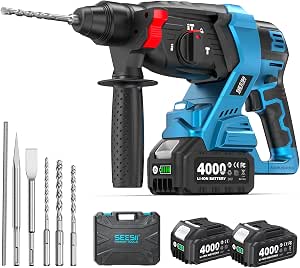
Seesii 1-Inch Cordless SDS-Plus Rotary Hammer Drill with Two 5.0Ah Batteries
For buyers comparing this group by striking force, the Seesii 3.2J leads the listed options, with an impact rate of 4,450 BPM and two 5.0Ah batteries in the kit. That combination favors demanding drilling and chiseling sessions over the lighter-duty role of the DEWALT 20V MAX, whose listed impact energy is 2.6J. Four operating modes also let the Seesii shift from drilling to chiseling and chisel positioning. It remains a 1-inch SDS-Plus tool, however, so its stronger rating does not make it a substitute for a larger demolition hammer when removing substantial concrete. The listed maximum speed of 1,000 rpm is lower than the DEWALT’s 1,500 rpm, and battery-platform details are not fully clear. I’d favor it when kit capacity and impact energy matter more than platform certainty.
Pros:- Highest stated impact energy in this group at 3.2J.
- Includes two 5.0Ah lithium-ion batteries.
- Four modes include chisel positioning as well as drilling and chiseling.
- Kit includes SDS-Plus bits, chisels, depth gauge, charger, and case.
Cons:- Maximum concrete drilling capacity is 1 inch, limiting larger-hole work.
- Listed maximum rotational speed is lower than the DEWALT 20V MAX.
- Battery compatibility details are limited.
Best for: Users who need a cordless SDS-Plus hammer for tougher concrete drilling and chiseling and value two high-capacity batteries in the package.
Not ideal for: Buyers who need a larger demolition hammer for broad concrete removal, or who require clearly documented battery-platform compatibility.
- Voltage:18V
- Impact energy:3.2J
- Impact rate:4,450 BPM
- Motor:Brushless
- Maximum rotational speed:1,000 rpm
- Chuck type:SDS-Plus
- Batteries included:Two 5.0Ah lithium-ion batteries
- Maximum concrete capacity:1 inch (26 mm)
Our verdict“Choose this Seesii for the strongest listed impact energy and larger included batteries, provided a 1-inch SDS-Plus tool suits your workload.”
MtiolHig 1-Inch SDS-Plus Cordless Rotary Hammer Drill, 4 Modes, 7 Speeds
The MtiolHig is the most adjustable pick here, pairing four operating modes with a seven-speed dial and a stated 4,800 BPM impact rate. That control can help users tailor the tool to different drilling and chiseling tasks, rather than relying on a fixed-speed feel. Its 3J impact energy falls between the Seesii 3.2J and the lower-output Seesii models, so it offers strong stated output without leading this group. The key buying distinction is battery fit: it is listed as compatible with DEWALT 20V batteries, but the tool is sold without a battery. Compared with the DEWALT rotary hammer, it adds four modes and speed adjustment, while giving up the reassurance of a named tool brand’s documented build details; the supplied data also lists plastic material without durability specifics.
Pros:- Seven-speed adjustment offers more speed-setting options than the other listed models.
- Four modes cover drilling, hammer drilling, chiseling, and chisel angle adjustment.
- Brushless motor is rated at 3J impact energy.
- Includes five SDS-Plus bits, depth rod, adjustable handle, and storage case.
Cons:- Battery is not included, so a compatible DEWALT 20V battery is needed.
- Product data lists plastic material but does not detail durability.
- Impact energy is below the Seesii 3.2J model.
Best for: DEWALT 20V battery owners who want a four-mode rotary hammer with adjustable speed for varied drilling and chiseling jobs.
Not ideal for: Buyers without a compatible battery, or those who want documented material durability and a complete ready-to-use kit.
- Voltage:20V
- Impact energy:3J
- Impact rate:4,800 BPM
- Maximum rotational speed:1,100 rpm
- Speed settings:7
- Operating modes:4
- Chuck type and capacity:SDS-Plus, up to 1 inch
- Battery compatibility:DEWALT 20V lithium-ion; battery not included
Our verdict“Pick the MtiolHig if adjustable speed and compatibility with a DEWALT 20V battery you already own matter more than a complete kit.”
Seesii 1-Inch Cordless SDS-Plus Rotary Hammer Drill, 2.5 J, Brushless, 4-Mode
This Seesii 2.5J is the lower-output option among the Seesii kits, but its listed safety clutch gives it a distinct role for DIYers who value help limiting sudden torque reaction when a bit binds. The package includes two 4.0Ah batteries, a charger, bits, chisels, and a case, so it arrives more complete than the DEWALT 20V MAX bare tool. Four modes support drilling, hammer drilling, chiseling, and chisel-angle adjustment, while the stated 4,800 BPM impact rate suits general concrete and masonry tasks. For heavier chiseling, the Seesii 3.2J offers more stated impact energy; this model is better chosen for mixed, moderate work and included safeguards than for maximum force. Battery-platform compatibility is described but not fully detailed.
Pros:- Safety clutch helps reduce sudden torque reaction if a bit binds.
- Two 4.0Ah batteries and a charger are included.
- Four modes cover drilling, hammer drilling, chiseling, and chisel angle adjustment.
- Kit includes SDS-Plus bits, two chisels, depth gauge, and carrying case.
Cons:- At 2.5J, it has less stated impact energy than the other Seesii models here.
- Concrete capacity is limited to 1 inch.
- Battery compatibility details are limited.
Best for: DIY renovators who want a complete cordless kit with a safety clutch for occasional concrete drilling, masonry work, and light chiseling.
Not ideal for: Users doing frequent heavy concrete removal or those who need well-documented compatibility with an existing battery platform.
- Impact energy:2.5J
- Power:900W
- Motor:Brushless
- Impact rate:4,800 BPM
- Modes:4
- Batteries:Two 4.0Ah
- Maximum concrete capacity:1 inch (26 mm)
- Chuck:Tool-free SDS-Plus
Our verdict“Choose this Seesii for moderate DIY drilling and chiseling when the included safety clutch and complete battery kit matter more than peak impact energy.”
NANWEI Cordless Rotary Hammer Drill SDS-Plus 3‑Mode with 2×4.0 Ah Batteries
The NANWEI stands out for buyers who want a cordless hammer drill kit ready for concrete and general drilling, rather than a demolition-focused tool. Its three modes cover hammer-only work, hammer drilling, and rotary drilling, while the two 4.0 Ah batteries provide a spare for longer work sessions. That makes it a more self-contained purchase than the DEWALT 20V MAX SDS Plus, which is listed as a bare tool. The brushless motor and anti-kickback clutch add useful efficiency and control, but the product data does not specify impact energy, so I would not rank it ahead of models with stated joule ratings for demanding chipping. Its SDS-Plus format and stated application suit lighter concrete work; the added battery capacity also means more weight to carry.
Pros:- Two included 4.0 Ah batteries reduce interruptions when one pack needs charging.
- Three operating modes support hammering, hammer drilling, and rotary drilling.
- Brushless motor is designed for improved efficiency and tool life.
- Rebar detection and an anti-kickback clutch add control and safety features.
Cons:- No impact-energy rating is supplied, making demolition capability harder to compare.
- Two batteries add carry weight compared with a bare-tool setup.
- SDS-Plus drilling format and listed application make it better suited to lighter work than demanding demolition.
Best for: DIYers and light contractors who need a cordless SDS-Plus tool for occasional concrete drilling and want two batteries in the kit.
Not ideal for: Buyers tackling extended, heavy demolition or comparing tools by impact energy, since no joule rating is provided; also a poor fit for those prioritizing the lightest setup.
- Power source:Battery powered
- Voltage:20 V DC
- Battery configuration:Two 4.0 Ah lithium-ion batteries
- Motor:Brushless
- Operating modes:Hammer only, hammer-drill, rotary
- Maximum rotational speed:950 rpm
- Maximum chuck size:14 mm
- Wood drilling capacity:38 mm
- Metal drilling capacity:13 mm
Our verdict“Choose the NANWEI for versatile, lighter concrete work when an included spare battery matters more than a documented impact-energy rating.”

How We Picked
I compared the six options through the needs of buyers seeking a cordless tool for lighter demolition: stated impact energy, motor type, operating modes and speed controls, handle design, battery capacity and what the kit includes. I also weighed practical ownership details, such as whether the tool is sold bare or with batteries, how adaptable its controls appear for drilling and chiseling, and whether the listed specifications give buyers enough information to judge fit.
The ranking favors useful capability and a clear ownership case, not the longest feature list. The DEWALT leads for buyers who already own compatible batteries; the Seesii 2.8J brushless model earns a strong position on its stated power, while battery-included options rank well for buyers starting without packs. Models with appealing controls or bundles still sit lower when specifications alone do not establish stronger performance, durability, or broader service support. Since all six use SDS-Plus, I treat them as lighter-duty options rather than substitutes for large demolition hammers.
Factors to Consider When Choosing Best Cordless Demolition Hammers
Before choosing among these models, match the tool to the material, work duration, and battery platform you actually expect to use. A cordless SDS-Plus hammer can make small chipping jobs and drilling more convenient, but it is easy to overestimate its role in sustained demolition.
Match SDS-Plus to the Work, Not the Product Name
Product titles can make a rotary hammer sound interchangeable with a dedicated demolition hammer, but the chuck system and intended workload matter more than the label. SDS-Plus is a common fit for drilling and lighter chipping, while continuous removal of thick concrete can call for a heavier tool class. Think about the toughest task you need to finish repeatedly, rather than the occasional small repair. If the work involves breaking slabs or extended structural removal, a larger corded or higher-capacity demolition tool may save time and strain. Choosing an undersized hammer because it is cordless can lead to slow progress and excess wear. Treat these six as portable, lighter-duty choices unless the manufacturer’s specifications confirm a more demanding use case.
Read Impact Energy Alongside the Rest of the Specs
Impact-energy figures offer one clue about striking force, but they do not predict job speed on their own. Bit design, material hardness, tool weight, vibration, and how consistently the mechanism performs all affect results. In this lineup, the Seesii brushless listings state 2.8J and 2.5J, but that difference should not outweigh fit, warranty terms, or battery availability without supporting performance data. Compare specifications published in the same units and under similar measurement conditions. If a listing omits details such as impact rate or vibration figures, regard that as uncertainty rather than assuming the tool is equivalent to a better-documented model. Match the tool to the work and avoid choosing solely by the largest number.
Calculate Battery Needs for a Full Work Session
Battery capacity and the number of packs included affect convenience, but they cannot promise a fixed runtime. Hard concrete, larger bits, frequent chiseling, and cold conditions can drain packs faster than light drilling. A two-battery kit lets one pack charge while the other is in use, which can help on longer jobs, but check charging time and whether a charger is included before deciding. If you already own compatible batteries, a bare tool may reduce duplication; if not, add the cost and availability of the complete battery system to your comparison without relying on promotional claims. Also check whether the stated amp-hour capacity is for each battery or the pair. For regular work, an accessible spare pack can matter more than a small difference in listed impact energy.
Choose Controls That Fit Your Tasks
Modes and speed settings can help a hammer adapt to drilling, chiseling, or more delicate work, but extra controls are useful only when they support tasks you actually do. Before buying, confirm what each mode does and whether the tool permits rotation-only drilling, hammer drilling, and hammer-only operation. Variable speed can help start holes cleanly or reduce bit wandering, while a simpler control layout may be easier to learn on occasional jobs. More modes do not automatically mean better power or stronger construction. Consider the gloves, visibility, and working positions involved, since controls that are awkward to adjust can interrupt the task. Prioritize understandable, accessible settings over a high mode count.
Account for Weight, Grip, and Overhead Work
A hammer that feels manageable at waist height can become tiring when held overhead or used for repeated chiseling. Look beyond the tool’s body weight and check whether the listed figure includes a battery, because the pack adds to what your arms carry. Handle shape also affects control: a D-handle can offer a different grip and stance from a conventional side-handle layout. If possible, compare the balance with the battery fitted and the side handle installed. Vibration information and fatigue-reducing features matter for frequent use, though not every listing provides enough detail to compare them. For occasional short jobs, portability may outweigh a heavier build; for longer sessions, ergonomics and breaks deserve more weight in the decision.
Check Platform, Parts, and Support Before Committing
A cordless tool is part of a battery and service system, not just a standalone purchase. Confirm battery compatibility rather than assuming packs from the same voltage class will fit across brands. Check what the kit includes, whether replacement batteries and chargers are easy to obtain, and what warranty or repair support applies in your region. These details can matter more over several years than a few additional controls. Buyers choosing lesser-known brands should pay particular attention to available manuals, replacement parts, and clear warranty procedures. A familiar platform can be a practical advantage for someone who already owns its batteries, while a bundle may be simpler for a first-time buyer. Compare the complete ownership setup, not only the tool body.
Frequently Asked Questions
Can any of these SDS-Plus hammers replace a dedicated demolition hammer?
Not for every job. These are SDS-Plus rotary hammers aimed at drilling and lighter chiseling, while sustained slab breaking or heavy structural removal can demand a larger demolition tool. The tool’s stated energy and motor type do not change the limits of its chuck class, duty cycle, and physical size. For a small repair or occasional tile and mortar removal, a compact cordless hammer may be convenient. If you expect long sessions against thick concrete, choose a tool specifically rated for that workload instead.
Should I choose the 2.8J Seesii over the 2.5J Seesii?
The 2.8J listing has the higher stated impact-energy figure, which may appeal if you are comparing the two brushless models by published force. It is not enough information to prove faster work or longer service life, since impact rate, vibration, build quality, and testing conditions also matter. Compare their modes, included accessories, battery arrangements, and warranty details before deciding. If those details are otherwise similar and the specifications are measured comparably, the higher figure may be a sensible tie-breaker. For demanding daily use, seek independent performance information rather than relying on the number alone.
Is a two-battery kit a better choice than the DEWALT bare tool?
It depends on the batteries you already own and how long your work sessions run. The Seesii and NANWEI bundles include two packs, which can reduce interruptions for buyers starting without compatible batteries. The DEWALT is more compelling when you already use its 20V MAX platform, since the bare-tool format avoids adding another battery system to your garage. Check whether a charger is included with each bundle and how easily replacement packs can be sourced. If you work intermittently, one battery may be enough; longer jobs make a spare more useful.
Are four modes and seven speeds worth prioritizing?
They can help if your work varies between drilling, hammer drilling, and chiseling, or if you need finer control at the start of a hole. But mode counts are not a measure of striking power, reliability, or ease of use. Confirm that the listed settings provide the functions you need, since sellers may describe modes differently. If your jobs are mostly one type of drilling, a simpler tool may be easier to operate and just as suitable. Give more weight to clear controls, sound battery support, and appropriate capacity than to a long feature list.
What should I check before using a cordless hammer for overhead chiseling?
Check the tool’s weight with its battery installed, handle arrangement, vibration information, and the manufacturer’s guidance for chiseling. Overhead work can become tiring quickly, and extra battery capacity also adds weight. Use a bit suited to the material and keep a secure stance; do not force a hammer that is struggling to make progress. Plan breaks for longer sessions and use appropriate eye, hearing, respiratory, and hand protection for concrete dust and debris. If the work is extensive, a lighter tool is not automatically safer or more efficient than choosing the correct larger tool and work setup.
Conclusion
For most buyers already invested in its battery system, I’d choose the DEWALT 20V MAX D-Handle as the best overall platform-led pick, while noting that it is sold as a bare tool. The Seesii 1-Inch 2.8J brushless model is my best value-style choice for buyers prioritizing its stated impact energy, and the Seesii two-battery 5.0Ah kit is a practical option for people who need included packs. I’d steer beginners toward a battery-included kit with clearly explained controls, such as the MtiolHig if its extra settings suit their work, rather than buying a bare tool without a compatible battery. For buyers who want the most listed control options, the MtiolHig’s four modes and seven speeds make it the specific-needs pick, though those features do not prove greater power. None of these is my choice for sustained heavy demolition; for that, move up to a tool class built for extended concrete breaking.