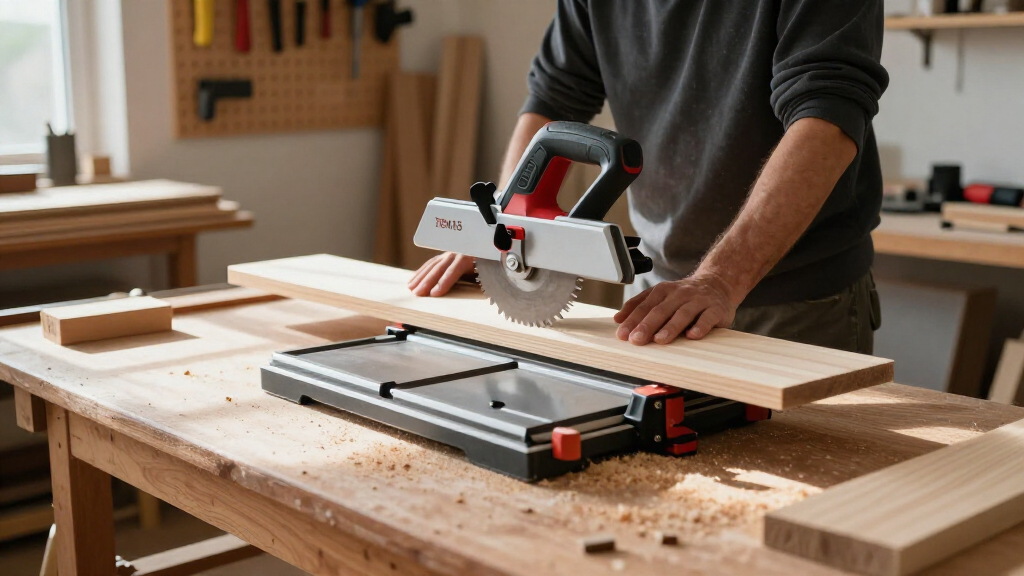

Among sliding compound miter saws, I’d name the DeWalt 12-inch Double Bevel the best overall pick for its large blade and XPS shadow-line system, while the Makita LS1019L stands out for a compact rail design and the Evolution R185SMS+ for cutting multiple material types with its included blade. The main tradeoffs are cutting capacity versus space, single versus dual bevel convenience, and wood-focused blades versus multi-material versatility. A larger saw can handle wider stock, but it takes up more room and may be harder to move. I compare all 13 options below so you can match the saw’s features to your projects and workspace.

Get business pricing on tools and workshop supplies
- Business-only prices and quantity discounts
- Tax-exempt purchasing
- Multiple users, one account, clear invoices
Complete the kit


Key Takeaways
- DeWalt’s 12-inch double-bevel saw combines broad cutting capacity with an XPS shadow line, making it the strongest all-around choice for buyers who have room for a larger saw.
- Makita’s LS1019L takes a different approach with its compact rail layout, a useful advantage when workshop depth is limited.
- Evolution’s R185SMS+ and R255SMS+ put multi-material cutting at the center of their appeal, unlike wood-focused options that may call for a separate blade strategy.
- Dual-bevel models reduce workpiece repositioning; single-bevel picks can suit simpler trim and crosscut work, but require more planning for mirrored angles.
- The lineup includes repeated DOVAMAN models and several sparsely specified entries, so I’d verify exact model details, included blades, and support before choosing on the name alone.


| sliding compound miter saw | Power source | Weight | Motor | Blade size |
|---|---|---|---|---|
| VEVOR 10" Double Bevel Sliding | Corded electric | 39.7 pounds | 15 Amp | 10 inches |
| Makita LS1019L 10-Inch Dual-Be | Corded electric | 72.8 pounds | — | 10 inches |
| DOVAMAN 12-Inch Dual-Bevel Sli | — | — | 15 Amp | 12 inches |
| Evolution Power Tools R185SMS+ | Corded electric | — | — | — |
| DOVAMAN 10-Inch Sliding Miter | — | 17 kg | 15 Amp | 10 inches |
| Marvtool 10-inch Sliding Compo | 120 V corded electric | 25.7 lb | — | — |
| Evolution Power Tools R255SMS+ | 120 V corded electric | 41.8 lb | — | — |
| Skil 10-Inch Dual Bevel Slidin | 120 V corded electric | 39.4 lb | 15 A; 1800 W | — |
| DOVAMAN 10-Inch Sliding Miter | 120 V corded electric | 17 kg | 15 A; 2000 W | — |
| VEVOR Sliding Compound Miter S | 120 V corded electric | 46.4 lb | 15 A; 3000 W listed | — |
| DeWalt 12-inch Double Bevel Sl | — | 58 lbs | — | 12 inches |
| NOVORIK Single Bevel Compound | Corded | — | 15 Amp / 1800W | 10 inches |
| 10-inch Sliding Compound Miter | Corded electric, 120 volts | 25.6 lbs | 15 Amp | 10 inches |
More Details on Our Top Picks
VEVOR 10″ Double Bevel Sliding Compound Miter Saw, 15 Amp, 60-Tooth Blade, LED Laser, Adjustable Angles
The VEVOR pairs a 10-inch blade, sliding action, and dual bevels, giving DIY woodworkers a flexible setup for crosscuts and angled joinery without stepping up to a 12-inch saw. Its 60-tooth blade and LED laser are aimed at cleaner, easier-to-align cuts in wood, laminate, and composite decking. Compared with the Makita LS1019L, it offers a similar core dual-bevel approach but with fewer supplied details about cutting capacity and convenience features such as a soft-start motor and electric brake. The tradeoff is that VEVOR calls for careful setup to get accurate results, and its corded design and 39.7-pound weight limit grab-and-go use. I’d choose it for a stationary home workshop where flexibility matters more than premium refinements.
Pros:- Dual-bevel design handles compound cuts without flipping the workpiece.
- Sliding system supports wider crosscuts than a fixed-head saw.
- 60-tooth blade and LED laser aid alignment and cleaner cuts.
- Aluminum base is intended to make the saw easier to move than heavier alternatives.
Cons:- Accuracy may depend on setup and alignment after unpacking.
- Corded power limits use away from an outlet.
- At 39.7 pounds, it is not a particularly light option for repeated transport.
Best for: DIY woodworkers who want a 10-inch sliding saw with dual bevels and laser alignment for varied trim and decking projects.
Not ideal for: Buyers who need verified cutting-capacity figures, frequent jobsite portability, or cordless operation.
- Blade size:10 inches
- Motor:15 Amp
- Power source:Corded electric
- Voltage:120 volts
- No-load speed:5000 rpm
- Blade teeth:60
- Bevel:Dual bevel
- Weight:39.7 pounds
Our verdict“Choose the VEVOR for a feature-rich, dual-bevel 10-inch saw in a home shop, but look to the Makita LS1019L for more documented convenience features.”
Makita LS1019L 10-Inch Dual-Bevel Sliding Compound Miter Saw with Laser
The Makita LS1019L is the precision-minded 10-inch choice in this group, combining dual bevels, a laser guide, soft start, and an electric brake. Those motor and stopping features make controlled cuts more comfortable during repeated trim or carpentry work, while the stated large cutting capacity suits stock that can challenge smaller saws. Compared with the VEVOR 10-inch double-bevel saw, the Makita offers more explicit convenience features, but it is also much heavier at 72.8 pounds and less appealing to move between work areas. Its 3200-rpm speed is lower than several other models listed here, and the supplied data does not give a numeric cutting-capacity figure to compare directly. I’d favor it for a dedicated workshop or a crew that values its operating features over easy portability.
Pros:- Dual-bevel operation supports compound cuts in either direction.
- Soft-start motor helps moderate startup movement.
- Electric brake is designed to stop the blade promptly after a cut.
- Laser guide helps indicate the cut line.
Cons:- At 72.8 pounds, it is substantially heavier than the VEVOR 10-inch option.
- Corded operation requires access to an outlet.
- The provided specifications do not quantify its cutting capacity.
Best for: Carpenters and serious home woodworkers who make repeated bevel and crosscuts and can keep the saw set up in one place.
Not ideal for: Solo users who regularly carry tools between jobsites or buyers who want a clearly stated cutting-capacity measurement before choosing.
- Blade size:10 inches
- Power source:Corded electric
- Voltage:120 volts
- No-load speed:3200 rpm
- Blade teeth:60
- Bevel:Dual bevel
- Weight:72.8 pounds
- Dimensions:31.75 x 25.38 x 26 inches
Our verdict“Pick the Makita for a stable shop setup where soft start, braking, and dual-bevel capability matter more than carrying weight.”
DOVAMAN 12-Inch Dual-Bevel Sliding Compound Miter Saw, 15-Amp
This DOVAMAN earns its place for buyers who need a 12-inch blade and a stated 4.2-by-13-inch cutting capacity. That reach makes it the clearest fit here for wider boards, while its sliding rail and dual bevels cover compound cuts without turning the workpiece around. The listed angle presets include common stops from 0 to 45 degrees on both sides, and the laser guide offers a quick visual reference. Compared with the Makita LS1019L, this model gives a more explicit capacity figure and a larger blade, but the available product data says little about motor refinements such as the Makita’s soft start and electric brake. DOVAMAN also warns that factory alignment may need attention, and the saw can be cumbersome to move. I’d choose it for larger stock, with setup time built into the plan.
Pros:- 12-inch blade and stated 4.2-by-13-inch capacity suit wider workpieces.
- Dual bevels support compound cuts to either side.
- Preset stops cover commonly used miter angles.
- Laser guide and transparent blade guard support alignment and visibility.
Cons:- May need alignment adjustments after shipment.
- Heavy construction can make frequent relocation difficult.
- The supplied specifications do not state voltage or weight.
Best for: Woodworkers cutting wider boards or trim who want a 12-inch dual-bevel slider and can check alignment before precision work.
Not ideal for: Users who need a frequently transported saw or want detailed documentation of motor features and factory calibration.
- Blade size:12 inches
- Motor:15 Amp
- Cutting capacity:4.2 x 13 inches
- No-load speed:3800 rpm
- Bevel:Dual bevel
- Angle presets:0°, 15°, 22.5°, 30°, and 45° left and right
- Laser guide:Included
Our verdict“Choose this DOVAMAN over the Makita LS1019L when a larger blade and explicit wide-stock capacity matter more than documented soft-start and brake features.”
Evolution Power Tools R185SMS+ Sliding Miter Saw with Multi-Material Cutting, 45 Degree Bevel, 50 Degree Miter, 210 mm Slide, Blade Included
The Evolution R185SMS+ stands apart by targeting wood, plastic, and metal, rather than concentrating only on woodworking. Its 45-degree bevel, 50-degree miter range, and 210 mm slide offer useful angle and crosscut flexibility, while the included blade means it is presented as a ready-to-cut package. Compared with the DOVAMAN 10-inch two-speed saw, which also lists soft-metal cutting, the Evolution provides a specific slide length and angle ranges but does not list two selectable speeds or a laser guide. The supplied data also contains an implausible 0.27-gram weight and a 4-inch blade length alongside the model’s R185 designation, so those figures should not guide a buying decision without confirmation. I’d shortlist it for mixed-material jobs, but verify blade and weight details before ordering.
Pros:- Designed to cut wood, plastic, and metal.
- Lists a 45-degree bevel and 50-degree miter range.
- 210 mm slide adds crosscut reach.
- Blade is included according to the product description.
Cons:- Provided blade-length and weight figures appear inconsistent and need verification.
- No laser guide is listed in the supplied product details.
- The listed 1200-watt rating is lower than the 15-amp DOVAMAN models described here.
Best for: DIYers and tradespeople who need one sliding saw for a mix of wood, plastic, and metal cuts.
Not ideal for: Buyers who need confirmed blade dimensions, dependable published weight data, or a clearly specified laser and safety-feature package.
- Power source:Corded electric
- Voltage:120 volts
- Wattage:1200 watts
- No-load speed:3700 rpm
- Blade teeth:60
- Bevel:45 degrees
- Miter:Up to 50 degrees
- Slide length:210 mm
Our verdict“Consider the Evolution for mixed-material cutting, but verify its blade and weight specifications before choosing it over the more clearly specified DOVAMAN two-speed saw.”
DOVAMAN 10-Inch Sliding Miter Saw, Multi-Material, 2-Speed, 15A
The DOVAMAN 10-inch slider is the most adaptable pick here for users switching between wood, plastic, and soft metal. Its two speed settings—5000 and 3200 rpm—give buyers a way to match the saw’s operation to different materials, while the laser and stated capacity of up to 4 by 13 inches help with alignment and wider crosscuts. Compared with the Evolution R185SMS+, it spells out its speed options and capacity, though Evolution lists a 50-degree miter range and a specific 210 mm slide. This DOVAMAN has a 0-to-45-degree bevel range, but the data does not specify a dual-bevel design, so buyers needing compound bevel cuts in both directions should look to the dual-bevel VEVOR or Makita instead. Its 17 kg weight and corded power also favor a workshop over mobile use.
Pros:- Two speed settings support work across listed material types.
- Sliding rail and stated capacity up to 4 by 13 inches suit wider stock.
- Laser guide helps line up cuts.
- Ambidextrous design accommodates different working preferences.
Cons:- The supplied data does not identify it as a dual-bevel saw.
- At 17 kg, it is heavy for frequent transport.
- Corded power limits use where outlets are unavailable.
Best for: DIYers who cut wood, plastic, and soft metal and want selectable speeds plus sliding capacity in a 10-inch saw.
Not ideal for: Carpenters who need confirmed dual-bevel capability or frequently carry a saw between jobsites.
- Blade size:10 inches
- Motor:15 Amp
- Speed settings:5000 rpm and 3200 rpm
- Voltage:120 volts
- Wattage:2000 watts
- Cutting capacity:Up to 4 x 13 inches
- Material compatibility:Wood, plastic, and soft metal
- Weight:17 kg
- Bevel range:0–45 degrees
Our verdict“Pick this DOVAMAN for varied material cutting and selectable speeds, but choose the Makita LS1019L or VEVOR if dual-bevel operation is a priority.”
Marvtool 10-inch Sliding Compound Miter Saw, Dual-Speed 5000/3300 RPM, 15 Amp, Single Bevel 0‑45°, with 2 TCT Blades
The Marvtool stands out for combining a 25.7-pound frame with separate blades and speed settings for wood and metal, making it easier to move between jobs than the heavier Evolution R255SMS+ Plus. Its 5000 RPM setting is specified for wood and plastic, while the lower 3300 RPM setting pairs with the included 48-tooth metal blade. That gives occasional DIYers a more purpose-built setup than a single-blade multi-material saw, though the product information doesn’t detail which metals it can cut. The tradeoff is its single-bevel design: unlike the dual-bevel SKIL MS6305-00, it requires repositioning the workpiece for opposite-side bevels. The included vise, dust bags, and extension table add practical value, but expect to reinstall the handle after delivery.
Pros:- At 25.7 pounds, it is lighter to carry and store than the Evolution R255SMS+ Plus.
- Separate 80-tooth wood and 48-tooth metal blades are included.
- Two speed settings let the user match the listed speed to wood, plastic, or metal work.
- Vise clamps, dust bags, and an extension table are included.
Cons:- Single bevel limits flexibility compared with the dual-bevel SKIL MS6305-00.
- The handle must be reinstalled after shipping.
- The supplied details do not clarify the metal types the saw can cut, and warranty coverage is limited.
Best for: DIYers who need a portable 10-inch slider for occasional wood, plastic, and soft-metal projects and value included material-specific blades.
Not ideal for: Trim installers who routinely make bevel cuts in both directions, or buyers seeking a clearly documented metal-cutting range and broad warranty coverage.
- Blade diameter:10 inches
- Motor power:15 A; 1800 W
- Speed settings:5000 RPM / 3300 RPM
- Bevel:Single bevel, 0°–45°
- Included blades:80-tooth wood blade; 48-tooth metal blade
- Weight:25.7 lb
- Dimensions:25.3 × 18.5 × 20.4 inches
- Power source:120 V corded electric
- Warranty:Limited, 2 years
Our verdict“Choose the Marvtool if light carry weight and included wood-and-metal blade options matter more than dual-bevel convenience.”
Evolution Power Tools R255SMS+ Plus 10-Inch Sliding Miter Saw with Multi-Material Cutting Capability
The Evolution R255SMS+ Plus is the lineup’s clearest fit for buyers who want one saw for wood, metal, plastic, and composite materials. Its listed 2500 RPM speed and included 60-tooth blade distinguish it from the faster, separate-blade approach of the Marvtool, which supplies dedicated blades for wood and metal instead. That simpler one-blade setup may suit mixed-material work, though buyers should check the blade’s material limits before cutting unfamiliar stock. Adjustable bevel and miter settings support varied angled cuts, and the three-year warranty is longer than the two-year coverage listed for the Marvtool. The downside is portability: at 41.8 pounds, it is a substantial step up from the Marvtool’s 25.7 pounds. The provided specs also don’t spell out the saw’s cutting capacity or exact angle ranges.
Pros:- Designed to cut wood, metal, plastic, and composite materials with one blade.
- Adjustable bevel and miter angles support varied angled cuts.
- Includes accessories such as clamps and a dust bag.
- Listed three-year warranty exceeds the Marvtool’s two-year warranty.
Cons:- At 41.8 pounds, it is much heavier than the Marvtool for transport and storage.
- The supplied specifications do not state cutting capacity or exact miter and bevel ranges.
- Setup may take more work for buyers who want a simple out-of-box start.
Best for: DIY remodelers and workshop owners who regularly switch among compatible wood, plastic, composite, and metal stock and prefer one included blade.
Not ideal for: Mobile users who frequently carry a saw between locations, or buyers who need clearly listed cutting-capacity and angle-range figures before purchase.
- Blade diameter:10 inches
- Motor power:1800 W
- Speed:2500 RPM
- Blade teeth:60
- Materials:Wood, metal, plastic, and composite materials
- Weight:41.8 lb
- Power source:120 V corded electric
- Warranty:3 years
Our verdict“Pick the Evolution if you want a single-blade saw for mixed-material jobs and can accept its heavier, less portable build.”
Skil 10-Inch Dual Bevel Sliding Compound Miter Saw MS6305-00
The SKIL MS6305-00 earns its place through dual-bevel cutting and an LED Shadow Line, a combination that helps with repeatable trim and molding cuts without relying on a laser line. Compared with the single-bevel Marvtool, it can bevel in either direction without flipping the workpiece, which is useful when alternating between left- and right-facing cuts. Its 4800 RPM motor and 10-inch blade make it the more woodworking-focused choice here; unlike the Evolution R255SMS+ Plus, it is not presented as a multi-material saw. The tall sliding fences are intended to support larger molding, but the machine itself is bulky at 39.4 pounds. Buyers should also note that the listing gives a 50-degree cutting angle without clarifying the full miter-angle range, and warranty details are sparse.
Pros:- Dual bevel avoids flipping stock for opposite-direction bevel cuts.
- LED Shadow Line provides a visible cut-alignment reference.
- Tall sliding fences are designed to accommodate larger molding.
- The 15 A motor is listed at 4800 RPM for woodworking cuts.
Cons:- At 39.4 pounds, it is not an easy choice for frequent carrying.
- Unlike the Evolution R255SMS+ Plus, it is not described as a multi-material saw.
- Warranty terms and the exact miter-angle range are not specified in the supplied details.
Best for: Trim carpenters and detail-focused DIY woodworkers who make frequent bevel cuts and want a visual alignment aid for molding.
Not ideal for: Users who need a lightweight jobsite saw, or buyers seeking a saw explicitly suited to cutting metal and other non-wood materials.
- Blade diameter:10 inches
- Motor:15 A; 1800 W
- Speed:4800 RPM
- Bevel capability:Dual bevel
- Cutting angle:50 degrees (as listed)
- Blade teeth:40
- Weight:39.4 lb
- Power source:120 V corded electric
Our verdict“Choose the SKIL for woodworking and molding projects where dual-bevel convenience and a shadow-line guide outweigh portability.”
DOVAMAN 10-Inch Sliding Miter Saw, Multi-Material, 2-Speed, 15A
The DOVAMAN’s standout claim is a cutting capacity up to 4 × 13 inches, which makes it a strong match for wider stock than a buyer focused only on small trim pieces might need. It combines that reach with a laser guide, extendable tables, and two speeds for listed wood, plastic, and soft-metal work. Compared with the Marvtool, it offers the stated larger crosscut capacity and laser alignment, while the Marvtool is notably lighter and includes separate wood and metal blades. DOVAMAN lists one 60-tooth blade and a 5000/3200 RPM range, but the supplied information does not explain its blade-change process or specify the bevel configuration beyond a 45-degree angle. At 17 kg, it is also a heavy saw to move around a workshop.
Pros:- Listed capacity reaches 4 × 13 inches for wide crosscuts.
- Laser guide helps indicate the cut line.
- Two speed settings are listed for wood, plastic, and soft-metal cutting.
- Extendable tables support longer workpieces.
Cons:- At 17 kg, it is less convenient to carry than the 25.7-pound Marvtool.
- The supplied details do not specify whether it has single or dual bevel.
- Blade-change instructions and the precise range of compatible metals are not provided.
Best for: DIY builders and workshop users who crosscut wide boards or panels and want a laser guide plus extendable table support.
Not ideal for: Contractors who carry their saw between sites, or buyers who need clearly documented blade changes, bevel direction, or fine-grained material limits.
- Blade diameter:10 inches
- Motor:15 A; 2000 W
- Speed settings:5000 RPM / 3200 RPM
- Blade teeth:60
- Cutting capacity:Up to 4 × 13 inches
- Materials:Wood, plastic, and soft metal
- Bevel angle:45 degrees
- Weight:17 kg
- Power source:120 V corded electric
Our verdict“The DOVAMAN suits workshop buyers who need its stated wide-cut capacity and laser alignment more than a lighter, better-documented setup.”
VEVOR Sliding Compound Miter Saw, 12-Inch Blade, 15 Amp Motor, 60-Tooth, Corded Double Bevel
This VEVOR is the only 12-inch saw in this five-product group, making it the pick for buyers who want a larger blade and dual-bevel cuts for broad woodworking tasks. Its sliding rail is intended to extend crosscut reach, while the LED alignment system helps place cuts; that makes it a more capacity-oriented option than the 10-inch SKIL MS6305-00, whose standout strength is its shadow-line guide for trim work. VEVOR lists a 15 A motor and 5000 RPM, but the stated 3000 W figure is unusual alongside that amperage and 120 V supply, so I would verify the motor details before treating it as a direct performance comparison. At 46.4 pounds, it is also the heaviest saw here, and its limited warranty details leave questions for buyers planning regular use.
Pros:- 12-inch blade offers a larger blade format than the 10-inch saws in this group.
- Dual-bevel capability supports angled cuts in either direction.
- Sliding mechanism is designed to extend crosscut reach.
- LED alignment and an adjustable aluminum base support positioning and setup.
Cons:- At 46.4 pounds, it is the heaviest option in this five-saw group.
- The listed 3000 W, 15 A, and 120 V specifications do not clearly align and merit verification.
- The supplied details do not provide a clear warranty duration or exact cutting-capacity figures.
Best for: Woodworkers who want a 12-inch sliding, dual-bevel saw for larger workpieces and can keep it set up in a workshop.
Not ideal for: Users prioritizing easy transport, or buyers who need clearly reconciled electrical specifications and detailed warranty terms.
- Blade diameter:12 inches (30.5 cm listed)
- Motor:15 A; 3000 W listed
- Speed:5000 RPM
- Blade teeth:60
- Bevel capability:Double bevel
- Cutting angle:45 degrees
- Weight:46.4 lb
- Power source:120 V corded electric
- Warranty:Limited; duration not specified
Our verdict“Choose this VEVOR if a 12-inch blade and dual-bevel sliding format matter more than portability and specification clarity.”
DeWalt 12-inch Double Bevel Sliding Compound Miter Saw with XPS LED Shadow Line System
The DeWalt earns its place for projects where large molding capacity and a clear cutline matter more than easy transport. Its 12-inch blade handles crown molding up to 7-1/2 inches and base molding up to 6-3/4 inches, giving it more room for substantial trim than the 10-inch NOVORIK. The XPS LED shadow line projects the blade’s cutline onto the workpiece, which can make alignment easier to read than a laser guide. Double-bevel operation also reduces the need to reposition long trim for opposite bevel cuts.
The tradeoff is its 58-pound weight and more involved setup, which make it better suited to a dedicated shop than frequent jobsite hauling. Its dust collection captures over 75% by the stated specification, but the saw still calls for dust-management planning. Casual users may find its capacity and feature set more saw than their projects require.
Pros:- 12-inch blade and stated capacity suit large crown and base molding.
- XPS LED shadow line makes the cutline visible on the workpiece.
- Double-bevel design allows bevel cuts in either direction without flipping the workpiece.
- Dust collection is specified to capture over 75% of dust.
Cons:- At 58 lbs, it is cumbersome to carry between work areas.
- Setup and adjustments may be demanding for first-time miter saw owners.
- Its heavy-duty capacity may be unnecessary for occasional small trim jobs.
Best for: Woodworkers and trim installers who regularly cut large crown or base molding and can keep a heavier saw set up in one place.
Not ideal for: Casual DIYers or mobile crews who prioritize a lightweight saw, quick setup, or a smaller footprint.
- Blade size:12 inches
- Motor power:1100W
- Weight:58 lbs
- Crown molding capacity:Up to 7-1/2 inches
- Base molding capacity:Up to 6-3/4 inches
- Miter range:60° right, 50° left
- Dust collection:Over 75% dust capture
Our verdict“Choose the DeWalt over the 10-inch NOVORIK when large trim capacity and double-bevel cuts matter more than portability.”
NOVORIK Single Bevel Compound Sliding Miter Saw, 10-inch Corded with Laser Guide and 15-Amp Motor
The NOVORIK is a straightforward choice for home workshops that need a 10-inch sliding saw with a laser guide and familiar angle settings. Its 15-amp motor and 4,000-rpm no-load speed are specified for cutting wood, plastic, and soft metal, while the laser gives a visible reference for lining up work. Compared with the DeWalt’s 12-inch double-bevel setup, this model gives up blade size and bevel flexibility, but its stated 0°–45° bevel and -45°–45° miter ranges cover many routine framing, shelving, and trim cuts.
Its main limitation is the single-bevel design: opposite bevels can require turning the workpiece, which is less convenient on repeated trim cuts than a double-bevel saw. The cord also ties it to an outlet, and the supplied information does not specify weight or cutting capacity. This is a practical fit for occasional shop use, not a substitute for the DeWalt when large molding is the priority.
Pros:- Laser guide provides a visible reference when positioning cuts.
- 15-amp motor and 4,000-rpm speed are specified for varied material applications.
- Miter range from -45° to 45° and bevel range from 0° to 45° cover common angled cuts.
- Positive stops at five listed angles can speed up repeat settings.
Cons:- Single-bevel operation can require repositioning the workpiece for opposite bevels.
- The 10-inch blade offers less capacity than the 12-inch DeWalt.
- Corded operation requires access to a power outlet.
Best for: DIYers who want a corded 10-inch slider with laser alignment for regular household woodworking and mixed light-material projects.
Not ideal for: Trim professionals making repeated opposing bevel cuts or buyers who need a double-bevel saw, larger blade, or cordless operation.
- Blade size:10 inches
- Motor:15 Amp / 1800W
- No-load speed:4,000 rpm
- Bevel range:0° to 45°
- Miter range:-45° to 45°
- Positive stops:0°, 15°, 22.5°, 30°, 45°
- Power source:Corded
Our verdict“Pick the NOVORIK for laser-guided everyday cuts, but choose the DeWalt if you regularly cut large trim or need double-bevel convenience.”
10-inch Sliding Compound Miter Saw, 5000RPM, 15 Amp, Single Bevel 0-45° with Extension Table, 36T Blade
At a stated 25.6 lbs, this saw stands out for buyers who need to move their tool between a garage bench, driveway, and jobsite. It includes extension tables and a 36-tooth blade, so the package offers basic work support without requiring those pieces as separate additions. Its listed 5,000-rpm speed and 15-amp motor pair with a single-bevel design for common angled cuts. Compared with the NOVORIK, it is lighter by specification and includes extension tables, while the NOVORIK lists a laser guide and specific positive stops.
The compromises are clear: this is a single-bevel 10-inch saw with a stated 45° cutting-angle limit, and no stand or extra accessories are included. The product description claims use with metal, plastic, wood, and laminates, but the supplied specs do not detail material-specific blade requirements. Handle installation is also required after delivery. I’d favor it for portable, occasional projects rather than repeated precision trim work or larger molding.
Pros:- Stated 25.6-lb weight makes it easier to move than the 58-lb DeWalt.
- Extension tables support longer workpieces during cutting.
- Includes a 36-tooth blade for getting started with general projects.
- Blade guard and vise clamp are listed as safety features.
Cons:- Single-bevel operation is less convenient for repeated opposing bevel cuts.
- No stand or additional accessories are included.
- Handle installation is required, and the supplied specifications do not give detailed cutting-capacity figures.
Best for: DIYers and maintenance workers who need a relatively light sliding saw with extension support for moving among small projects.
Not ideal for: Trim crews cutting large molding or users who want double-bevel operation, a stand, or a clearly specified laser cutline guide.
- Blade size:10 inches
- Motor:15 Amp
- Speed:5,000 rpm
- Weight:25.6 lbs
- Bevel range:0° to 45°
- Blade:36 teeth
- Power source:Corded electric, 120 volts
- Warranty:Limited warranty
Our verdict“Choose this saw for portable projects where low weight and included extension tables matter more than double-bevel flexibility or large-capacity cutting.”

How We Picked
I compared these sliding compound miter saws on the factors that change day-to-day work: stated blade size and bevel range, sliding capacity, angle and cut-line aids, material compatibility, and how much shop space the design is likely to claim. I also weighed practical ownership details, including included blades, likely maintenance needs, and whether the listed features make sense for trim work, framing, or mixed-material projects. A feature matters here only when it gives a buyer a useful advantage, such as a dual bevel that saves repeated setup or a compact rail arrangement that fits a shallow bench.
The ranking favors capable, versatile saws with clearly useful advantages over models whose listings provide fewer details. DeWalt leads for the combination of 12-inch capacity, double bevel, and XPS cut-line guidance; Makita follows for buyers who need a more space-conscious design. Evolution earns distinction for material versatility, while Skil and the 10-inch dual-bevel options offer a more approachable balance of capacity and features. Single-bevel and less-documented models remain relevant for narrower needs, but rank lower when they ask buyers to accept more setup limits or uncertainty.
Factors to Consider When Choosing Sliding Compound Miter Saws
Choosing a sliding compound miter saw is less about collecting the longest feature list and more about matching the saw to your stock, cuts, and workspace. I’d start with the jobs you repeat most, then check capacity, bevel workflow, blade compatibility, and the room needed for the slide.
Match Blade Size to Stock and Workshop Space
A 12-inch blade can offer more cutting capacity than a 10-inch model, but the blade number alone does not tell you the maximum width or height the saw can cut. Check the manufacturer’s capacity figures at common angles, since bevel cuts and miter settings can reduce usable capacity. Wider stock may be better handled with a suitable saw setup or another tool rather than forcing a cut beyond the stated range. Larger saws also tend to demand more bench space, weight capacity, and room for material support. Measure the saw’s full operating depth, including rails and the movement of long boards, before buying. A compact rail design can be a better fit than a larger blade if your shop is shallow.
Choose Single or Dual Bevel Around Your Repeated Cuts
A single-bevel saw tilts one way, so a mirrored pair of trim cuts can require flipping the workpiece or changing its orientation. That may be perfectly manageable for occasional projects, but it adds setup steps when making repeated crown, casing, or furniture cuts. A dual-bevel saw tilts both ways, letting you make opposing bevels without turning the stock around. This can reduce handling errors, especially on long or awkward pieces. The tradeoff is that a dual-bevel feature is less valuable if most of your work consists of square crosscuts and simple miters. Think about the cuts you make in batches, not just the most complex cut the saw can perform.
Treat Blade Choice as Part of the Saw Decision
The included blade affects cut quality, material range, and how soon you may need an upgrade. Tooth count and blade design should match the finish you want and the material you plan to cut; a blade suited to rough framing may leave a less refined edge on trim. Multi-material saws can be useful for projects that mix wood, plastic, or suitable metal stock, but only with the correct blade and the manufacturer’s approved materials. Never assume that a saw marketed for multiple materials can safely cut every metal or composite. Check blade diameter, arbor size, maximum speed rating, and material guidance before purchasing a replacement. Buyers who need fine finish cuts should budget attention for blade selection even when a saw arrives ready to use.
Compare Cut-Line Aids With Your Lighting and Accuracy Needs
Laser guides and shadow-line systems help indicate where the blade will meet the workpiece, but neither replaces a stable fence, a square setup, and a test cut. A shadow line can remain visible under lighting that makes some laser lines difficult to see, while a laser may appeal to buyers who prefer a projected mark. The guide’s usefulness also depends on blade condition and correct calibration. If you work in changing light or move the saw between locations, check how the guide is adjusted and whether it can be recalibrated. For fine trim, pair any guide with a reliable method of checking angles and confirming the cut on scrap. Do not pay for a cut-line feature at the expense of capacity or bevel range you genuinely need.
Plan for Dust, Support, and Safe Material Handling
Long boards need support beyond the saw table, and unsupported stock can shift or pinch during a cut. Before choosing a model, consider whether its extensions work with your typical material length or whether separate stands will be needed. Dust collection varies by saw and setup, so check the port size and whether it suits the extractor or vacuum you already own. A collection port does not guarantee a clean workspace; the saw’s hood design and the cut itself affect how much dust escapes. Keep the saw stable, clamp short or awkward pieces when appropriate, and follow the manual’s limits for workpiece size. These setup needs can matter more to comfortable daily use than a small difference in motor speed.
Weigh Convenience Features Against Listing Certainty
Features such as extension tables, included blades, variable or dual speeds, and laser guides can reduce setup work, but they are useful only when the specifications are clear and suited to your projects. Several entries in this roundup have sparse naming or overlapping model descriptions, and two DOVAMAN entries appear identical in the supplied product list. Verify the exact model number, what comes in the box, warranty terms, replacement blade availability, and service options before committing. For frequent use, accessible parts and clear support may be worth more than an extra accessory. Buyers with occasional home-project needs can prioritize a straightforward setup, while production work calls for stronger evidence of capacity, durability, and serviceability.
Frequently Asked Questions
Is a 12-inch sliding miter saw worth choosing over a 10-inch model?
A 12-inch model is worth considering when your projects regularly involve wider or taller stock and its stated capacity covers those cuts. It can be a poor fit if the saw’s footprint, weight, or blade costs make your workspace harder to manage. Compare published capacities at the angles you actually use rather than assuming the larger blade solves every cut. A 10-inch saw may cover common trim and furniture work while taking up less room. For this lineup, the DeWalt and VEVOR 12-inch options are the capacity-oriented choices, while 10-inch models offer a more compact alternative.
Do I need a dual-bevel sliding miter saw for trim work?
You can complete trim work with a single-bevel saw, but dual bevel can save time when making mirrored bevel cuts or working through a batch of pieces. With a single-bevel design, you may need to flip or reposition stock, which can make orientation mistakes more likely. If your trim projects mostly use square cuts and simple miters, that convenience may not justify giving up other features you need. For frequent crown or casing work, a dual-bevel model is usually easier to run consistently. Also check whether the saw has clear, repeatable bevel stops for the angles you use.
Can a multi-material miter saw replace separate saws for wood and metal?
Not automatically. Multi-material models such as the Evolution options are designed around compatible blades and approved materials, but material limits still apply. Read the manual for the specific saw and blade before cutting metal, plastic, or composites; some materials may be prohibited or require a particular setup. A dedicated tool can remain the safer or more practical choice for frequent metal work, especially when cut finish, chip control, or production volume matters. For occasional mixed-material projects, a compatible multi-material saw may reduce tool changes, provided you follow its stated restrictions.
How much space should I leave behind a sliding miter saw?
Space needs depend on the rail layout and whether the saw slides toward the wall or projects backward as it moves. Do not judge the fit from the folded or parked position alone; check the full operating dimensions and make room for stock to pass through the cut. A shallow bench or wall-mounted station may favor a compact rail design such as the Makita LS1019L. Long boards also need clear space on both sides, often with support stands or extensions. If you cannot provide safe clearance, a larger-capacity saw may be less useful than a model that fits your station.
What should I verify before buying a lesser-known or sparsely specified saw?
Confirm the exact model number first, since product names can overlap and listings may omit details that affect compatibility. Check cutting capacities, bevel and miter ranges, blade diameter and arbor, included accessories, and which materials the manufacturer approves. Look for accessible replacement blades, a clear manual, warranty coverage, and a practical route to parts or service. The supplied list includes repeated or minimally described entries, so a familiar headline feature is not enough to distinguish every version. If the seller cannot clarify a specification that matters to your work, I’d favor a better-documented alternative.
Conclusion
For the broadest mix of capacity and convenience, I’d choose the DeWalt 12-inch double-bevel saw as best overall, especially for a permanent workshop with room for a full-size tool. The Makita LS1019L is my pick for buyers prioritizing a space-conscious rail design, while the Evolution R185SMS+ fits projects that call for compatible multi-material cutting. For beginners, I’d favor a clearly specified 10-inch dual-bevel option such as the Skil MS6305-00, after confirming its capacity and included accessories for the intended work. Buyers seeking a value-oriented setup can compare the simpler 10-inch options, but should verify model details, blade contents, and support before deciding. Choose a 12-inch VEVOR if its capacity suits your stock and you have space; choose a single-bevel model only when its simpler cut workflow matches your regular jobs.