

This checklist is for DIYers looking to make a home workshop more capable in 2026, whether you are building furniture, handling repairs, or refining a workspace for regular projects. Each pick covers a different part of the work, from drilling and sanding to clamping and dust collection. Use the list to focus on the jobs you do most and the tools that would make them easier.

Get business pricing on tools and workshop supplies
- Business-only prices and quantity discounts
- Tax-exempt purchasing
- Multiple users, one account, clear invoices
The sections follow the six product slots in the article: cordless drill driver, random orbital sander, parallel bar clamps, benchtop router table, digital angle finder, and dust extractor hose. Each one explains why the category matters, what to check before buying, and who may find the named pick most useful. The dust extractor listing ends with “Dua,” so confirm the full product name and included accessories before choosing it.
Before buying, check your existing tools, work surfaces, and project materials. Compare fit and compatibility details in the product listing, including battery systems, workpiece capacity, connection sizes, and adjustment ranges where applicable. Treat the named item as a candidate, then verify that its specifications match your setup and the tasks you expect it to handle.
Cordless Drill Driver
A drill driver earns its place through repeated use: making pilot holes, driving fasteners, and supporting everyday assembly work. A combo kit can be convenient when it supplies several tools alongside batteries and a charger, but the product name alone does not identify every included tool or its specifications. Review the kit contents and confirm that the drill driver is suited to the materials and fasteners you commonly use. Check the complete kit list before assuming a particular accessory is included. A common buying mistake is overlooking battery compatibility. Confirm the battery platform works with tools you already own or plan to add, and check how many batteries come in the kit. Consider the drill’s size and handling, especially if you often work overhead or in tight spaces. For a first cordless setup, check what charger is included and whether the kit’s other tools fill genuine gaps in your workshop. The Greenworks 24V 6-Tool Combo Kit with Batteries and Charger may make sense when you want a coordinated set, but compare each included tool with your actual needs. Choose for your projects, not simply for the number of items in the box.What to look for:
- Confirm the kit includes the drill driver and identify every other included tool.
- Check the number of batteries and confirm their compatibility with your existing tools.
- Review the charger type and whether it suits your available outlets and storage setup.
- Consider tool size, grip, and access to the work areas you handle most.
- Match the drill’s stated capabilities to your materials and typical fasteners.
Greenworks 24V 6-Tool Combo Kit with Batteries and Charger

This Greenworks 24V 6-tool combo kit includes a drill, impact driver, circular saw, reciprocating saw, multi-tool, and flashlight, all powered by long-lasting 24V batteries. Designed for DIY and professional projects, it features brushless motors, variable speeds, and quick accessory changes for versatile use in woodworking, metalworking, and home repairs.
Pros:
- Versatile 6-tool combo suitable for various DIY and professional tasks
- Long-lasting, powerful batteries with fast charging and wide tool compatibility
- Brushless motors provide increased torque, longer runtime, and durability
- Compact design and built-in LED lights for working in tight or dark spaces
Cons:
- High initial cost for the complete kit
- Battery and charger may be bulky for some users
- Limited to 24V ecosystem, requiring additional tools for broader use
Best for: DIYers building out a cordless tool collection
Not ideal for: Shoppers who need only a drill driver
Bottom line: Choose this kit if its included tools and battery setup fit the projects you actually take on.
Random Orbital Sander
A random orbital sander helps with surface preparation and finishing on projects where a consistent, controlled sanding process matters. This Bosch model is identified as a dual-mode, 7.5 amp, 6-inch sander, giving you useful details to compare against your work and existing abrasives. Check the product information to understand how its modes operate and which tasks each is intended to suit. Match the modes to your work instead of assuming every setting is right for every surface. Before buying, verify the sanding disc size and attachment method, then check that the abrasives you can readily use fit the tool. Think about how you will manage dust: confirm the sander’s collection arrangement and whether it can connect to your extractor or vacuum. A common mistake is focusing on power while overlooking handling, control access, and how the tool feels during longer sessions. Consider the size of the surfaces you typically sand and whether a 6-inch format is practical for them. Review the manufacturer’s instructions for material suitability and operation. The Bosch GET75-6N may suit a workshop seeking a dual-mode sander, provided its disc and dust connections work with your setup.What to look for:
- Confirm how the dual-mode settings work and which applications the maker recommends.
- Check that 6-inch sanding discs and their attachment pattern are easy for you to source.
- Review dust collection options and compatibility with your vacuum or extractor.
- Consider grip, control placement, and handling for your usual sanding duration.
- Follow the maker’s guidance on suitable materials and sanding technique.
Bosch GET75-6N Dual-Mode Random Orbit Sander, 7.5 Amp, 6-Inch

This corded 6-inch sander offers standard random-orbit sanding and a turbo mode for more aggressive material removal. It has variable speed, a multi-hole backing pad compatible with a range of abrasive discs, and a vacuum-assisted dust collection system.
Pros:
- Standard and turbo sanding modes
- Variable-speed motor
- Multi-hole pad works with a variety of 6-inch abrasive discs
- Soft-grip design and side-mountable auxiliary handle
Cons:
- Dust collection requires a vacuum and hose
- Some compatible vacuum hoses are sold separately
Best for: DIYers who want a 6-inch sander with selectable modes
Not ideal for: Those whose abrasives or dust setup are incompatible
Bottom line: Check the mode instructions, disc fit, and dust connections before adding this sander to your bench.
Parallel Bar Clamps
Parallel bar clamps help hold pieces together while glue sets or during other assembly work. The named pick is a 24-inch, 2-pack, so first consider whether that length and quantity suit the panels and joints you build. Measure your common workpieces and think about where the clamp bars need to reach; a clamp that is too short for a project cannot provide the intended hold. Measure your typical assemblies before deciding on clamp length. Buying mistakes often come from treating the stated length as a complete guide to capacity. Look for the product’s clamping capacity, throat depth, and instructions for applying pressure, since these details affect fit and use. Confirm the jaws are appropriate for your work and whether protective pads are included or needed to avoid marking surfaces. A two-pack may be enough for small assemblies, while wider glue-ups can require more clamps or different lengths. Check the bar design and how the clamps store in your workshop. The “Parallel Clamps for Woodworking, 24-inch, 2-Pack” can be a practical addition when its reach and capacity match your projects; verify those specifications in the listing before purchase.What to look for:
- Measure the width of your common glue-ups and compare with stated clamping capacity.
- Check throat depth and the usable reach of the jaws.
- Confirm whether pads are included and how the clamp jaws contact your work.
- Consider whether two clamps are sufficient for your typical assemblies.
- Review the bar design, adjustment method, and storage requirements.
Parallel Clamps for Woodworking, 24-inch, 2-Pack

These heavy-duty parallel clamps feature a 4-way pressure design with parallelogram couplers, ensuring flat panels and flush joints in woodworking projects. Fully adjustable to accommodate panels up to 24 inches wide and 3 inches thick, they are built from durable steel with a powder-coat finish for longevity.
Pros:
- Innovative 4-way pressure for even clamping
- Fully adjustable for various project sizes
- Durable construction with rust-resistant finish
- Includes two clamps for efficient workflow
Cons:
- May be heavier than standard clamps
- Adjustments require manual setup
Best for: Woodworkers assembling projects within the clamps’ verified capacity
Not ideal for: Those regularly joining panels wider than the available reach
Bottom line: Confirm capacity, throat depth, and jaw protection against your usual glue-up dimensions.
Benchtop Router Table
A benchtop router table can make a router setup more useful for shaping and edge work, while providing a defined surface for guiding workpieces. The Woodriver Benchtop Router Table is the named pick, but its product name does not establish which routers it accepts or what accessories are included. Check the compatibility information for your router’s make and model, along with the table opening and mounting arrangement. Verify router compatibility first so the table can work with the tool you own. A common mistake is choosing a table based on its footprint without checking the support and adjustment details that matter at the bench. Review the table dimensions, fence setup, insert or plate arrangements, and how the unit attaches to your work surface. Consider the size of the stock you plan to guide and whether the table provides enough room and support for that work. If you expect to connect dust collection, confirm the port dimensions and compatible hose. Read the maker’s instructions for setup and safe operation, and plan for stable mounting before routing. The Woodriver table may suit a compact workshop when its mounting and router fit match your equipment and available bench space.What to look for:
- Confirm the table accepts your router make and model, including its mounting pattern.
- Check table dimensions, opening size, and any included inserts or plates.
- Review the fence arrangement and adjustment features in the product details.
- Measure available bench space and plan for stable mounting.
- Check dust port dimensions if you intend to connect an extractor.
Woodriver Benchtop Router Table

This benchtop router table features a large 24" x 16" laminate-covered surface, an adjustable aluminum fence, and a spacious cabinet with magnetic latches. It includes a 9-1/4" x 11-3/4" insert plate with a 2" bit opening and dust ports for shop vacuum connection, ideal for woodworking projects.
Pros:
- Large work surface provides ample space for projects
- Adjustable fence allows precise routing
- Includes dust ports for easy cleanup
- Sturdy cabinet with magnetic latches
Cons:
- No motor or router included
- Assembly required
- Limited to 24" width
Best for: DIYers with a compatible router and limited bench space
Not ideal for: Those unable to confirm router or mounting compatibility
Bottom line: Check router fit, mounting, and work support before committing to this benchtop table.
Digital Angle Finder
A digital angle finder helps you read angles during layout and setup tasks where a clear measurement can guide the next cut or adjustment. The Klein Tools 935DAGL is identified as a digital level angle finder with a programmable angle, so review the product documentation to understand its measuring range, display, and programming process. Learn the control sequence before relying on a programmable setting during a project. Before buying, check how the tool references and displays angles, what units it supports, and whether it can be zeroed or calibrated as needed. Look for the stated accuracy and operating instructions, rather than assuming a digital display guarantees a particular result. Consider the surfaces where you will place it: size, magnetic attachment if specified, and access to the display can matter around saws, blades, and workpieces. A frequent mistake is overlooking whether the tool fits the task’s measurement range or whether its form works in tight spaces. Confirm the manufacturer’s guidance for use with your equipment. The Klein Tools model may be useful for repeatable setup when its range and interface match the angles and surfaces you need to check.What to look for:
- Review the stated measuring range and accuracy in the product documentation.
- Confirm supported units and how to set or program a reference angle.
- Check how the tool is placed or attached to the surfaces you measure.
- Consider display readability and control access in your typical work area.
- Follow the maker’s instructions for calibration and use with shop equipment.
Klein Tools 935DAGL Digital Level Angle Finder with Programmable Angles
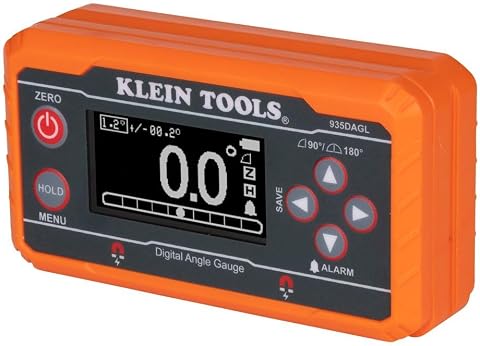
The Klein Tools 935DAGL is a digital level that accurately measures angles from 0 to 90 or 180 degrees, with a rotating display for horizontal or vertical use. It features an audible alarm for target angles, a magnetic base for attachment to ferromagnetic surfaces, and a versatile display for precise alignment in various applications.
Pros:
- Accurate angle measurement with programmable target angles
- Rotating display enhances usability in different orientations
- Magnetic V-groove base allows secure attachment to ferromagnetic surfaces
- Audible alarm ensures precise target angle detection
Cons:
- Limited to measuring angles up to 180 degrees
- Requires batteries for operation
- Designed primarily for professional use, may be complex for casual users
Best for: DIYers who regularly set or verify angles
Not ideal for: Those needing a measuring range or format this tool lacks
Bottom line: Compare its range, accuracy, and controls with the angle checks your projects require.
Dust Extractor Hose
Dust collection helps keep sanding and cutting work connected to a collection system, but a hose only works well when its ends fit the tools and extractor involved. The supplied product name describes a 9-gallon, 1400W, 19KPA wet dry vacuum cleaner and ends with “Dua,” leaving the complete listing unclear. Confirm the exact product, included hose, and connection dimensions before treating it as a hose upgrade. Identify the complete product and its included parts first. A common mistake is assuming that a hose will connect directly to every sander, saw, or vacuum. Measure or check the tool ports and extractor inlet, and look for adapters or cuffs that may be required. Review hose length and flexibility for the distance between your work area and collection unit; a hose that is awkward to route can interfere with handling. Also verify whether the product is intended for wet and dry use and follow the manufacturer’s instructions for the materials you collect. Confirm what filtration and accessories are included rather than inferring them from the listing title. This pick is worth considering only after its hose dimensions and connections are clear and suitable for your workshop equipment.What to look for:
- Verify the full product name and whether a hose is actually included.
- Check hose length, diameter, and end connection sizes.
- Confirm compatibility with your tools’ dust ports and the extractor inlet.
- Determine whether adapters are included or need to be sourced separately.
- Review the manufacturer’s wet and dry use instructions and included accessories.
Dust Extractor, 9 Gallon, 1400W, 19KPA Wet Dry Vacuum Cleaner with Dual Cyclone

This 9-gallon wet/dry vacuum features a dual cyclone pre-separator and HEPA filter, providing strong suction of 19KPA powered by a 1400W motor. It is designed for heavy-duty cleanup around woodworking shops, handling wood chips, shavings, and coarse debris efficiently while reducing filter maintenance.
Pros:
- Powerful 1400W motor with strong 19KPA suction
- Dual cyclone pre-separator reduces filter clogging
- Large 9-gallon capacity suitable for heavy-duty cleanup
- HEPA filter extends filter life and improves air quality
Cons:
- Heavy at 35.5 pounds, may be less portable
- No battery option, requires AC power
- Noise level of 80 dB may be loud for some users
Best for: DIYers matching a collection unit to known tool ports
Not ideal for: Shoppers who cannot confirm the complete listing or fittings
Bottom line: Confirm the full product details and connection sizes before relying on this as a hose upgrade.
When organizing purchases, start with the work that blocks your current projects most often: drilling and driving, surface preparation, glue-ups, routing, angle setup, or dust management. Then check what you already own and prioritize the missing capability with the clearest fit. Confirm compatibility and included parts before moving on to the next slot, especially for the combo kit, router table, and extractor listing.
A workshop does not need every upgrade at once. Build the checklist around the projects you enjoy and the tools that support them, taking time to verify dimensions, connections, and instructions as you go. With a little planning, each addition can make your workspace more ready for the next project.
Halloween Picks

Panefright Halloween Window Projector – Scary Projector for Spooky Decor

Kalolary 11 ft Halloween Inflatable Archway Ghost House Tunnel

HOPOCO Halloween Pumpkin Fog Machine with 12 LED Colors & Remote Control
As an affiliate, we earn on qualifying purchases.