
TL;DR

Get business pricing on tools and workshop supplies
- Business-only prices and quantity discounts
- Tax-exempt purchasing
- Multiple users, one account, clear invoices
Choose a jobsite fan by first deciding whether you need worker cooling, general circulation, or air exhausted from an enclosure. Match fan type and delivered airflow to the space, then check power, runtime, noise, durability, and placement. A fan can improve comfort, but it does not lower room temperature or replace designed ventilation, dust extraction, or controls for hazardous fumes.
A fan can make a hot room feel better in minutes, yet the same blast can send sanding dust across a finished floor or push fumes toward another worker. That gap between air movement and ventilation is where a good jobsite choice starts.
This guide helps you match a fan to the job: cooling people, circulating air, exhausting hot air, or supplying outdoor air. You’ll learn how to read CFM and m³/h ratings, when to choose an axial fan or blower, and how to plan for power, runtime, noise, and cleanup.
One point to keep in view: a jobsite fan can improve comfort, but it is not a substitute for a designed ventilation system, source capture, or the controls required for hazardous dust and fumes. A fan should support a safe work plan, not stand in for one.
Decide whether you need cooling, circulation, supply air, or exhaust before choosing a fan.
Compare CFM or m³/h ratings under similar test conditions, then account for ducting, distance, and obstructions.
Use axial fans for broad open-area airflow, blowers for more resistance or ducting, and exhaust fans to move air out of an enclosure.
Place the fan to avoid sending dust, debris, or fumes toward workers or other occupied spaces.
Check heat conditions, power, runtime, durability, noise, and maintenance; rent specialized high-capacity gear for short jobs.
Field guide / air movement
Tips for Selecting the Right Jobsite Fan for Ventilation and Cooling
Start with the job: cool workers, circulate room air, exhaust hot air, or supply outdoor air. Then match the fan and airflow path to the space, while planning for dust, power, runtime, noise, and placement.
Choose the outcome before the fan
These jobs can overlap, but they are not interchangeable. Name the problem and decide where the air should go.
Cooling
Move air across people to support sweat evaporation. The fan does not cool the room itself.
Circulation
Reduce stagnant pockets, while checking that the stream does not spread dust or debris.
Exhaust
Move hot air or odors out through a route that discharges away from other occupied spaces.
Supply air
Bring outdoor air into the space and allow a clear path for air to leave or be exhausted.
A comfort fan does not capture dust at its source. For hazardous airborne material, use suitable local exhaust ventilation or dust collection and follow site safety requirements.
Follow the air, step by step
The right setup depends on the work area, heat load, contaminants, available power, and the position of workers.
Name the job
Cooling, circulation, supply, or exhaust? Set one clear primary goal.
Map the path
Account for openings, distance, duct bends, filters, and obstructions.
Choose the type
Use an axial fan for open airflow, a blower for resistance, or exhaust gear for an enclosure.
Check at work
Confirm the stream reaches people or exits where intended without carrying contaminants elsewhere.
CFM is a starting point
CFM means cubic feet per minute; m³/h is cubic metres per hour. Compare ratings measured under similar conditions.
Rated airflow can differ from delivered airflow.
A box rating describes airflow under stated test conditions. Distance, ducting, filters, bends, dirty screens, and blocked openings can reduce what reaches a worker or exits an enclosure. There is no single CFM number for every room or task.
The bars show a directional concept, not a promised airflow percentage. Check manufacturer test conditions and assess the air at the occupied position or outlet.
Three designs, different strengths
Choose by the route air must take and its restrictions, not by appearance alone.
Axial fan
Moves a broad volume of air in a mostly straight path. Often suits open-area circulation, but may disturb loose dust and lose effectiveness in restrictive ducting.
Good fit / open spacesBlower
Creates a focused stream and can be a better candidate for ducting or bends. Resistance still reduces delivered airflow, so check the full route.
Good fit / defined routeExhaust fan
Moves air out through a planned opening. Provide a route for replacement air and discharge away from workers and other occupied areas.
Good fit / planned exhaustMake the setup work for the crew
A useful fan must fit the working conditions as well as the airflow task.
Air movement may help evaporation, but very hot or humid conditions can make airflow alone inadequate.
Do not aim contaminated air toward workers or other occupied spaces. Use controls suited to the material and task.
Confirm voltage, amperage, outlets, cord length, battery runtime, and safe operation in the intended environment.
Check the base, grille, housing, weight, and resistance to expected dust, moisture, and impacts.
Position airflow to reach workers without blowing loose materials around; consider communication and concentration.
Inspect cords and housing, clean grilles and blades, and replace parts as needed. Dust buildup can reduce performance.
Place the fan for people, not just airflow.
Aim a controlled stream across the occupied area while keeping dust, debris, and fumes away from workers. For hot-air exhaust, plan both the outlet and replacement-air inlet. A breeze can improve comfort; it does not prove that heat stress or exposure is controlled.
Before purchase: Compare similar airflow test conditions, confirm duct compatibility and power needs, review manufacturer instructions, and rent specialized high-capacity equipment for short jobs when appropriate. Verify current specifications and safety certifications directly with manufacturers.
Decide what you need the fan to do before comparing airflow
A jobsite fan earns its place when you match it to one clear task: cooling workers, circulating air, exhausting hot air, or bringing outdoor air into a space. Those jobs overlap, but they are not interchangeable; a fan that stirs indoor air does not remove contaminants from it. Treating them as separate goals helps prevent a common mistake: buying a high-output fan and assuming its airflow solves every heat or air-quality problem.
Picture a crew cutting trim in a small room on a warm afternoon. A fan aimed across the crew may help sweat evaporate, while the saw’s dust still needs collection at the tool. If you aim that fan toward an open doorway, you may simply push fine dust into the hall. The fan can make the room feel more comfortable while making dust control worse, so the intended destination of the air matters as much as how much air the fan moves.
Start by naming the problem and where the air should go. For worker comfort, direct a gentle stream across the occupied area without blasting debris. For hot air or odors, plan an exhaust path and a route for replacement air; without an inlet, the fan may have to work against pressure and move less air. For dust, use task-appropriate extraction or local exhaust ventilation; a comfort fan cannot capture particles at the source.
- Cooling: move air across people, while recognizing that the fan does not lower air temperature. The benefit depends on conditions and worker exposure, so a breeze alone does not establish that heat stress is controlled.
- Circulation: reduce stagnant pockets in a room, while checking that you are not spreading dust. Mixing air can make temperatures feel more even, but it does not remove contaminants.
- Exhaust or supply: move air through a planned opening, often with suitable ducting or equipment. The path must let replacement air enter and must discharge air somewhere it will not create another exposure.
That distinction is one of the key points for choosing a jobsite fan. If the job involves hazardous fumes or airborne material, follow the task’s safety requirements and select controls for the exposure. For electrical, gas, structural, or roof work, use licensed professionals where required; shut off power before work near electrical components, wear suitable PPE, and follow code and permit requirements.
Popular right now

Shark Navigator Lift-Away Upright Vacuum (NV360)

Dreame L40 Ultra Gen 2 Robot Vacuum and Mop

KitchenAid Artisan Series 5-Quart Tilt-Head Stand Mixer, Dried Rose (KSM150PS)
As an affiliate, we earn on qualifying purchases.
Read CFM as a starting point, then check the air where you work
CFM, or cubic feet per minute, tells you how much air a fan is rated to move under specified conditions; m³/h expresses the same kind of flow in metric units. Use the rating to compare fans tested on a similar basis, then account for how far the air must travel and what can block it. A rating describes the fan under a test setup, not necessarily the airflow a worker will feel or the amount of air that will leave a room.
A large number on a box can sound like a promise of strong airflow everywhere. In a real room, a doorway, stacked material, a long duct, or a dirty screen can slow the stream. The air at a worker’s bench may feel weak even while the fan is running at full speed. This is why a bigger free-air rating may offer little advantage if the job requires pushing air through a restrictive route.
For example, a compact fan set beside a doorway may move air effectively across a small work zone. Put the same fan at the end of a long duct with several bends, and the delivered flow can fall. Each bend, narrow section, or obstruction adds resistance; the fan spends more effort overcoming that resistance, leaving less airflow at the outlet. That is why the fan’s effective throw, duct compatibility, and placement matter alongside its rated CFM.
When choosing for a room, consider the room’s volume, openings, heat load, number of workers, and the work itself. There is no single CFM number that suits every job. A small open work area may need a directed stream for comfort, while exhausting an enclosure depends on the openings and resistance in the whole air path. If you need a specified ventilation rate for an exposure or enclosed space, use the applicable workplace guidance and a properly designed system rather than guessing from a comfort-fan rating.
Compare ratings honestly: check whether the manufacturer states a free-air figure or a measurement with resistance, and avoid treating different test conditions as equal. An airflow rating is useful evidence, but it does not guarantee that a particular worker receives enough fresh air or that contaminants leave the space. For a comfort task, check the airflow at the occupied position; for exhaust, verify that air can travel through the full route and discharge where intended.
Choose axial, blower, or exhaust designs for the path air must take
An axial fan moves a broad volume of air in a mostly straight path, a blower or centrifugal fan pushes against more resistance, and an exhaust fan is intended to move air out of an enclosure. Choose by the air path and restrictions, not by the fan’s shape alone. The useful distinction is how each handles the route: open and direct airflow favors an axial fan, while ducting and bends make resistance a bigger part of the decision.
An axial unit often suits general circulation in an open room. It can move a broad stream across a crew or toward a doorway, much like opening a window and adding a steady breeze. That broad stream can cover people without complicated setup, but it can also disturb loose dust and tends to lose effectiveness when asked to push through restrictive ducting. A blower is a better candidate when you need to push or pull air through ducting or around bends, though resistance still reduces delivered airflow. Its more focused flow can suit a defined route, but it does not remove the need to account for duct length, bends, and outlet placement.
Exhaust fans serve a different purpose: they move air out, so the setup needs a way for replacement air to enter. If you exhaust from a basement work area but seal every other opening, the fan may struggle to move air. Think through both ends of the path before plugging in. The inlet location matters too: replacement air should travel through the work area toward the exhaust so contaminated air is carried away rather than pulled across another occupied zone.
| Fan type | Best fit | Watch for |
|---|---|---|
| Axial | Broad air movement in open areas | Can stir dust or lose effectiveness with resistance |
| Blower or centrifugal | Ducting, focused airflow, or greater resistance | Duct length, bends, and restrictions reduce flow |
| Exhaust fan | Moving air out of an enclosure | Needs a planned exhaust route and replacement air |
Imagine a musty crawlspace where you need to direct air outside. An exhaust setup with suitable ducting may make more sense than a portable fan aimed at the access hatch. The right equipment depends on the enclosure and the hazard; for confined or potentially hazardous spaces, use the required assessment and controls, not a fan chosen for comfort.
Place the fan so it cools workers without spreading dust
Place a jobsite fan so its airflow reaches the people who need comfort while keeping dust, debris, and fumes away from workers and other occupied areas. Good placement can make a modest fan useful; poor placement can turn it into a dust distributor. Think of the fan as setting an air route: where the air starts, what it crosses, and where it ends up all affect whether the placement helps.
Start with the work zone and the air’s destination. A fan angled across a room may help a worker at a bench, but if it points at an open bag of joint compound or a pile of sawdust, the breeze can lift material into the air. Keep loose sheets, insulation, and plastic sheeting clear of the intake and outlet, too. When the source of dust is active, moving air across it can carry fine particles farther than they would otherwise travel, so source extraction should take priority over comfort airflow.
Here’s a practical sequence for a warm renovation room:
- Identify the occupied area and the task generating heat or airborne material. This shows whether the fan should serve workers, support an exhaust route, or stay off during a dusty operation.
- Choose the intended air path—across workers, toward an exhaust opening, or through ducting. A clear path makes airflow more predictable and helps avoid pushing air into another work area.
- Set the fan on a stable surface where it cannot tip, block an exit, or catch a cord underfoot. A safe, secure position also keeps the fan from shifting and redirecting air as people move around it.
- Run it at a moderate setting and check for blowing dust, loose materials, or an uncomfortable direct blast. Increasing speed can improve reach, but it can also stir debris and make conversation harder.
- Recheck as the work changes, especially when doors close or other trades start making dust. A changed opening or new dust source can alter the air route and turn a previously suitable setup into a problem.
A contractor finishing drywall might use source dust extraction during sanding and reserve a fan for worker comfort after the dusty task ends. That simple timing change helps avoid sending fine dust through the room. If contaminants are present, choose controls based on the material and task, and follow the fan instructions and site safety rules.
Airflow that feels pleasant is not proof of safe air. A comfort fan can move contaminants around without removing them.
Check heat, humidity, power, and runtime before the shift starts
Air movement can help sweat evaporate and can improve comfort, but it does not remove heat from a room or cool the air itself. In very hot, humid conditions—or when workers cannot cool themselves effectively—airflow alone may not be enough. That limit matters because feeling a breeze can create a false sense that the overall heat exposure is under control.
That difference matters on a humid afternoon in a closed upper-floor room. A fan may make sweat evaporate more readily, yet the room can remain hot, and the body may still struggle to shed heat. Follow the site’s heat-safety plan and use appropriate rest, hydration, and monitoring practices; don’t treat a breeze as a cure for heat stress.
Then check how the fan will run. Confirm voltage, amperage, available outlets, cord length, battery platform, and expected runtime at the speed you plan to use. A mismatch between the fan’s power needs and the site supply can limit where it can run or interrupt work. Battery-powered models are handy where outlets are scarce and can reduce cord clutter, but runtime changes with speed and battery capacity. A crew that needs airflow for a full shift should plan spare batteries or a charging rotation instead of relying on a best-case runtime claim; that adds kit and logistics, but avoids losing airflow partway through the task.
Keep cords out of walkways, inspect them for damage, and use electrical equipment only as directed for the environment. If the area is wet, dusty, or otherwise demanding, verify that the fan is suitable for those conditions. Do not assume a general-purpose model is approved for hazardous or explosive atmospheres; it must be specifically rated for that use.
For example, a small battery fan may be a sensible DIY-grade choice for a short punch-list task in a dry room. A crew ventilating a large enclosure for hours may need pro-grade equipment, a planned power supply, or a rental unit sized for the airflow path. Pay for capacity and duty cycle you will use: extra capacity can help where resistance or long operation matters, while an oversized or underused unit adds cost, weight, and storage burden without solving a poorly planned airflow route.
Compare durability, noise, maintenance, and rental value
A jobsite fan should have a stable base, a protective grille, housing suited to expected impacts, and parts you can clean and inspect. These details matter because a dusty, vibrating unit can lose performance, tip in traffic, or become a nuisance before the project ends. A sturdier model may cost more and weigh more to move, so consider how often it will be transported and whether it will sit in one protected spot or travel between rough work areas.
Listen to the fan where people will work, not just beside the motor. A loud unit can drown out instructions and concentration, especially in a small room with hard walls. If a quieter setting still moves enough air, use it; if the job needs stronger airflow, position the fan farther from conversation areas and keep the stream pointed where it helps. Lower noise can improve communication, but choosing a quieter fan that cannot deliver the needed airflow is a poor trade, so assess noise and performance together at the intended position.
Dust buildup can clog grilles and blades, reducing airflow. Unplug the fan or remove its battery before cleaning, follow the manufacturer’s instructions, and inspect the cord, housing, grille, and base for damage. A quick check at the end of a dusty shift can catch a cracked grille or loose mount before the next crew starts. Regular cleaning takes time, but letting buildup accumulate can reduce airflow and make the fan less effective when the job needs it most.
Features such as brushless motors, speed settings, adjustable stands, and shared battery platforms are increasingly common. They can be useful, but judge each by the task: multiple speeds help tune airflow, while a shared battery may reduce the kit a small crew carries. Verify current runtime, specifications, and safety certifications directly with the manufacturer before purchase.
Rent when you need high-capacity ventilation for one short project, specialized ducting, or equipment that would sit unused afterward. Buy a portable DIY-grade fan for occasional comfort work; choose pro-grade gear when it will take daily transport, dust, and long runtimes. A one-week rental can cost less than storing and maintaining a machine you rarely need, while frequent rentals may cost more over time than owning suitable equipment. Compare the expected use, transport, storage, and maintenance rather than judging by purchase price alone.
Frequently Asked Questions
What size jobsite fan do I need for my room?
There is no single fan size for every room. Consider the room volume, openings, heat, number of workers, task, and whether you need comfort airflow or actual exhaust ventilation. A small fan can serve a bench area, while an enclosure or long duct run may call for purpose-built equipment.
How many CFM should I look for?
Use CFM as a comparison figure, not a guarantee of air at the worker’s position. Compare ratings measured under similar conditions, then account for distance, ducting, filters, and obstructions. For required contaminant control or a specified ventilation rate, follow applicable guidance and use a properly designed system.
Can a jobsite fan cool a room?
A fan moves air; it does not lower the room’s air temperature. Air movement can help sweat evaporate and make people feel cooler, but heat and humidity can limit that benefit. Follow the site heat-safety plan when conditions are severe.
Will a jobsite fan remove dust, fumes, or odors?
A recirculating fan does not remove contaminants and may spread them. Use source capture, suitable local exhaust ventilation, or other controls matched to the material and task. Do not direct contaminated air toward workers or into occupied areas.
Can I use a fan with ducting in a basement or crawlspace?
Some blowers and exhaust fans work with ducting, but bends, length, and restrictions reduce delivered airflow. Plan both the exhaust route and the path for replacement air, and check that the equipment is suitable for the environment. For confined or potentially hazardous spaces, follow required safety procedures and ventilation design rather than relying on a comfort fan.
Is a battery-powered fan strong enough for a full shift?
It depends on the fan, battery capacity, speed setting, and duty cycle. Higher speeds generally draw more power, so check runtime at the setting you intend to use and plan spare batteries or charging. Battery models can reduce cord clutter where outlets are scarce, but they do not automatically provide the airflow needed for ventilation.
Where should I place the fan to avoid spreading dust?
Keep the fan’s stream away from loose dust, debris, and contaminated air, and aim it toward the intended occupied zone or planned exhaust route. Pair dusty tasks with appropriate extraction at the source. Recheck placement when doors, materials, or other trades change the airflow path.
Conclusion
Choose a jobsite fan by tracing the air from its starting point to its destination, then match the fan, power, and placement to that route. For worker comfort, airflow can help; for hazardous dust or fumes, use the designed controls the task requires.
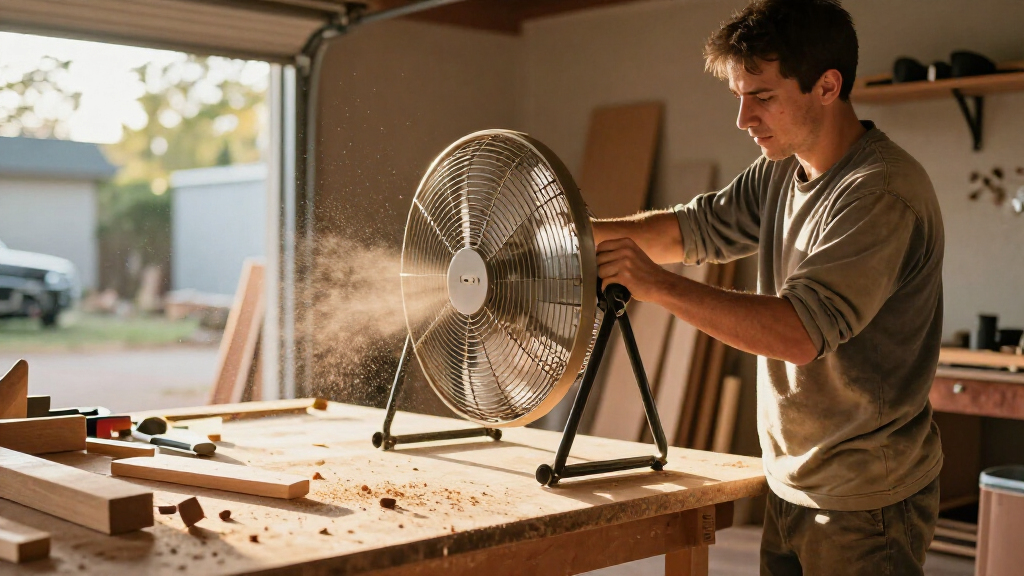
Make that distinction before the motor starts. The right fan should leave the crew cooler and the air path clearer—not leave a sunlit cloud of dust drifting through the doorway.