
TL;DR

Get business pricing on tools and workshop supplies
- Business-only prices and quantity discounts
- Tax-exempt purchasing
- Multiple users, one account, clear invoices
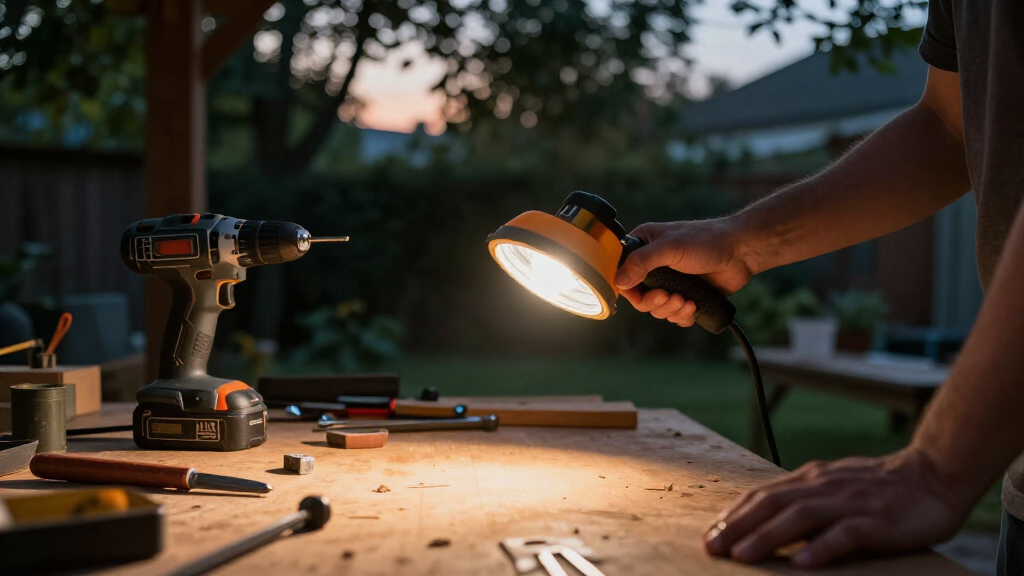
The best portable work light for nighttime or low-light work provides sufficient brightness matched to the task (300–1,000 lumens for most garage and automotive work, 1,000+ for construction), a CRI of 80 or higher for color-accurate tasks, honest sustained runtime, and secure mounting. Advertised maximum lumens routinely overstate real-world output because most lights throttle brightness within minutes to manage heat — so check runtime at the setting you’ll actually use, not the box claim.
The ugliest jobsite injury I ever saw happened at 9 p.m. on a half-finished addition. Guy was carrying a bundle of trim across a room lit by one dim headlamp, missed a floor opening, and went down hard. Nothing broken, but he lost three weeks of work. The light was the problem — not his eyes, not his footing. The portable work light he grabbed that night was the wrong tool for the job.
After twenty-plus years running renovation crews, I’ll tell you what I tell every apprentice: nighttime or low-light conditions punish cheap lighting faster than any other jobsite condition. And the specs on the box will actively mislead you if you don’t know how to read them. A good portable work light should deliver enough brightness, hold position, survive a drop, and still be running when the job runs long — with long battery life at the brightness you actually set, not the eco mode nobody uses.
In this guide, you’ll learn how to match lumens to your task, why color rendering matters more than most people think, how to spot fake runtime claims, and which light styles fit which jobs. No product roundups. Just the spec literacy that keeps you working — and keeps all ten fingers.
Match lumens to the task: 300–1,000 lumens covers most garage, automotive, and home work; save 1,000+ lumens for construction and large outdoor areas.
Assume sustained output is 50–70% of the advertised maximum — always check runtime at the brightness setting you’ll actually use.
Buy CRI 80+ (ideally 90+) and neutral white 4,000–5,000K for any wiring, painting, or color-identification work; low-CRI light distorts what you see.
Positioning beats brightness: magnetic bases, hooks, clamps, and tripod mounts make a mid-power light more useful than a big one you can’t place.
Never use a standard LED work light around flammable vapors or combustible dust — hazardous-location-rated lighting is a code requirement, not a preference.
Choosing the Best Portable Work Light for Nighttime or Low-Light Conditions
Twenty-plus years of renovation crews taught one lesson fast: darkness punishes cheap lighting faster than any other jobsite condition. This is the spec literacy that keeps you working — and keeps all ten fingers.
How Many Lumens You Actually Need (It’s Less Than the Box Says)
Lumens measure total output — not usability at your work surface. Light falls off with the square of distance, so the same 800-lumen light can feel perfect under a car and useless across a backyard. A well-designed 800-lumen flood panel lights an entire engine bay evenly; a sloppy 2,000-lumen beam leaves you squinting at hotspots while corners sit in shadow. Beam pattern beats raw output almost every time.
Match the Light to the Job: A Contractor’s Use-Case Table
Brightness, mounting style, and power source all shift with the task. Here’s the cheat sheet built from years of jobsite trial and error.
| Use Case | Brightness | Best Style | Must-Have Features |
|---|---|---|---|
| Home repairs & DIY | 300–800 lm | Folding panel or magnetic light | Rechargeable, stable base |
| Automotive work | 300–1,000 lm | Slim magnetic inspection light | High CRI (80+), flexible positioning |
| Construction / jobsite | 1,000+ lm | Folding panel or tripod flood | Impact resistance, IP54+, long runtime |
| Camping | 100–500 lm | Lantern style | Low-power mode, weather resistance |
| Emergency preparedness | 300–1,000 lm | Lantern + headlamp combo | Multi-power, power-bank function |
| Crawlspace / under-vehicle | 200–500 lm | Headlamp | Adjustable beam, comfortable strap |
Runtime Lies: Why Your Light Dies Two Hours Early
LEDs convert roughly a third of their input power to light — the rest becomes heat, and heat kills LEDs and lithium batteries. So manufacturers install a governor: most work lights throttle to 50–70% of advertised brightness within minutes, and almost none of them put it on the front of the box. That 3-hour runtime claim? Usually measured at the lowest usable setting — not the maximum you bought the light for.
Real-World Case · Budget 1,800 lm Tower
Advertised “4 hours” — but in real testing on high, it hit half brightness at the twelve-minute mark and shut off completely at 1 hour 50 minutes. The “4 hours” was true only at the 300-lumen setting nobody actually works by.
Output Scaling Reality
A light that runs ten hours at 100 lumens may last only 90 minutes at 1,000. Your 2,000-lumen light probably functions as a 1,200-lumen light after ten minutes. Compare runtime charts at each brightness level — reputable manufacturers publish them.
Power On
Advertised peak lumens delivered — briefly.
Heat Builds
~⅔ of input power converts to heat inside the housing.
Thermal Governor
Circuit silently throttles to 50–70% of peak output.
Check the Chart
Buy on runtime at the setting you’ll actually use.
Why Color Rendering Matters More Than You Think
For electrical work, painting, wiring, or identifying color-coded components, low-CRI light distorts what you see. Buy CRI 80+ (ideally 90+) with neutral white in the 4,000–5,000K range. Cool-white up to 6,500K can make details pop, but strays toward blue distortion on painted surfaces.
Match lumens to the task
300–1,000 lm covers most garage, automotive, and home work; save 1,000+ for construction and large outdoor areas.
Assume 50–70% sustained output
Always check runtime at the brightness setting you’ll actually use — not the eco mode nobody uses.
Buy CRI 80+ and neutral white
4,000–5,000K for wiring, painting, and color-ID work. Low-CRI light distorts what you see.
Mounting beats lumens
Magnetic bases, hooks, clamps, and tripods make a mid-power light more useful than a big one you can’t place.
Hazardous locations need rated lights
Never use a standard LED light around flammable vapors or combustible dust — hazloc rating is code, not preference.
IP rating ≠ impact resistance
IP54/IP67 covers dust and water only. Look for impact-rated housings, sealed switches, and rubberized edges separately.
How Many Lumens You Actually Need (It’s Less Than the Box Says)
For most household, garage, and automotive work, 300–1,000 lumens is plenty. Close-up inspection and small repairs need only 100–300 lumens. Reserve 1,000+ lumens for construction sites, large outdoor areas, and emergency area lighting. Anything beyond that is marketing muscle-flexing that trades runtime for numbers on a box.
Why the ranges instead of one number? Because usable brightness depends on distance and spread. Lumens measure total light output, not how usable that light is at your work surface. Light falls off with the square of distance — a light that generously illuminates a workbench two feet away leaves a ten-foot room mostly dark. That’s why the same 800-lumen light can feel perfect under a car and useless for lighting a backyard job site. Match the number to the throw distance, not to the sticker.
Here’s the trap. A 2,000-lumen light with a sloppy, hot-centered beam can leave you squinting at hotspots while the corners of your workspace sit in shadow. Meanwhile, a well-designed 800-lumen flood panel lights an entire engine bay evenly. Beam pattern beats raw output almost every time — and overbuying lumens carries a real penalty: more heat, faster throttling, shorter runtime, and glare that actually makes detail work harder to see.
Think of it like watering a garden. A fire hose puts out more water than a sprinkler, but the sprinkler covers the whole bed. A spot beam concentrates light for inspection at a distance — reading a breaker panel label from across a garage or checking soffit damage from the ground. A flood beam spreads it across a workspace — an engine bay, a workbench, a stairwell during a trim-out. For nighttime or low-light conditions, you almost always want flood, with a spot mode available for checking something 40 feet across the yard.
Concrete example: a homeowner wiring an outlet at night needs maybe 400 lumens of even flood light clipped to a shelf overhead. A framer closing in a deck after dark needs 1,500+ lumens on a tripod just to see layout lines across sixteen feet of framing. Same hour of the night, wildly different lumen budgets — which is why a single “brightest light wins” shopping strategy fails both of them.
Last thing: never confuse advertised maximum output with sustained output. More on that in the battery section, because it’s the single most common way buyers get burned.
Popular right now

Bose QuietComfort Wireless Bluetooth Headphones with Active Noise Cancellation, Mic, USB‑C Charging, Deep Bass, 24‑Hour Battery – White Smok

Bose QuietComfort Wireless Noise-Cancelling Over-Ear Headphones, Black

Apple AirPods Pro 3 Wireless Earbuds with Active Noise Cancellation
As an affiliate, we earn on qualifying purchases.
Match the Light to the Job: A Contractor’s Use-Case Table
The right portable work light depends entirely on the task — brightness, mounting style, and power source all shift with the job. Here’s the cheat sheet I’ve built from years of jobsite trial and error.
| Use Case | Brightness | Best Style | Must-Have Features |
|---|---|---|---|
| Home repairs & DIY | 300–800 lm | Folding panel or magnetic light | Rechargeable, stable base |
| Automotive work | 300–1,000 lm | Slim magnetic inspection light | High CRI (80+), flexible positioning |
| Construction / jobsite | 1,000+ lm | Folding panel or tripod flood | Impact resistance, IP54+, long runtime |
| Camping | 100–500 lm | Lantern style | Low-power mode, weather resistance |
| Emergency preparedness | 300–1,000 lm | Lantern + headlamp combo | Multi-power, power-bank function |
| Crawlspace / under-vehicle | 200–500 lm | Headlamp | Adjustable beam, comfortable strap |
Real example: last winter I pulled a late night swapping a water heater in a tight mechanical closet. The light that saved me wasn’t the brightest one on the truck — it was a slim magnetic inspection light stuck to the ductwork above the fittings, throwing shadow-free light exactly where my hands were. The 1,500-lumen tripod in the hallway was nearly useless through the closet door.
Notice the pattern: positioning beats brightness in tight spaces. A light you can aim, stick, hang, or wear outperforms a bigger light you can’t place.
Runtime Lies: Why Your Light Dies Two Hours Early
Most LED work lights throttle output within minutes of turning on to manage heat, and many drop to 50–70% of advertised brightness during sustained use. That 3-hour runtime claim? It’s usually measured at the lowest usable setting, not the maximum you bought the light for. This is the most expensive misunderstanding in work light shopping.
Here’s the physics behind it: LEDs convert roughly a third of their input power to light and the rest to heat, and heat is what kills LEDs and lithium batteries. Think of it like a car engine — redline it constantly and something gives, so the manufacturer installs a governor. Almost all light makers quietly “govern” the output down, and almost none of them put that on the front of the box. The implication for you: the 2,000-lumen light you bought probably functions as a 1,200-lumen light after ten minutes, and its runtime claim at “2,000 lumens” is a fiction.
A light that runs ten hours at 100 lumens might last 90 minutes at 1,000. Concrete case: I bought a budget 1,800-lumen tower a few years back, advertised at “4 hours.” On high, in real testing, it hit half brightness at the twelve-minute mark and shut off completely at 1 hour 50 minutes. The “4 hours” was true only at the 300-lumen setting nobody actually works by. So when you’re comparing models, look past the headline number and find the runtime chart at each brightness level. Reputable manufacturers publish them. The ones who don’t are telling you something.
For nighttime or low-light conditions specifically, plan your power around your worst-case job, not your typical one. My rule of thumb from running night crew work: buy double the runtime you think you need. Batteries age — a pack that held 100% new holds 80% after two years of jobsite cycling — cold cuts lithium-ion capacity by 20–30% (which is why the light that ran all last summer dies mid-shift in January), and jobs always run long after dark. Example: if your typical evening job runs two hours, buy for four — because the night the water heater bursts at 10 p.m. is the night the job takes four.
- USB-C charging — one cable for light and phone; ditch proprietary chargers
- Swappable battery packs — tool-brand lights sharing your drill batteries are gold on jobsites
- Hybrid AC/battery power — corded backup when an outlet is reachable
- Battery-level indicator — non-negotiable; guessing dead is how jobs stall
- Power-bank function — handy for emergencies, but it drains your light fast
Never trust the lumens-and-hours pairing on the front of the box. Check the runtime at the setting you’ll actually use — that’s the only number that matters at midnight.
Color Temperature and CRI: The Specs That Reveal What Your Eyes Miss
Color Rendering Index (CRI) measures how accurately a light shows true colors, on a scale to 100 — and for electrical, painting, or automotive work, it matters more than extra lumens. A CRI of 80+ is the floor for color-sensitive work; 90+ is what you want when misreading a wire color or a paint match costs real money.
I learned this the hard way on a trim-punch job. Under a cheap 6,500K cool-blue light, a touch-up caulk line looked matched. In daylight, it was visibly yellow. Two hours of redo for the sake of a $30 CRI difference. Now every light in my painting kit is 90+ CRI, no exceptions.
Color temperature works on a simple tradeoff. Neutral white around 4,000–5,000K is the all-purpose sweet spot — natural detail visibility without the harsh blue. Cooler light up to 6,500K feels brighter and works for general construction. Warmer, diffused light is easier on the eyes in pitch-dark surroundings and preserves night vision better.
The failure mode nobody warns you about: very bright, low-CRI light makes you feel like you can see everything while actually distorting what you see. Glare and harsh shadows compound it. Diffusers, frosted lenses, and adjustable brightness all help. And don’t stare into a high-output LED — a 1,000-lumen point source at arm’s length leaves a purple blot in your vision for several minutes. On a ladder, that’s a genuine hazard.
Durability, IP Ratings, and the Safety Stuff That Keeps You Out of Trouble
For jobsite use, look for an IP54 rating minimum (dust-protected, splash-resistant), with IP65 or IP67 for outdoor rain exposure or washdown environments. But know what the rating doesn’t cover: IP measures dust and water ingress only, not impact resistance or hazardous-location suitability. A waterproof light can still shatter, and no standard LED work light belongs around flammable vapors.
My jobsite durability shortlist, earned through broken hardware:
- Rubberized edges and impact-resistant housing — lights get knocked off hoods and scaffolding; assume it will drop
- Sealed switch and charging port — dust kills switches years before the LED dies
- Aluminum housing or heat sink — thermal management sustains output and extends LED and battery life
- Stable, weighted base — a tipping light is a falling light
- Lockout mode — prevents a packed-away light from turning on and arriving dead
Now the serious part. If you’re working around gasoline vapors, solvents, propane, or combustible dust — garage fuel systems, spray finishing, grain handling — you need lighting rated for hazardous (classified) locations. A general-purpose LED work light is not intrinsically safe, and its circuits can produce sparks or hot surfaces. That’s not a DIY judgment call; it’s a fire code issue, and it’s one of the few areas where I’ll flat-out say: talk to a licensed professional or your fire marshal before you light that space.
Same discipline applies to leaving any light running unattended overnight: stable surface, clear of flammable materials, ventilation unobstructed. Batteries and thermal protection fail — give them room to do it safely.
Ten Minutes of Shopping Discipline: A Step-by-Step Selection Process
Picking the right portable work light in one pass comes down to six questions answered in order — task first, budget last. Here’s the exact sequence I use before spending money on any light, tool-brand or budget.
- Define the task and space. Tight inspection work, room-filling area light, or hands-free crawling? This single answer eliminates half the market. Example: “brake jobs in my driveway at night” points you to a magnetic high-CRI light, not a tripod flood.
- Set the brightness range. 100–300 lm close-up, 300–1,000 lm general work, 1,000+ lm large areas and outdoor jobsites.
- Check CRI and color temp. 80+ CRI for any color work, 90+ for paint and wiring; 4,000–5,000K neutral white as the default. If the listing doesn’t mention CRI at all, assume it’s low — silence is a spec.
- Verify real runtime. Find runtime at your intended brightness, then double it. Confirm USB-C or swappable-battery power. If the spec sheet only shows one runtime number with no brightness setting attached, walk away.
- Match the mounting. Magnetic base, hook, clamp, tripod thread, or head strap — the light must hold position where you work. Picture your actual job: if you can’t say exactly where the light will attach, it’s the wrong light.
- Check durability and total cost. IP54+ for dusty or damp sites, drop protection, replaceable batteries, and a real warranty. A $90 light with a 5-year warranty beats three $35 throwaways — the throwaway math only works if it never gets dropped, which it will.
The tradeoff worth naming honestly: every light compromises somewhere. Ultrabright lights trade runtime. Compact lights trade beam spread. Cheap lights trade sustained output and switch life. Your job in step one is deciding which compromise you can live with — because “no compromise” at $60 doesn’t exist.
On DIY-grade versus pro-grade: a homeowner doing occasional evening projects does not need a $200 tool-platform light. A solid $60–100 folding LED panel covers 90% of home use. Where pro-grade earns its price is sustained jobsite abuse, shared battery ecosystems, and runtime under cold conditions. And if you have a one-off overnight project — a single 2 a.m. plumbing repair — rent a proper tripod light for $25 instead of buying the wrong one forever.
Frequently Asked Questions
How many lumens do I need for nighttime work?
For most household, garage, and automotive tasks, 300–1,000 lumens is sufficient. Construction sites and large outdoor areas call for 1,000 lumens or more, while close-up inspection needs only 100–300. Beam pattern and positioning matter more than chasing higher numbers.
Is a higher lumen rating always better?
No. A high lumen rating with a poor beam creates glare, hotspots, and shadows while draining the battery faster. Beam shape, color rendering, mounting options, and honest runtime determine whether light is actually usable at your work surface.
Why does my work light get dimmer after a few minutes?
Most LED work lights use thermal regulation and automatically reduce brightness to control heat and protect the LED and battery. Sustained output often falls to 50–70% of the advertised peak, so manufacturers’ maximum-output runtime claims rarely reflect real use.
Are rechargeable work lights better than replaceable-battery models?
Rechargeable lithium-ion lights are more economical for frequent use, especially with USB-C charging. But for emergencies or remote work without charging access, lights with replaceable batteries or dual AC/battery power are the safer bet. Keeping both types covers you.
What does CRI mean, and when does it matter?
CRI (Color Rendering Index) measures how accurately a light reveals true colors, up to 100. It matters for electrical wiring, painting, and automotive work where misreading a color costs money — look for CRI 80 or higher, and 90+ for color-critical tasks.
Can I use a regular LED work light around gasoline or solvent vapors?
No. General-purpose LED work lights are not intrinsically safe and can produce sparks or hot surfaces. Areas with flammable vapors or combustible dust require lighting specifically rated for hazardous locations — treat this as a code and safety requirement and consult a qualified professional.
Do I need an IP-rated work light?
For outdoor, garage, jobsite, or emergency use, yes. IP54 handles dust and splashes; IP65–IP67 covers rain and temporary immersion. Note that IP ratings only measure dust and water protection, not impact resistance or hazardous-location suitability.
Conclusion
If you remember one thing from this guide, make it this: buy the runtime and the mounting, not the lumen number. A modest, honest 800-lumen light you can position exactly where your hands are, running reliably at hour three, beats a 2,000-lumen torch that throttles down, tips over, and dies before the job does. The best portable work light is the one still burning when you’re packing up tools in the dark.
Check the runtime chart. Check the CRI. Check the base. Five minutes of spec literacy on the front end saves you the midnight hardware store run — and maybe, like that trim carpenter I worked with years ago, saves you a fall you never saw coming.