TL;DR

Get business pricing on tools and workshop supplies
- Business-only prices and quantity discounts
- Tax-exempt purchasing
- Multiple users, one account, clear invoices
A framing-lumber stamp records who made and graded a board, its grade and species, and how wet it was when surfaced. Those details link the board to published design values and code span tables; a price tag or visual inspection cannot establish the same information. A stamp applies to a graded lot, however, and does not promise that every board in a store bin meets its grade.
A grade stamp on framing lumber identifies the mill, grading agency, grade, species and moisture condition—information that determines how the board connects to published structural design values. A Family Handyman report explains how those markings help builders and buyers choose lumber for floors, walls and roofs, while cautioning that the stamp does not guarantee every board in a retail bin is on grade.
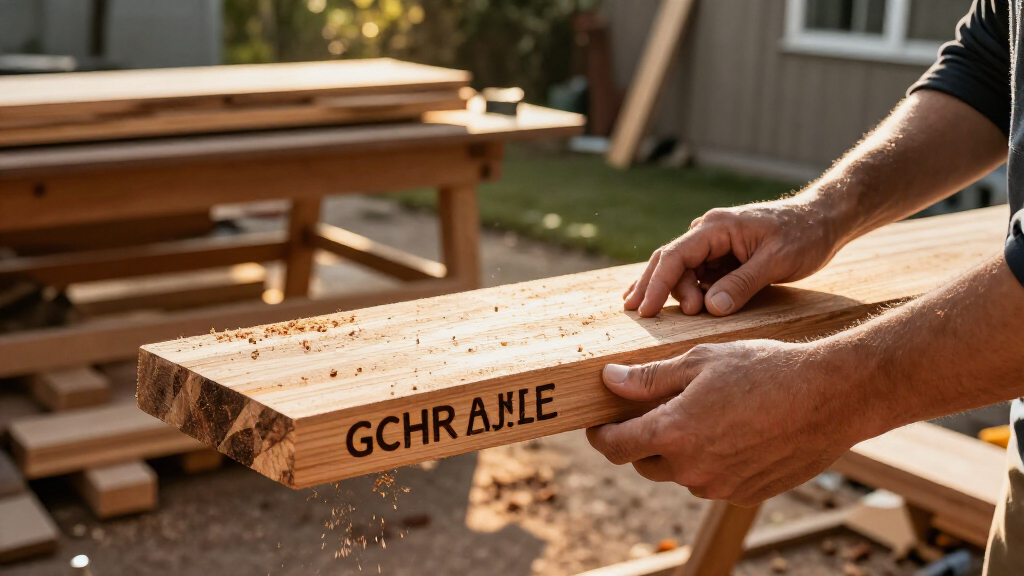
The stamp is usually printed in black ink near one end of a 2-by-4, 2-by-6 or other framing board. Its five core fields identify the mill, the agency overseeing the grade, the board’s grade, its species and its moisture condition when surfaced. Some stamps also include a note about surfacing. The agency’s layout can vary, so readers may need to identify each field by its wording or mark rather than its position.
The grade and species together connect a board to published design values, including strength ratings used in building-code span tables. Those tables specify how far a joist or rafter can extend between supports based on factors such as lumber size, species, grade and spacing. The report says the 2024 International Residential Code requires sawn lumber used for load-supporting framing to bear a grade stamp or a certificate of inspection.
The report identifies mill numbers as traceability information: they can help track a board back to its source if a problem affects a batch, but do not by themselves change the board’s structural rating. The grading-agency mark shows who supervised grading. Agencies accredited under the American Lumber Standard Committee system apply common dimension-lumber grading rules, so a grade such as No. 2 has a shared meaning across accredited agencies.
Why the Stamp Affects Structural Choices
Reading the stamp matters because appearance alone does not establish structural capacity. The report describes a buyer rejecting five boards for wane—bark or missing wood along an edge—then selecting five replacements that were all below grade. A board that looks cleaner is not necessarily a better structural choice, and visible defects matter according to how grading rules relate them to strength.
For a homeowner or builder, the grade and species help determine whether lumber is suitable for a particular framing use and span. Choosing by the printed price or by appearance alone can leave out information that code-based span tables require. The stamp is not a substitute for the plans, applicable code or correct span table; it supplies identification needed to use those references.
Moisture information also helps explain why a board can change after installation. The report says the stamp records how wet the lumber was when surfaced, or planed to its final size. That can provide an indication of how much shrinkage may remain, though it is not a precise prediction of how much an individual board will move in a particular building.
Popular right now

Vitamix Propel Series 510 Professional-Grade Blender, 3 Programs, Black

Dreame L50 Ultra Robot Vacuum and Mop

Bose QuietComfort Wireless Bluetooth Headphones with Active Noise Cancellation, Mic, USB‑C Charging, Deep Bass, 24‑Hour Battery – White Smok
As an affiliate, we earn on qualifying purchases.
How Lumber Grading Is Supervised
The source report draws on interviews with Pete Austin, Western Wood Products Association director of quality, and Paul Conway, executive vice president of the American Lumber Standard Committee. Austin has worked in lumber grading for nearly 30 years, according to the report. Conway described lumber grading as imperfect because wood is a natural material and boards differ.
As described in the report, grading agencies inspect mills and oversee grading rather than requiring every board to be individually checked by an outside grader. The American Lumber Standard Committee requires agencies to inspect each mill at least 12 times a year, and the federal standard bars an agency from being controlled by a producer whose products it inspects. The source says agencies assess lumber by production unit, or a banded bundle shipped as one lot; a unit is considered on grade when at least 95 percent of its pieces meet the grade.
That lot-based system explains why a retail board can fall short even when its stamp is legitimate. The report says design values are conservative: they are based on strength near the lower end of a grade and adjusted for safety and sustained loads. The stamp is therefore part of a standards system, not a promise of identical performance from every piece.
“I don’t think that they fully understand what it is they’re buying.”
— Pete Austin, Western Wood Products Association director of quality, as quoted in Family Handyman
What a Stamp Cannot Confirm
A grade stamp does not establish that every individual board in a store bin meets its printed grade. According to Conway, the system accepts a production unit when at least 95 percent of its pieces make grade, so some individual pieces may not. The report does not say how often a consumer will encounter an off-grade board in a particular store or lot.
The stamp also does not by itself confirm that a board is appropriate for every project. A suitable span depends on the species, grade, dimensions, spacing and loading conditions, among other details represented in applicable tables and plans. The source report does not give project-specific spans or assess any individual board or building.
Moisture markings describe the board’s condition when it was surfaced, not a precise forecast of future shrinkage. The report also advises checking an unfamiliar agency mark against the ALSC’s published list. It does not establish the status of a particular stamp unless that mark is checked against the current list.
Check the Mark Before Building
For buyers choosing framing lumber, the practical next step is to read the full stamp rather than stopping at the grade or price. Confirm the species and grade against the plans and the relevant span table, and check an unfamiliar grading-agency logo against the ALSC list. The report says the committee’s January 2026 list includes seven U.S. grading agencies and 10 Canadian agencies.
Builders should continue to follow applicable building codes and project specifications. Where structural suitability is uncertain, the stamp alone cannot resolve the question; the correct design values and project conditions must be checked. The report provides no announced policy change or new grading requirement. Its central guidance is about interpreting an existing system and understanding the limits as well as the value of the markings.
Key Questions
What information is on a framing-lumber stamp?
The stamp generally identifies the mill, grading agency, grade, species and moisture condition when the lumber was surfaced. Some stamps also include a surfacing note, and agencies may arrange the fields differently.
Does a grade stamp guarantee every board meets its grade?
No. The report says grading inspections assess a production unit, and a unit is considered on grade when at least 95 percent of its pieces meet the grade. The stamp does not guarantee every board in a retail bin is on grade.
Why do grade and species matter?
Together, grade and species link lumber to published design values. Those values are used in code span tables to determine how far a joist or rafter can span under specified conditions.
What does the mill number tell a buyer?
The mill number identifies the lumber’s source and can help trace a batch if a problem arises. According to the report, it does not change the board’s structural rating.
What should I do if I do not recognize the agency logo?
Check the mark against the American Lumber Standard Committee’s list of accredited grading agencies. The report says a logo not on that list is not an accredited grade stamp, and the board counts as unstamped.
Source: rss