TL;DR

Get business pricing on tools and workshop supplies
- Business-only prices and quantity discounts
- Tax-exempt purchasing
- Multiple users, one account, clear invoices
Most nail guns need a compressor delivering 2–4 CFM at 90 PSI; a 6-gallon oil-free hot dog or pancake compressor handles framing and finish work for one user. Match the compressor’s CFM rating to your tool’s spec with 25% headroom, keep noise under 80 dB for indoor work, and drain the tank after every use to prevent rust.
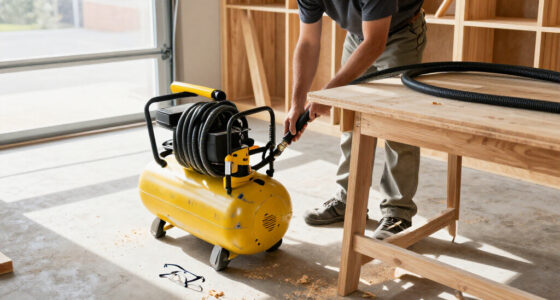
The loudest thing on most renovation sites isn’t the saw — it’s the wrong air compressor, cycling every fourth board because somebody bought on tank size instead of CFM. I’ve watched it happen a dozen times. A homeowner grabs a 3-gallon pancake compressor for a decking project, and by noon the poor thing is running half the time just to keep a framing nailer fed.
Here’s the good news: choosing a compressor for nail guns is simple once you know three numbers — CFM at 90 PSI, tank size, and noise output. Everything else is preference. This guide gives you a working knowledge of those specs, plus the jobsite habits that keep a compressor alive for a decade instead of two seasons.
No product roundups here. Just the spec literacy and honest tradeoffs — DIY-grade versus pro-grade, corded versus battery, buy versus rent — that a contractor would give you standing in the tool aisle.
Match CFM, not tank size: add up your tools’ CFM at 90 PSI and buy 25% extra headroom. Most single-gun finish work needs 2–4 CFM at 90 PSI.
A 6-gallon oil-free compressor at 2.6+ CFM covers 90% of single-user nailing tasks; two-gun framing needs 5+ CFM and an 8-gallon twin-stack.
Oil-free pumps win for indoor and DIY use — no oil mist down the hose, no maintenance, cold-weather starts. Oil-bathed pumps only earn their keep on daily prod…
Drain the tank after every use. Water rusts compressors from the inside, and it’s the single most ignored maintenance step there is.
Keep noise under 75 dB for occupied interiors, run gas models outdoors only (carbon monoxide), and put corded units on a dedicated circuit with a 12-gauge cord.
Best Portable Air Compressors for Nail Guns
Most nail guns need a compressor delivering 2–4 CFM at 90 PSI. A 6-gallon oil-free hot dog or pancake unit handles framing and finish work for one user. Match the compressor’s CFM to your tool’s spec with 25% headroom, keep noise under 80 dB indoors, and drain the tank after every use to prevent rust. Everything else is preference.
A compressor’s CFM at 90 PSI — not tank size — determines whether it can keep up with a nail gun. The tank is a buffer, not a reservoir you drain all day.
Key Insight · Jobsite Rule No. 1most nail guns
single-user nailing
over tool demand
indoor work
Air Demand by Nail Gun Type
PSI almost never disqualifies a compressor — nearly every unit can hit 70–120 PSI. CFM does, constantly. Add up the CFM demands of everything you’ll run at once, then buy 25% more capacity. Compressors are rated at ideal conditions, and running at 100% duty cycle cooks the motor.
CFM AT 90 PSI · SCALE 0–5 · SOURCE: MANUFACTURER SPEC STICKERS
Size Your Compressor in Five Minutes
Sizing comes down to reading two stickers and doing one piece of arithmetic. The tank determines how long you can fire before the pump kicks back on — the pump, not the tank, sets the ceiling. A 6-gallon at 2.6 CFM outperforms a 10-gallon at 1.5 CFM on any continuous nailing task.
Read the tool sticker
Find the CFM at 90 PSI rating on your nailer’s body or manual — it takes thirty seconds.
Add up simultaneous demand
Two guns off one compressor doubles the demand. Finish work ≈ 1 CFM per nailer.
Add 25% headroom
Compressors are rated at ideal conditions. Running at 100% duty cycle cooks the motor.
Match tank to work pattern
6 gallons absorbs burst work — twenty nails in ten seconds — without waking the motor.
Check the dB rating
Under 75 dB for occupied interiors; verify the unloader valve recovers quietly.
Tank Size Reference
Tank size determines how long you can fire before the pump kicks on — that’s it. Think of it like a water heater: an 80-gallon tank with a terrible recovery rate still leaves the fourth shower cold.
| Tank Size | Best For | Typical Weight | Verdict |
|---|---|---|---|
| 1–2 gallon | Pin and brad nailers, trim punch-lists | 20–30 lbs | TRIM ONLY |
| 4–6 gallon (pancake / hot dog) | Finish nailers, single-gun framing | 30–45 lbs | SWEET SPOT |
| 8–10 gallon (twin-stack / wheelbarrow) | Two-gun framing, roofing | 60–90 lbs | CREW GRADE |
Oil-Free vs. Oil-Bathed Pumps
Fire a finish nailer into white-painted trim with an oily hose fitting, and you can leave a faint stain exactly where you least want one. That’s the trade nobody tells you about.
Oil-Free Pump
DIY · Indoor finish work · Cold climates- No oil mist contaminating the air line or trim
- Zero maintenance — no oil checks or changes
- Starts reliably in cold weather
- Works on slopes without oil migrating
- Shorter lifespan under daily production use
Oil-Bathed Pump
Framing crews · Wheelbarrow units · Full-time use- Runs cooler and quieter
- Simply lasts longer working all day, every day
- Standard on pro wheelbarrow compressors
- Trace oil vapor films the inside of your hose
- Requires regular oil checks and changes
Noise Decides Jobs
QUIET OIL-FREE
OCCUPIED-HOME LIMIT
OSHA HEARING PROTECTION
TRADITIONAL PANCAKE
PORTABLE COMPRESSOR RANGE: 70–90 dB
The Quiet-Compressor Dividend
A traditional pancake at 90 dB will wake a sleeping infant two floors up. Quiet oil-free designs in the 60–75 dB range murmur along at conversation volume. I’ve finished entire second-floor trim packages in occupied homes because the compressor sat in the garage with 100 feet of hose. The homeowner made me coffee.
Key Takeaways
Match CFM, not tank size
Add up your tools’ CFM at 90 PSI and buy 25% extra headroom. Most single-gun finish work needs 2–4 CFM at 90 PSI.
6 gallons covers 90% of tasks
An oil-free 6-gallon at 2.6+ CFM handles single-user nailing; two-gun framing needs 5+ CFM and an 8-gallon twin-stack.
Oil-free wins indoors
No oil mist down the hose, no maintenance, cold-weather starts. Oil-bathed pumps only earn their keep on daily production work.
Drain the tank every use
Water rusts compressors from the inside — the single most ignored maintenance step there is. Gas models: outdoors only (CO).
The Only Two Numbers That Matter: CFM at 90 PSI
Every air tool has an air consumption rating, measured in cubic feet per minute (CFM) at a given pressure, usually 90 PSI. That number, not tank size, determines whether your compressor keeps up. A brad nailer sips air at 0.3–1 CFM per shot cycle. A framing nailer driven hard can pull 2.5–4 CFM. Run two guns off one small compressor and you’ve doubled the demand.
PSI is the pressure the tool needs to fire — most nailers run happily between 70 and 120 PSI, and nearly every compressor made can hit that. So PSI almost never disqualifies a compressor. CFM does, constantly.
Here’s the rule I use: add up the CFM demands of everything you’ll run at once, then buy 25% more capacity. Compressors are rated at ideal conditions, and running at 100% duty cycle cooks the motor. A single finish nailer needs about 1 CFM, so a 2.6 CFM unit lives an easy life. A framing crew running two guns needs 5–8 CFM combined — that’s twin-stack territory, not pancake territory.
Quick reference for common nailers:
- 18-gauge brad nailer: 0.3–0.8 CFM — any compressor works
- 15/16-gauge finish nailer: 1–2 CFM — small pancake is fine
- Framing nailer (3-1/2″): 2.5–4 CFM under production use
- Roofing coil nailer: 2–4 CFM, and it fires fast — budget high
Check the spec sticker on your nailer’s body or manual. Manufacturers list it, and it takes thirty seconds.
Popular right now

KitchenAid Classic Series 4.5 Quart Tilt-Head Stand Mixer K45SS, Onyx Black

Ninja Specialty Coffee Maker CM401, 10-Cup Carafe, Fold-Away Frother, Black

Bose QuietComfort True Wireless Earbuds with Active Noise Cancellation, Black
As an affiliate, we earn on qualifying purchases.
Tank Size: Why Bigger Isn’t Automatically Better
Tank size determines how long you can fire before the pump kicks back on — that’s it. A bigger tank doesn’t give you more capacity for sustained nailing; the pump still has to refill it at whatever CFM it can manage. The tank is a buffer, not a reservoir you drain all day.
Think of it like a water heater. An 80-gallon tank lets three people shower back-to-back, but if the recovery rate is terrible, the fourth person gets a cold shower. Same math with air. A 6-gallon tank at 2.6 CFM will outperform a 10-gallon tank at 1.5 CFM on any continuous nailing task, because the pump — not the tank — sets the ceiling.
Where tank size genuinely helps is burst work. Setting a run of hardwood stair treads, you might fire twenty nails in ten seconds, then measure and cut for five minutes. A 6-gallon tank absorbs that burst without the motor ever waking up your client’s napping toddler downstairs.
| Tank Size | Best For | Typical Weight |
|---|---|---|
| 1–2 gallon | Pin and brad nailers, trim punch-lists | 20–30 lbs |
| 4–6 gallon (pancake/hot dog) | Finish nailers, single-gun framing | 30–45 lbs |
| 8–10 gallon (twin-stack/wheelbarrow) | Two-gun framing, roofing | 60–90 lbs |
For one person doing trim or light framing, 6 gallons is the sweet spot. It’s the tank size on most jobsite compressors for a reason.
Oil-Free vs. Oil-Bathed Pumps: The Maintenance Trade Nobody Tells You About
An oil-free pump uses a permanently lubricated piston design — no oil checks, no oil changes, and no risk of oil mist contaminating your air line. That last part matters more than people think. Oil-lubricated compressors pass trace oil vapor downstream, which eventually films the inside of your hose. Fire a finish nailer into white-painted trim with an oily hose fitting, and you can leave a faint stain exactly where you least want one.
The tradeoff is lifespan under heavy use. Oil-bathed pumps run cooler and quieter and simply last longer when they’re working all day, every day — which is why wheelbarrow compressors on framing crews are almost always oil-lubed. Oil-free pumps are the right call for the other 90% of users: they start in cold weather, work on slopes without oil migrating, and ask nothing of you.
Either way, the one maintenance task nobody skips twice: drain the tank after every use. Compressed air drops out water, and that water sits in the bottom of the tank eating it from the inside. I’ve cut open tanks that were half full of rust sludge from guys who never cracked the drain valve. Thirty seconds with a petcock valve at the end of the day buys you years.
The drain valve is the cheapest component on the compressor and the one that decides whether it lasts three years or ten.
Noise, Neighbors, and Indoor Work: Why Decibels Decide Jobs
Portable compressors run 70–90 dB, and that spread is the difference between working inside an occupied house and getting thrown off the job. A traditional pancake compressor at 90 dB sounds like a coffee grinder with a grudge — it’ll wake a sleeping infant two floors up and rattle your fillings in a closed room. Quieter oil-free designs in the 60–75 dB range murmur along at conversation volume.
According to OSHA guidance, sustained exposure above 85 dB requires hearing protection on a jobsite — so a loud compressor means you’re wearing muffs all day, every day, even when you’re not nailing. A quiet one means you protect your ears when tools actually fire instead of against background noise.
Practical moves that cost nothing:
- Set the compressor in another room or outside a window when finishing interior work; 50 feet of hose is cheap.
- Put a rubber stall mat scrap under it — vibration against a subfloor amplifies noise through the whole house.
- Check whether your model recovers quietly or whether the unloader valve lets out a loud hiss on shutdown.
I’ve finished entire second-floor trim packages in occupied homes because the compressor sat in the garage with 100 feet of hose. The homeowner made me coffee. That’s the quiet-compressor dividend.
Corded, Cordless, or Gas: Which Power Source Fits Your Work
Corded electric is the default for good reason: unlimited runtime, consistent CFM, and a 15-amp household circuit runs any portable nail-gun compressor. Cordless battery-powered compressors — typically built around 20V/60V tool platforms — have come a long way and genuinely shine for punch-list work and remodels where power isn’t stubbed in yet. A cordless unit will drive hundreds of finish nails per charge, but runtime and recovery speed still trail corded models, and you’re managing batteries.
Gas-powered portables belong on remote new-build sites with no power. Indoors, never — carbon monoxide from a gas engine in an enclosed space can kill you. This isn’t a gray area; treat a gas compressor indoors like you’d treat a running car in the garage.
One electrical habit worth forming: run a corded compressor on a dedicated circuit when you can. Motor startup draws a momentary inrush well above the running amps, and sharing a circuit with a miter saw will trip breakers all morning. Use a 12-gauge extension cord of the shortest length that reaches — long, thin cords starve the motor and shorten its life.
For most readers: corded for the shop and powered job sites, battery for punch lists and trim work in finished spaces, gas only when there’s no outlet within a hundred feet.
How to Size Your Compressor in Five Minutes: A Step-by-Step Method
Sizing a compressor for nail guns comes down to reading two stickers and doing one piece of arithmetic. Here’s the exact process:
- Find your nailer’s CFM rating on the tool body or manual. If it lists air per fastener cycle instead, assume 1 CFM for finish tools, 2.5–4 CFM for framing under production pace.
- Multiply by the number of guns you’ll run simultaneously. Two finish nailers = roughly 2 CFM.
- Add 25% headroom for duty cycle and hot weather. Two finish nailers now needs a ~2.5 CFM compressor.
- Pick your tank size from the table earlier — 6 gallons covers nearly all single-user work.
- Filter by noise and weight for your actual environment: under 75 dB for occupied interiors, under 50 pounds if you’re hauling it upstairs solo.
Real example: you’re building a deck — 3-1/2″ framing nailer, mostly you alone, occasional helper. The nailer demands up to 4 CFM at pace. With headroom you want 5 CFM, which pushes you out of pancake range into an 8-gallon twin-stack around 5 CFM. Buy the small one anyway and you’ll spend the summer listening to a motor that never catches up.
Another example: you’re a homeowner installing baseboard and casing in three bedrooms. A 15-gauge finish nailer at 1.5 CFM, plus headroom, means a 2 CFM compressor — so a 6-gallon pancake at 2.6 CFM is already overkill on air. Here your deciding factors are noise (occupied house) and weight (stairs), not capacity.
And if this is a one-time project — a fence, a shed, one floor of new trim — price out renting before you buy. A $40–60 daily rental beats a $200 compressor gathering rust in a garage you’ll never drain.
Safety and Air-Line Habits That Keep Fingers Attached
Nail guns send tens of thousands of people to US emergency rooms every year, and a misbehaving air system makes a dangerous tool worse. Start with the basics every time: safety glasses, and never point the gun at anything you don’t want fastened.
Check your regulator before the first nail of the day. Exceeding the tool’s rated PSI doesn’t just waste air — it can drive fasteners through materials and cause double fires. Set pressure to the tool manufacturer’s range and adjust upward only if nails aren’t sinking, a notch at a time.
- Disconnect the hose before clearing jams — residual air can fire the driver blade.
- Bleed the tank and shut off the compressor before servicing or moving it.
- Inspect hoses for cracks near the fittings; a whipping hose under 120 PSI is a real hazard.
- Use a whip check or latch on couplings when running long lines or high pressure.
Concrete scenarios worth picturing before they happen: a jammed framing nailer still holds a charged driver — an apprentice of mine yanked the magazine open without disconnecting the hose and the driver blade snapped down hard enough to crack the nosepiece an inch from his thumb. Or the classic roofing setup: a 100-foot hose dragged across a ridge trips over the edge, the cracked fitting lets go, and the line whips around the roof deck at full pressure until someone reaches the shutoff. And a nail gun that double-fires because the regulator was set 30 PSI over spec — that’s how a deck board gets two fasteners an inch apart and a hand gets a close call.
One note on regulators and quick-connects: cheap couplers choke airflow. If your framing nailer starves on a hot day despite adequate CFM at the tank, the fitting is often the villain — swap to a high-flow coupler before blaming the compressor.
Frequently Asked Questions
What size air compressor do I need for a framing nailer?
Plan on 2.5–4 CFM at 90 PSI for production framing, which means a 6-gallon compressor rated around 2.6 CFM handles light framing for one user but works hard. For steady all-day framing or a helper running a second gun, step up to an 8-gallon twin-stack delivering 5 CFM or more.
Can I run a finish nailer off a small pancake compressor?
Yes — finish and brad nailers need only 1–2 CFM at 90 PSI, well within any 4–6 gallon pancake or hot dog compressor’s output. The tank buffers shot bursts, so the motor cycles rarely. This is the classic pairing for trim and cabinet work.
Are battery-powered compressors good enough for nail guns?
They’re excellent for trim, punch lists, and spots without power — modern 20V/60V units drive hundreds of finish nails per charge. Runtime and recovery speed still trail corded models, so for continuous framing or roofing, corded electric remains the better tool.
How do I maintain a portable air compressor?
Oil-free models need almost nothing besides draining the tank after each use, checking the safety valve occasionally, and keeping the intake filter clean. Oil-bathed pumps add oil level checks and periodic changes. Never store a compressor with a full, wet tank — that’s how tanks rust through.
Why does my compressor run constantly when I’m nailing?
Either the tool’s CFM demand exceeds the compressor’s output, or airflow is restricted. Check for a clogged intake filter, undersized or leaking hose, and cheap quick-connect fittings that choke flow. If the math checks out and it still runs nonstop, the compressor is simply too small for that tool — that’s a sizing problem, not a repair problem.
Conclusion
If you remember one thing, make it this: the CFM at 90 PSI rating decides whether your compressor keeps up — everything else is comfort. Size it to your busiest realistic day, not your average one, because the day you’re racing daylight on a roof is the day an undersized pump will betray you.
Buy the 6-gallon quiet unit if you’re like most people. Drain it every night. And the next time someone tells you their compressor “just isn’t keeping up,” ask them what it’s rated at 90 PSI — then enjoy the look on their face.