
TL;DR

Get business pricing on tools and workshop supplies
- Business-only prices and quantity discounts
- Tax-exempt purchasing
- Multiple users, one account, clear invoices
The best material handling equipment for renovation jobs is a matched set: a 600-lb-capacity appliance dolly and panel cart for ground-level moves, a material hoist or ladder lift for anything above the second story, and modular scaffolding or a compact lift for work at height. Bauecho’s jobsite data shows proper material handling can reduce renovation project time by up to 20%, and material handling remains a leading cause of construction injuries — so capacity ratings and OSHA/ANSI compliance matter more than brand names.
The drywall is on the truck. The staircase is 34 inches wide with a landing turn. And that’s the moment you realize nobody carried a dolly. I’ve watched three guys burn forty-five minutes and two sore backs wrestling eight sheets of 5/8-inch drywall up a staircase that a $40-a-day panel cart would have handled in ten minutes.
Material handling is the unglamorous half of every renovation job. Nobody photographs the dolly. But the gear that moves your material — dollies, hoists, carts, scaffolds, lifts — decides whether your job finishes on schedule or bleeds money through wasted labor hours.
In this guide, I’ll give you a straight answer on what to buy, what to rent, and what capacity ratings actually mean for typical renovation loads. I’ll also cover the safety and code side, because a dropped bundle of lumber off a scaffold isn’t a productivity problem — it’s an ambulance ride.
Match capacity ratings to real loads: a 600–800 lb dolly rating is the renovation sweet spot because shock loads at thresholds, not static weight, break cheap…
Rent anything used fewer than 5–7 job-days per year — lifts, hoists, and scaffold are almost always rentals; platform carts and dollies pay for themselves and…
A ladder lift at $85–120/day is the highest-leverage rental on second-story jobs, moving sheet goods one person simply cannot safely carry up stairs.
Verify floor loading before running a scissor lift (1,500+ lbs concentrated) over residential wood framing — and use a licensed pro for anything structural, el…
Every scaffold, ladder, and lift placard includes body weight in its capacity limit; overloading and skipped inspections drive most material handling injuries…
Stage material to its final floor before finishes go in — moving material through finished space triples handling time and risks damage.
RENOVATION JOBSITE GUIDE — EQUIPMENT SERIES
Best Material Handling Equipment for Renovation Jobs
The drywall is on the truck. The staircase is 34 inches wide with a landing turn. And that’s the moment you realize nobody carried a dolly. Nobody photographs the dolly — but the gear that moves your material decides whether your job finishes on schedule or bleeds money through wasted labor hours.
“I’ve watched three guys burn forty-five minutes and two sore backs wrestling drywall up a staircase that a $40-a-day panel cart would have handled in ten minutes.”
Thirty years on job sites01 — Ground Level
The Ground Game: Dollies, Hand Trucks, and Carts
For flat, ground-level movement inside a renovation, you need three tools: an appliance dolly with straps, a platform cart, and a drywall/panel carrier. That trio handles roughly 80% of material moves on a typical interior renovation. Start with capacity — it’s the number that gets ignored. The margin isn’t for the tub, it’s for the shock load when a wheel catches a threshold.
BUY-CLASS: BUY
Appliance Dolly
Strap-equipped with stair climbers, for tubs, ranges, safes, and HVAC units. A homeowner-grade steel unit won’t survive the job — pro-grade aluminum survives being thrown off a truck tailgate for a decade.
$40–60/day rental · $180 buyBUY-CLASS: BUY
Platform Cart
800-lb rating, for tile boxes, mortar bags, and tool totes. Buy this one — you’ll use it forever. A platform cart pays for itself in two jobs.
≈$150 buyBUY-CLASS: RENT
Panel / Drywall Cart
Two rubber wheels let one person walk 12 sheets of 1/2-inch drywall from truck to room — instead of two people, four trips, and a chipped corner on every sheet. Rent unless you do drywall monthly.
$40/day rentalCapacity ratings — what the numbers actually buy you
The $60 vs. $180 price difference buys the shock-load margin — thresholds, not static weight, are what break cheap dollies. Every scaffold, ladder, and lift placard includes body weight in its capacity limit.
02 — Above the Ground Floor
Getting Material Upstairs: Hoists, Ladder Lifts, Cranes
Carrying bundles up stairs by hand is how renovations generate both injuries and damaged finishes. For material above the ground floor you need powered or mechanical lifting — and the math is simple: if you’re lifting more than about 1,500 lbs of material total, powered lifting beats manual labor on cost alone.
Manual Carry
One person, stairs, 75-lb sheets. Injuries and damaged finishes. Only for a few light items.
Ladder Lift
Motorized track on an extension ladder. One sheet at a time, up to 28 ft. $85–120/day.
Material Hoist
Window- or scaffold-mounted. 400–800 lbs per pass. Keeps 80-lb sacks out of finished hallways.
Crane / Telehandler
Anything over ~500 lbs or past the third story. Licensed operator, rigging inspection, street permit.
“If a load needs two people and a prayer to move vertically, it needs a machine instead.”
Rule of thumb — anything structural means a licensed pro, not a DIY decision. Budget $500–900 for a short boom truck pick.03 — Working at Height
Scaffolds and Lifts That Actually Fit Inside a House
Interior renovations kill standard rolling scaffolds on footprint — a 5-foot-wide tower doesn’t fit through a 32-inch interior door. Every choice hinges on floor footprint and floor loading, not just height. A scissor lift plus operator plus material can exceed 1,500 lbs concentrated on a residential floor system: verify the structure before rolling it over century-old joists.
| Access Option | Working Height | Typical Rental | Best Renovation Use | Fits 32″ Door |
|---|---|---|---|---|
| Baker Scaffold | Up to ~12 ft | $25–40/week | Ceilings, walls, long straight runs indoors | ✓ Yes |
| System Scaffold | Adjustable, multi-story | $40–60/week | Stairwells, vaulted ceilings, uneven ground | ~ Modular |
| Compact Electric Scissor Lift | 12–15 ft platform | $150–250/day | Full drywall ceilings on large floors — beats scaffold on speed | ✓ ~30″ wide |
| Standard Rolling Tower | Up to ~20 ft | $30–50/week | Exterior walls, open commercial space only | ✗ 5-ft footprint |
Electric lifts run on battery — no exhaust indoors. Stage material to its final floor before finishes go in: moving material through finished space triples handling time and risks damage.
04 — The Short List
Six Rules That Decide the Job
Match capacity to real loads. 600–800 lb is the renovation sweet spot — shock loads at thresholds, not static weight, break cheap dollies.
Rent anything used under 5–7 job-days per year. Lifts, hoists, and scaffold are almost always rentals; platform carts and dollies pay for themselves.
The ladder lift is the highest-leverage rental on second-story jobs — sheet goods one person simply cannot safely carry up stairs.
Verify floor loading before running a scissor lift (1,500+ lbs concentrated) over residential wood framing. Use a licensed pro for anything structural or electrical.
Capacity placards include body weight. Overloading and skipped inspections drive most material handling injuries — OSHA/ANSI compliance beats brand names.
Stage material to its final floor before finishes go in. Moving material through finished space triples handling time and risks damage.
Traceability — matched-set equipment chain
The Ground Game: Dollies, Hand Trucks, and Carts That Save Your Back
For flat, ground-level movement inside a renovation, you need three tools: an appliance dolly with straps, a platform cart, and a drywall/panel carrier. That trio handles roughly 80% of the material moves on a typical interior renovation — sheet goods, cabinets, appliances, tile pallets, lumber bundles.
Start with capacity, because it’s the number that gets ignored. A homeowner-grade steel hand truck is rated around 300 lbs. A pro-grade aluminum unit runs 600–800 lbs and survives being thrown off a truck tailgate for a decade. The price difference is about $60 versus $180. On a job where you’re moving a 250-lb cast-iron tub up a porch steps, buy the 600-lb rating — the margin isn’t for the tub, it’s for the shock load when a wheel catches a threshold.
Panel carriers are the underrated one. Drywall, plywood, backer board, doors — sheet goods are awkward, wind-catching, and account for an enormous share of renovation strains. A panel cart with two rubber wheels lets one person walk 12 sheets of 1/2-inch drywall from the truck to the room. One person. Compare that to two people, four trips, and a chipped corner on every sheet.
- Appliance dolly ($40–60/day rental): strap-equipped, stair climbers, for tubs, ranges, safes, HVAC units
- Platform cart ($150 buy): 800-lb rating, for tile boxes, mortar bags, tool totes — buy this one, you’ll use it forever
- Panel/drywall cart: rent for sheet-goods-heavy jobs unless you do drywall monthly
- Stair-climbing hand truck: only worth owning if basements are your business
The honest take: this is DIY-grade territory where buying makes sense. A platform cart pays for itself in two jobs. Everything with wheels should have non-marring rubber — a steel wheel across a refinished hardwood floor is a claim you don’t want to explain.
Popular right now

Shark Navigator Lift-Away Upright Vacuum (NV360)

Dreame L40 Ultra Gen 2 Robot Vacuum and Mop

KitchenAid Artisan Series 5-Quart Tilt-Head Stand Mixer, Dried Rose (KSM150PS)
As an affiliate, we earn on qualifying purchases.
Getting Material Upstairs: Hoists, Ladder Lifts, and When a Crane Earns Its Money
For material above the ground floor, you need powered or mechanical lifting: a ladder lift for sheet goods, a material hoist for bulk loads, or a crane for anything over ~500 lbs or past the third story. Carrying bundles up stairs by hand is how renovations generate both injuries and damaged finishes.
Here’s the workhorse scenario: second-story siding or roof repair. A rented ladder lift — basically a motorized track bolted to an extension ladder — carries one sheet of drywall or plywood, roughly 75–100 lbs, up to about 28 feet at the push of a button. Rental runs $85–120 per day. One roofer I worked alongside moved 40 bundles of shingles to a second-story roof in a morning with one; by hand, that’s a full day for two laborers and a lot of twisted ankles on the ladder.
Material hoists are the next step up. These mount to a window opening or scaffold frame and lift 400–800 lbs per pass. Interior renovation in an occupied building? A window-mounted hoist saves you hauling 80-lb mortar sacks through a customer’s finished hallway. The math is simple: if you’re lifting more than about 1,500 lbs of material total, powered lifting beats manual labor on cost alone.
And know the cutoff. Anything heavy and structural — a steel beam, a rooftop HVAC package unit, a tub cast into place — means a crane or a telehandler with trained rigging. That’s not a DIY decision. Crane work requires a licensed operator, rigging inspection, and often a street permit depending on your municipality. Budget $500–900 for a short boom truck pick and treat it as cheap insurance.
Rule of thumb from thirty years on job sites: if a load needs two people and a prayer to move vertically, it needs a machine instead.
Working at Height: Scaffolds and Lifts That Actually Fit Inside a House
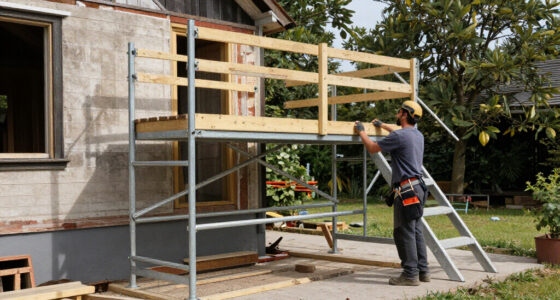
For renovation work at height, the best setup is modular scaffolding for long straight runs (ceilings, stairwells, exterior walls) and a compact electric lift for spot work — and every choice hinges on floor footprint and floor loading, not just height.
Interior renovations kill standard rolling scaffolds on footprint. A 5-foot-wide rolling tower doesn’t fit through a 32-inch interior door. That’s why baker scaffolding — narrow, adjustable-height rolling platforms rated around 1,000 lbs — is the renovation standard. You can push one through a doorway, crank it to 6 feet, and hang an entire ceiling without a ladder shuffle. Rent at $25–40 per week per section. For stairwells and vaulted ceilings, system scaffolds with adjustable legs handle the uneven ground that a rolling tower can’t.
Compact lifts are the newer answer. A narrow electric scissor lift — roughly 30 inches wide, 12–15 feet of platform height — fits through most doorways and runs on battery, so no exhaust indoors. Rental runs $150–250 per day. For a full drywall ceiling job on a 2,500 sq ft floor, it beats scaffold on speed by a wide margin. The catch: floor loading. A scissor lift plus operator plus material can exceed 1,500 lbs concentrated on a residential floor system. On a suspended wood floor, you need to verify the structure can take it — this is where a conversation with a contractor or engineer is worth having before you roll 1,500 lbs over your sister-in-law’s century-old joists.
| Access option | Working height | Typical rental | Best renovation use |
|---|---|---|---|
| Baker scaffold | Up to ~12 ft | $25–40/week | Ceilings, walls, long runs indoors |
| Rolling tower (5 ft) | Up to ~20 ft | $50–80/day | Exterior, open interiors |
| Narrow scissor lift | 15–25 ft | $150–250/day | Large ceiling/floor jobs, speed matters |
| Ladder + ladder jack | ~20 ft | Own it | Short exterior touch-ups only |
OSHA requires guardrails, proper planking, and trained assembly on scaffolds above 10 feet. There is no homeowner exemption on a rental scaffold — fall it, and it’s your claim.
Rent or Buy? The Break-Even Math That Doesn’t Lie
Renting beats buying for any material handling equipment you’ll use fewer than about 5–7 total job-days per year — lifts, hoists, and scaffolding almost always fall on the rent side for one-off renovations, while dollies and platform carts pay for themselves quickly enough to own.
Run the numbers with me. A narrow scissor lift rents for roughly $180/day or $450/week. Buying one starts around $12,000 for a pro-grade unit. You’d need 60-plus rental weeks to break even — nobody’s one renovation gets there. A platform cart is $150 to buy and $25/day to rent. Break even in six days of use. Buy it. A ladder lift at $100/day versus ownership at $2,500 plus storage? Rent it, every time, unless you’re a drywall sub.
There’s a hidden factor most DIY calculators miss: storage and transport. A scissor lift needs a trailer. Scaffold sections eat a garage bay. Rental yards deliver for $50–100, and delivery on a Monday with pickup Friday is how most small contractors actually run. That delivery fee is cheaper than the trailer you’d have to own, insure, and park.
One more honest note on grade. Pro-grade equipment survives job site abuse — dropped off tailgates, over-loaded once in a while, left in the rain. DIY-grade gear is fine for the weekend warrior doing one bathroom. But if you’re a flipper running three projects a year, the cheap stuff fails at the worst moment, and a failed hoist with a load hanging is not a cheap lesson.
Safety and Compliance: The Rules That Apply Even to Your Own House
The safety rules that govern material handling equipment are OSHA 1926 Subpart L for scaffolding, ANSI A14 for ladders, and powered-industrial-truck standards for lifts — and they apply to any worker on your job, hired or not, while your personal liability doesn’t care whether you knew the rule.
Start with capacity. Every rated piece of equipment has a placarded load limit. That limit includes your body weight, your tool belt, and the material — combined. A baker scaffold rated at 1,000 lbs sounds generous until you put two workers, a stack of drywall, and a compound mixer on it. Overloading is the single most common cause of scaffold collapse, and scaffold-related falls remain among OSHA’s most-cited construction violations year after year.
- Read the placard before the first load — capacity, height limits, and required bracing.
- Inspect before every use: cracked rungs, bent frames, missing pins, hydraulic leaks, frayed straps.
- Wear PPE: hard hat when work happens overhead, gloves for handling, safety glasses when cutting near material moves.
- Keep loads low and controlled on dollies — top-heavy loads tip at door thresholds.
- Lock the wheels on any rolling platform before climbing it. Every time.
- Train the operator for anything powered — lifts and hoists require instruction, not intuition.
The permit side matters too. A crane pick on a residential street often needs a municipal permit and traffic control. Structural reinforcement for a lift’s floor loading can pull a permit and an engineer’s letter. I’m not a lawyer and every jurisdiction differs, but skip the paperwork and you’re gambling with fines and insurance denial, not just a delay.
Material handling injuries are a leading cause of construction site injuries — and nearly all of them trace back to overloading, skipping inspection, or using the wrong tool for the weight.
Matching Equipment to Your Renovation: A Quick Decision Framework
The right material handling package for a renovation is decided by three questions: how heavy is the material, how high does it go, and how tight is the path. Answer those and the equipment list writes itself.
Scenario one: a bathroom gut on the second floor. Loads are small — tile, backer board, a tub, fixtures. Package: appliance dolly for the tub, platform cart for tile and mortar, ladder lift for the drywall sheets. Total rental spend around $150, and one of those days covers all the vertical moves.
Scenario two: a whole-house interior with vaulted ceilings. Now you’re moving a hundred sheets of drywall and working 16-foot ceilings for weeks. Package: narrow scissor lift for the week, baker scaffolds for tight rooms, panel cart owned. The lift’s $450 weekly rate is trivial next to the labor it saves — remember that 20% schedule reduction, which on a six-week job is a full week back.
Scenario three: exterior renovation — siding and roof. Ladder lift for material, rolling scaffold towers for the walls, and honestly, a conversation about fall protection beyond 6 feet, because OSHA’s residential fall threshold applies to hired crews and gravity doesn’t distinguish. Each scenario buys or rents a different list, which is the whole point: equip for the job, not for the tool aisle.
One practical tip from the field: stage your material by floor before demo starts. Hauling material into a finished, occupied, furnished house mid-job triples the handling time and risks finishes. Get it up the stairs while the stairs are still ugly.
Frequently Asked Questions
What material handling equipment do I need for a small renovation like a bathroom?
A strap-equipped appliance dolly for the tub and fixtures, a platform cart for tile and mortar bags, and a rented ladder lift if drywall is going to a second floor. Total rental spend for a bathroom job typically runs under $150, and a platform cart is worth buying outright at around $150 since it pays for itself within a few jobs.
Is renting or buying material handling equipment more cost-effective?
Renting wins for anything you’ll use fewer than 5–7 job-days per year — lifts, hoists, and scaffolding almost always fall here. A narrow scissor lift rents for $150–250/day versus $12,000-plus to buy, so break-even takes 60+ rental weeks. Dollies and platform carts flip the math: at $25/day rental versus $150 purchase, buy them.
What lifting capacity do I need for renovation materials?
Choose equipment rated at least 50–100% above your heaviest expected load to absorb shock loads — a 300-lb-rated hand truck fails on a 250-lb tub when a wheel catches a threshold. For dollies, target 600–800 lb ratings. For hoists, match your bulkiest single pass (typically 400–800 lbs for material hoists), and remember scaffold and lift placards include worker body weight in the limit.
Are electric or manual handling tools better for indoor renovations?
Indoors, electric and battery-powered equipment wins on two counts: zero exhaust and far less noise. A battery-powered narrow scissor lift works inside occupied homes where a gas unit can’t. For flat ground-level moves, manual gear (carts, dollies) is simpler, cheaper, and rarely worth electrifying. The split point is vertical movement — powered for up, manual for along.
What safety rules apply to material handling equipment on a renovation?
OSHA 1926 Subpart L governs scaffolding, ANSI A14 covers ladders, and powered lifts require operator training. Inspect equipment before each use, never exceed placarded capacity, lock rolling platforms before climbing, and use PPE — hard hats when work happens overhead, gloves, and safety glasses. Crane picks and anything structural, electrical, or gas-related need licensed professionals, and permits may apply depending on your municipality.
Can a scissor lift damage a residential floor?
Yes — a narrow scissor lift plus operator plus material can concentrate 1,500 lbs or more on a wood-framed residential floor, which older joist systems may not carry. Verify the floor’s load capacity (often with a contractor or engineer) before rolling one inside, use plywood load-spreading pads where needed, and consider baker scaffolding as a lighter alternative on questionable floors.
Conclusion
Here’s the takeaway I’d want you to remember: plan your material moves with the same seriousness you plan your cuts. Bauecho’s jobsite data puts the payoff at up to 20% off the schedule, but the quieter payoff is that nobody ends the day with a wrecked back or a load through the homeowner’s new window. Rent the lift, buy the cart, read the placard, lock the wheels.
Before your next renovation starts, walk the path from truck to final destination with the heaviest item in mind — every stair, doorway, and floor in between. If that walk makes you wince even once, you’ve just found the piece of equipment you need to rent. Gravity never negotiates. Make sure your equipment doesn’t have to either.