TL;DR

Get business pricing on tools and workshop supplies
- Business-only prices and quantity discounts
- Tax-exempt purchasing
- Multiple users, one account, clear invoices
For multi-story renovations, a 24–28 ft fiberglass extension ladder handles exterior second-story work, while a multi-position ladder covers interior tasks like stairwells and high ceilings. Choose fiberglass over aluminum near electricity, match the ANSI duty rating to your body weight plus tools, and always maintain a 4:1 setup angle with three points of contact. Most homeowners should rent a scaffold or articulating ladder for long-duration work instead of stretching a step ladder past its design limits.
Here’s a number that should stop you cold: falls are the leading cause of death on construction sites, and ladders account for a big slice of those. After twenty-plus years swinging a hammer on two-story renovations, I can tell you the ladder itself is rarely the problem. The problem is using the wrong ladder for the job — a step ladder stretched to its tiptoe limit, an aluminum extension ladder under a service drop, a 16-footer that leaves you three rungs short of the fascia.
This guide walks you through the best ladder types for reach and stability in multi-story renovations, with the height math, material tradeoffs, and setup rules that actually matter. No product roundups. Just the spec-literate decisions a pro makes before climbing, and where the DIY-grade gear stops making sense.
A 24-foot extension ladder only delivers about 21–23 feet of safe working reach — size to your highest contact point plus 3 feet, which usually means a 28–32 f…
Fiberglass is the default for multi-story renovation because its non-conductive rails protect you near service drops, meter pans, and exterior wiring; aluminum…
Duty ratings cap at your body weight plus tools and materials — a 5-gallon paint bucket alone adds 55 pounds, so Type I (250 lb) is the practical minimum for r…
The 4:1 setup angle, 3 feet of extension above the roofline, and three points of contact are the three non-negotiable rules that prevent most ladder accidents…
Rent a scaffold ($40–70/day) for any task exceeding about four hours at second-story height, and hire licensed pros for roof-edge work or anything near electri…
Best Ladder Types for Reach & Stability in Multi-Story Renovations
Falls are the leading cause of death on construction sites — and the ladder itself is rarely the problem. The problem is using the wrong ladder for the job: a step ladder stretched to its limit, aluminum under a service drop, a 16-footer that leaves you three rungs short of the fascia.
No product roundups. Just the height math, material tradeoffs, and setup rules a pro checks before climbing.
Ladder Length Isn’t Reach
A 24-foot extension ladder delivers only about 21–23 feet of usable reach — you never stand on the top three rungs, and the ladder must extend 3 feet above the roofline. A typical two-story colonial has eaves at 18–20 ft and a peak near 26–28 ft, which is why most pros carry a 28- or 32-footer. Sizing rule: match the highest contact point plus 3 feet.
House Height vs. Ladder Reach
Buy for the Highest Point
A ladder that’s slightly too tall costs you a few bucks and some storage space. One that’s too short costs you a fall. Buy for the highest point on the house, not the average — and always leave yourself three rungs to spare at the top.
Which Type Earns Its Spot on Your Job
Stability in multi-story work comes from matching the type to the surface and task — not from buying the biggest ladder at the store.
| Ladder Type | Typical Reach | Best For | Watch Out For |
|---|---|---|---|
| Step ladder (6–12 ft) | Up to ~14 ft | Interior walls, first-floor ceilings, trim work | Never use fully closed or leaned against walls |
| Extension ladder (16–40 ft) | Up to ~37 ft | Exterior siding, gutters, roof access | Setup angle, overhead lines, soft ground |
| Telescoping ladder | 8.5–15 ft | Transport in a sedan, occasional indoor height | Cheap pinching mechanisms — buy ANSI 14.2 rated only |
| Multi-position ladder | Up to ~20+ ft | Stairwells, 2-story foyers, scaffold conversion | Heavier; locks must be verified every use |
The Multi-Position Advantage
Set it in a 90-degree stairwell configuration and you can paint a two-story entry hall no other ladder touches without scaffolding. Add a plank and it becomes a 4-foot scaffold for running crown molding. The one ladder a serious DIY renovator should buy first.
Telescoping Temptation
They collapse to carry-on size — but the $80 no-name imports with unverified locks have caught fingers. If it doesn’t carry an ANSI 14.2 rating, walk away.
Fiberglass vs. Aluminum
Fiberglass whenever you’re near electricity; aluminum whenever you’re carrying the ladder up three flights all day. That’s the whole tradeoff in one sentence — the details matter for a renovation spanning weeks.
Non-Conductive Rails
- ✓ Non-conductive — safe near service drops, meter pans, exterior wiring
- ✓ Why every electrical contractor’s truck carries them
- ~ 24-ft unit weighs ~58 lb vs. aluminum’s 45 lb
- ~ Higher price — you feel it on a forty-reposition paint job
Light and Cheap
- ✓ Lightweight, corrosion-resistant, cheaper
- ✓ Saves your back over a full day of repositioning
- ✗ Conducts electricity — non-negotiable physics near any energized line
- ~ Only if you know the overhead picture is clear
Wood still exists — mostly in barns and grandparents’ garages. Sturdy but heavy, it weathers and hides internal rot under sound-looking paint. Retire the heirloom.
Your Ladder Holds More Than You Weigh
Duty rating = your body plus every tool, paint can, and bundle of shingles. A 5-gallon paint bucket alone adds 55 pounds. Type I (250 lb) is the practical minimum for renovation work.
| Rating | Capacity | Verdict for Renovation Work |
|---|---|---|
| Type III — Household | 200 lb | ✗ Light indoor tasks only — disappears fast under a tool belt |
| Type II — Commercial | 225 lb | ~ Light trade work and occasional DIY use |
| Type I — Industrial | 250 lb | ✓ The practical minimum for renovation carrying tools and materials |
| Type IA — Professional | 300 lb | ✓ What pros carry — headroom for shingles, nail guns, and paint |
So It Doesn’t Kick Out From Under You
Setting up an extension ladder safely comes down to three numbers — and three non-negotiable rules that prevent most ladder accidents.
4:1 Angle
One foot of horizontal distance for every four feet of height. Too steep and it tips; too shallow and it kicks out.
+3 ft Above Roofline
The ladder must extend three feet above the roof edge when climbing onto a roof — a hard requirement, not a suggestion.
Three Points of Contact
Two hands and a foot, or two feet and a hand — always. Never carry loads that force you off this rule.
Verify the Ground
Check footing for soft soil, verify locks on multi-position hinges, and station a spotter for long exterior sessions.
Where Rental Gear Beats Stretching a Ladder
For any task exceeding about four hours at second-story height, rent a scaffold ($40–70/day) instead of stretching a step ladder past its design limits. Hire licensed pros for roof-edge work or anything near electricity. Recent ladder tech — shock-absorbing steps, anti-slip coatings, smart stability sensors, and lighter composites — makes modern units more reliable, but none of it replaces a solid setup and a spotter on the ground.
Why Reach Math Trips Up Most Homeowners (Ladder Length Isn’t Reach)
Your ladder’s listed length is not your working reach — and this gap catches more DIYers than any other spec. A 24-foot extension ladder gives you roughly 21–23 feet of usable reach, because OSHA and every manufacturer worth the label say you never stand on the top three rungs. Add the requirement that an extension ladder must extend 3 feet above the roofline when you’re climbing onto a roof, and a 24-footer suddenly handles only about a 21-foot contact point.
Here’s the real-world version. A typical two-story colonial has eaves at 18–20 feet and a peak closer to 26–28 feet. If you buy a 24-foot extension ladder because “the house is two stories,” you’ll be able to clean the gutters but not safely reach the peak for painting. That’s why most pros carry a 28-foot or 32-foot extension ladder for full two-story exterior work.
Extension ladders are generally rated from 16 to 40 feet, which covers nearly any residential renovation you’ll encounter. The sizing rule of thumb: match the highest point you need to touch, plus 3 feet, and buy the ladder that gets you there while leaving three rungs to spare.
Buy for the highest point on the house, not the average. A ladder that’s slightly too tall costs you a few bucks and some storage space. One that’s too short costs you a fall.
Popular right now

KitchenAid Classic Series 4.5 Quart Tilt-Head Stand Mixer K45SS, Onyx Black

Ninja Specialty Coffee Maker CM401, 10-Cup Carafe, Fold-Away Frother, Black

Bose QuietComfort True Wireless Earbuds with Active Noise Cancellation, Black
As an affiliate, we earn on qualifying purchases.
The Four Ladder Types Compared: Which One Earns Its Spot on Your Job
For multi-story renovations, the best ladder types break into four camps, and each one has a specific job it wins at. Step ladders own ground-floor and low-ceiling work. Extension ladders own exterior second-story access. Telescoping ladders own portability. Multi-position (articulating) ladders own weird geometry — stairwells, slopes, and interior two-story volumes. Stability in multi-story work comes from matching the type to the surface and task, not from buying the biggest ladder at the store.
| Ladder Type | Typical Reach | Best For | Watch Out For |
|---|---|---|---|
| Step ladder (6–12 ft) | Up to ~14 ft | Interior walls, first-floor ceilings, trim work | Never use fully closed or leaned against walls |
| Extension ladder (16–40 ft) | Up to ~37 ft | Exterior siding, gutters, roof access | Setup angle, overhead lines, soft ground |
| Telescoping ladder | 8.5–15 ft | Transport in a sedan, occasional indoor height | Cheap pinching mechanisms; buy ANSI-rated only |
| Multi-position ladder | Up to ~20+ ft in extension mode | Stairwells, 2-story foyers, scaffold conversion | Heavier; locks must be verified every use |
That multi-position ladder deserves a special shout-out. Set it in a 90-degree stairwell configuration, and you can paint a two-story entry hall that no other ladder touches without scaffolding. Convert it to a work platform with a plank, and it becomes a 4-foot scaffold for running crown molding. It’s the one ladder I’d tell a serious DIY renovator to buy first.
Telescoping ladders are the tempting ones — they collapse to the size of a carry-on and live in a closet. The good ones are genuinely useful. The $80 no-name imports with unverified locks? I’ve seen fingers caught in those. If it doesn’t carry an ANSI 14.2 rating, walk away.
Fiberglass vs. Aluminum: The Material Choice That’s About More Than Weight
Fiberglass is the correct choice whenever you’re working near electricity; aluminum is the correct choice whenever you’re carrying the ladder up three flights all day. That’s the whole tradeoff in one sentence, but the details matter for a renovation spanning weeks. Aluminum is lightweight, corrosion-resistant, and cheaper — a 24-foot aluminum extension ladder might weigh 45 pounds where the fiberglass equivalent pushes 58. On a two-story paint job where you’re repositioning forty times, you’ll feel every one of those pounds by Wednesday.
But aluminum conducts electricity, and that’s non-negotiable physics. Service drops, meter pans, exterior light fixtures, and that coax cable the last homeowner DIY’d too close to the power line — all of it rules out aluminum. Fiberglass rails are non-conductive, which is why every electrical contractor’s truck carries the orange or yellow fiberglass units. In a multi-story renovation, you’re almost always near something energized on the exterior, so my default recommendation is fiberglass unless you know the overhead picture is clear.
Wood still exists, mostly in barns and grandparents’ garages. It’s sturdy but heavy, it weathers, and it hides internal rot under sound-looking paint. Retire the heirloom.
One more material note: newer composite and hybrid designs are shaving weight off fiberglass, and some modern units add shock-absorbing steps and improved anti-slip coatings. Nice upgrades, but they don’t replace a solid setup and a spotter on the ground.
Duty Ratings: Why Your Ladder Needs to Hold More Than You Weigh
Your ladder’s duty rating is the maximum total load it’s designed to carry — your body plus every tool, paint can, and bundle of shingles you haul up. Most homeowners buy on price and discover mid-project that a Type III household ladder is rated at 200 pounds, which disappears fast when you’re 190 pounds carrying a nail gun and a full caulking gun in a tool belt.
- Type III (Household): 200 lb — light indoor tasks only
- Type II (Commercial): 225 lb — light trade work, occasional DIY
- Type I (Industrial): 250 lb — the minimum I’d recommend for renovation work
- Type IA (Professional): 300 lb — pro job sites, heavy tool loads
- Type IAA (Extra Heavy): 375 lb — masonry, roofing, big loads
The scenario that ends badly: a 210-pound homeowner on a Type III ladder carrying a 5-gallon paint bucket (that’s 55 pounds alone) to reach second-story window trim. That’s 265-plus pounds on a 200-pound ladder, extended to near its limit, on soft garden soil. Nothing about that setup provides secure footing, and the duty rating is the first thing an investigator checks after a failure.
Look for the ANSI and OSHA compliance sticker on the rail. No sticker, no sale — regardless of what the box claims. For multi-story renovation work, honestly assess your working weight and buy one rating up from what you think you need. The price difference between Type II and Type IA is usually under $50. A fractured heel is not.
How to Set Up an Extension Ladder So It Doesn’t Kick Out From Under You
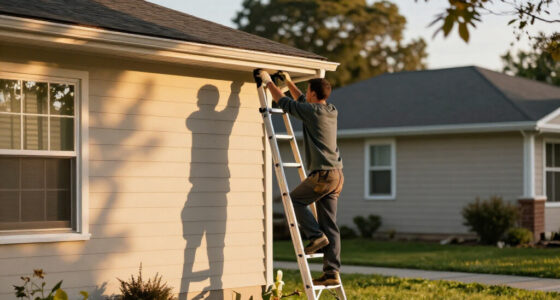
Setting up an extension ladder safely comes down to three numbers: a 4:1 angle (one foot of horizontal distance for every four feet of height), 3 feet of extension above the roofline, and two feet of rail overlap on multi-section units. Get those right and the ladder behaves like furniture. Get them wrong and it’s a catapult with your name on it.
- Inspect first. Check for cracked rails, bent rungs, missing foot pads, and sticky rope-and-pulley action. Any of those, and the ladder stays on the rack.
- Walk the base. Place feet on dry, level, solid ground — a plywood pad on soft soil beats garden mulch every time.
- Set the 4:1 angle. For a 24-foot ladder touching at 22 feet, the base sits about 5.5 feet from the wall. The quick field check: stand with your toes at the base, arms straight out — your palms should touch the rails.
- Extend and lock. Raise the fly section, seat the rung locks fully, and verify you can’t shift the sections by hand.
- Tie it off. Secure the top rails to the structure when you’ll be on it more than a few minutes, especially at height.
- Climb with three points of contact. Two hands and a foot, or two feet and a hand. Tools go in a belt or a hoist line — never carried in your hands.
The anti-slip feet matter more than people think. Those rubber pads are shaped to grip in the flat position and dig cleat-first on softer surfaces. Flip them correctly for the ground you’re on. And if you can’t achieve stable footing — a sloped grade, a mulch bed, a frost heave — add a ladder stabilizer arm that spans a window or standoff bracket rather than improvising with bricks. I’ve pulled more than one ladder off a job site for exactly that move.
Never move a ladder while you’re on it. Never stand above the marked highest safe rung. And never let a second person climb a single-ladder section while you’re on it. These three rules eliminate most residential ladder accidents.
When to Rent Instead of Buy: The Honest Contractor’s Answer
Rent when the job needs sustained work at height; buy when it’s repeated short access. That’s the rule after two decades of watching homeowners buy $400 ladders for one weekend of gutter work. If you’re spending more than four hours at second-story height on one task — painting a gable, replacing fascia, installing siding — a ladder is the wrong tool. You want a scaffold or a pump jack, because ladder work means one hand for the job and two feet balanced on a 1.5-inch rung. Nobody does fine carpentry that way for long without fatigue setting in.
Rental math backs this up. A rolling scaffold section or a stair scaffold rents for roughly $40–70 a day at most yards. A multi-position ladder with a plank runs similar. Compare that to buying scaffolding outright — $600-plus for a decent setup — and renting wins for anything under a week of use. Meanwhile, the ladder you’ll use for a decade (a good fiberglass extension ladder and a solid multi-position unit) is worth buying, because access needs never really stop on a house.
The DIY-versus-pro line matters here too. Exterior second-story work over a hard landing surface, anything involving the roof edge, and any job near electrical service are places where a licensed pro with proper fall protection earns their fee. Inside, on flat floors with the right ladder? That’s fair DIY territory, and honestly some of the newer articulating ladders with levelers and stabilizers are better than what I started on twenty years ago.
A word on maintenance, since you’ll own these for years: hose off fiberglass rails to prevent fiberglass splinters, keep aluminum out of long UV exposure, check the rope and pulley quarterly, and never paint a wooden or fiberglass ladder — paint hides cracks. Store ladders indoors, hanging horizontally if you can. A stored-correctly ladder lasts fifteen-plus years; one left against the sunny side of the barn lasts five.
Frequently Asked Questions
What size extension ladder do I need for a two-story house?
Most two-story homes have eaves at 18–20 feet and peaks at 26–28 feet, so you want a 28-foot extension ladder for full coverage. Remember the ladder must extend 3 feet above the roofline for safe roof access, and you can’t stand on the top three rungs — so a 24-footer only gives about 21–23 feet of working reach. If your budget allows one size up from your estimate, take it.
Are fiberglass ladders really better than aluminum for electrical work?
Yes — it’s physics, not marketing. Fiberglass rails are non-conductive, while aluminum is an excellent conductor. Near service drops, meter pans, or exterior wiring, aluminum can carry current straight through you on contact. Fiberglass costs more and weighs 10–15 pounds more at extension sizes, but for multi-story renovation work where you’re frequently near something energized, it’s the correct default.
Can I use a step ladder to reach high or two-story ceilings?
Not beyond its rated height. A 12-foot step ladder gives roughly 14 feet of maximum reach — enough for first-floor ceilings and standard stairwells, not a two-story foyer. For two-story interior volumes, use a multi-position ladder in stairwell or extension configuration, or rent a stair scaffold. Never lean a closed step ladder against a wall; it’s designed to be self-supporting only.
What safety features should I look for when buying a ladder?
Start with ANSI and OSHA compliance markings on the rail — no sticker, no sale. Then check swiveling anti-slip feet, rung locks you can verify by hand, a duty rating that covers your body plus tools (Type I, 250 lb minimum for renovation work), and wide, D-shaped rungs for comfort during long climbs. Newer models add shock-absorbing steps, integrated levelers for uneven ground, and stabilizer arms — genuinely worth the money on extension ladders.
How do I stabilize a ladder on soft or uneven ground?
Place a plywood or composite pad under both feet on soil, mulch, or gravel to distribute the load — a 2×2-foot piece of 3/4-inch plywood works. On slopes, use a ladder with integrated levelers rather than stacking bricks or boards, which slip. Keep the 4:1 angle regardless of the surface, and have someone foot the base whenever you’re working above 16 feet. If you can’t achieve solid footing, that’s the signal to switch to a scaffold, not to improvise.
How much weight can a typical ladder hold?
It depends entirely on the duty rating: Type III holds 200 lb, Type II 225 lb, Type I 250 lb, Type IA 300 lb, and Type IAA 375 lb. That rating covers everything — you, your tool belt, and the materials you carry. A 190-pound person hauling a 5-gallon paint bucket is already at 245 pounds, which rules out anything below Type I. Check the sticker before every job, not just at purchase.
Conclusion
If you take one thing from this guide: the ladder is a system — type, height, material, rating, and setup angle — and any single weak link in that chain puts you on the ground. Buy the multi-position ladder first for interior two-story work, add a fiberglass extension ladder sized 4 feet longer than you think you need, and rent the scaffold when the job justifies it.
Before your next climb, do the thirty-second check: sticker on the rail, locks seated, feet planted, 4:1 angle, three points of contact. Gravity doesn’t negotiate, and neither should you. Now go get those gutters — safely.