
TL;DR

Get business pricing on tools and workshop supplies
- Business-only prices and quantity discounts
- Tax-exempt purchasing
- Multiple users, one account, clear invoices
The most comfortable work boot is not simply the softest boot; it must fit your larger foot, hold your heel, leave your toes free, and match the hazards underfoot. Shop late in the day with your normal work socks, test both boots through job-like movements, and reject any pair that causes pressure, numbness, rubbing, or instability.
A boot can feel like a couch cushion at 8 a.m. and like a steel trap by lunch. Your feet swell, the foam warms up, and every small pressure point gets repeated across thousands of steps. By hour ten, a rubbing seam or cramped safety toe can feel as sharp as a pebble trapped under your sock.
This guide shows you how to select the most comfortable work boots for long days without trading away required protection. You will learn how to judge fit, toe shape, cushioning, support, traction, weight, and moisture control. You will also get a practical fitting test that works better than pacing twice across a carpeted store aisle.
The right choice depends on your actual shift. A warehouse picker walking polished concrete needs something different from a carpenter climbing ladders, a utility worker crossing muddy ground, or a welder standing near hot debris. Treat your boot like any other jobsite tool: match the specification to the work, test it under realistic conditions, and do not let glossy marketing make the decision.
Shop late in the day, fit the larger foot, and wear the same socks and orthotics you use during a shift.
Match safety certification and outsole design to actual hazards; toe material and a slip-resistant label do not tell the whole story.
Choose balanced cushioning with a firm heel counter, stable platform, and flex near the ball of the foot.
Test both boots by walking, crouching, kneeling, climbing, and standing for at least five focused minutes.
Replace or repair boots when tread, cushioning, support, waterproofing, or protective components fail, even if the upper still looks good.
How to Select the Most Comfortable Work Boots for Long Days
The most comfortable boot is not simply the softest. It must fit your larger foot, secure your heel, leave your toes free, and match the hazards beneath you. A boot that feels plush at 8 a.m. can become a steel trap after hours of swelling, heat, and repeated pressure.
Secure the heel. Free the toes.
Feet commonly expand during a long shift, especially in heat or during hours on concrete. Try both boots late in the day with your real socks, then judge width, volume, and shape—not just the printed size.
No repeated lift or rub
Walk briskly and climb steps. A little settling may disappear as the upper flexes; repeated skating creates friction, blisters, and unstable footing.
Ball meets boot
The ball of your foot should align with the boot’s widest area. Side pressure, tingling, or bulging over the sole edge signals the wrong width or shape.
Wiggle without impact
Crouch and walk downhill if possible. Toes should move freely without striking the front or pressing against the edge of a protective cap.
Lace without crushing
The upper should close securely without compressing the top of your foot. Thick socks, orthotics, and replacement insoles all consume space.
Protection without crushed toes
Certification and cap shape matter more than material alone. Choose the roomiest compliant design that still holds your heel and midfoot securely.
| Toe type | What you gain | Tradeoff to test | Strong use case |
|---|---|---|---|
| Steel | ✓Strong protection in a relatively thin cap | ~More weight and faster heat or cold transfer | Shop work where compact protection matters |
| Composite | ✓Nonmetallic with less temperature transfer | ~The cap may feel bulkier on some feet | Cold outdoor or metal-sensitive workplaces |
| Alloy | ✓Lower weight than many steel designs | ~Still metallic and often more expensive | Walking-heavy work requiring protection |
| Soft toe | ✓Lower weight and greater flexibility | ✗No impact or compression protection | Low-hazard tasks where policy permits it |
Before buying: ask your employer which impact, compression, electrical-hazard, or puncture-resistance markings your work requires. Run a finger around the cap edge, then flex and kneel in both boots to expose hidden pressure lines.
Balance cushioning with control
Maximum softness is not maximum comfort. Long shifts demand impact control, a stable platform, durable foam, and enough structure to stop your feet and lower legs from correcting every small wobble.
Firm heel counter
Squeeze the rear of the boot. It should resist collapse and keep the heel centered.
Torsional control
Twist the toe and heel gently. Excessive rotation can feel unstable under loads.
Appropriate arch shape
Support should meet the foot without feeling like a hard ridge beneath it.
Removable footbed
Creates options for compatible replacement insoles or prescribed orthotics.
Long-shift comfort priorities
A practical weighting guide: fit and stability should lead the decision before plushness or marketing claims.
Build the boot around the shift
A warehouse picker, ladder-climbing carpenter, utility worker, and welder need different combinations of tread, flexibility, coverage, protection, and climate control.
Slip-resistant tread
Performance varies with contaminant, flooring, tread condition, and technique. Slip-resistant never means slip-proof.
Deeper outsole lugs
Prioritize self-cleaning tread, a stable platform, and secure heel hold on irregular surfaces.
Stiffer sole or shank
More underfoot structure can improve support on narrow rungs, shovel edges, and uneven terrain.
Shock control and low weight
Walking-intensive shifts benefit from forefoot flex and reduced weight without sacrificing stability.
Waterproof construction
Water protection helps outdoors but may retain more heat and perspiration than breathable footwear.
Task-specific protection
Confirm heat resistance, electrical-hazard protection, puncture resistance, and required coverage.
Move like you work.
Test both boots on a firm surface while wearing your normal socks and orthotics. Focus on pressure, movement, stability, and toe clearance—not the mirror.
Walk briskly
Check heel lift, rubbing, side pressure, and whether the foot slides forward.
Crouch and kneel
Expose toe-cap pressure and pinching across the forefoot or top of the foot.
Climb and descend
Test heel security, forefoot flex, toe impact, and stability on an edge.
Turn under control
Notice excessive sole twist, foot roll, or a platform that feels too narrow.
Stand and scan
Pause long enough to detect hot spots, numbness, arch pressure, cramped toes, or uneven support.
Replace performance, not appearances
A clean upper does not prove that a boot is still safe or supportive. Repair or replace footwear when the components beneath and around the foot stop doing their jobs.
Final rule: fit the larger foot, match the actual hazard, test realistic movement, and reject pain immediately. The best boot is the one that remains secure, stable, and unobtrusive deep into the shift.
Get a Fit That Still Feels Right at Hour Ten
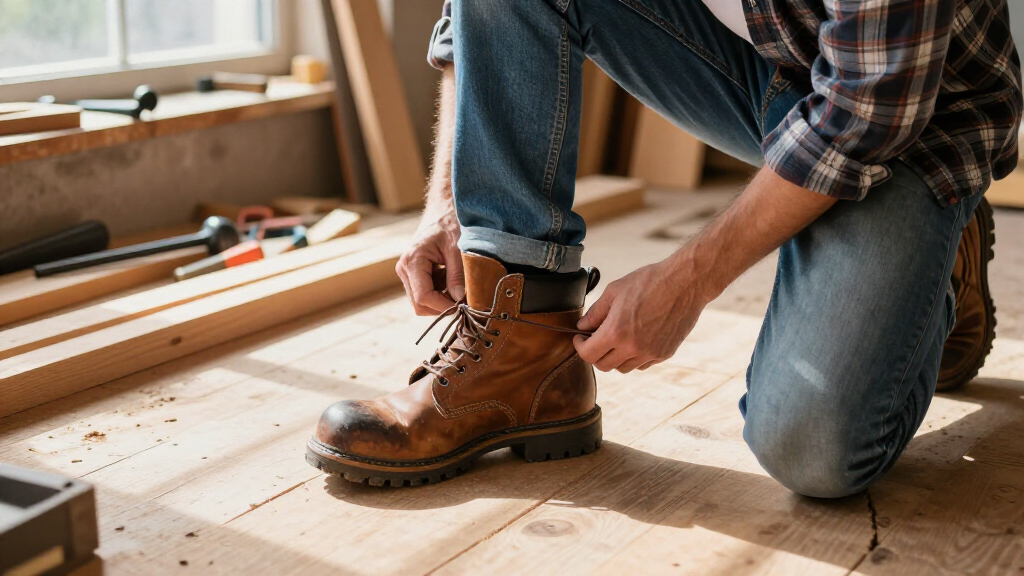
How to select the most comfortable work boots for long days starts with fitting the larger foot late in the day, while wearing your normal work socks. The boot should hold your heel and midfoot securely, leave your toes free to move, and allow some space for swelling without letting your foot slide.
Feet commonly expand during a long shift, especially in heat or when you spend hours standing on concrete. If you shop early in the morning, a close-fitting boot can become a vise after lunch. Try both boots because one foot is often slightly larger, then let that larger foot set the size.
Do not automatically buy a half-size longer when the sides feel tight. You may need a wide or extra-wide model, not more length. A boot that is too long lets your heel skate up and down, much like a loose wrench slipping on a bolt; the movement creates friction, blisters, and shaky footing on stairs.
- Check the heel: Walk briskly and climb a few steps. A small amount of movement can settle as the upper flexes, but repeated lifting or rubbing means the boot is not holding you correctly.
- Check the widest point: The ball of your foot should line up with the widest part of the boot. Side pressure, tingling, or bulging over the sole edge points to the wrong width or shape.
- Check the toes: Wiggle them, crouch, and walk down an incline if the store has one. Your toes should not strike the front or press against the safety cap.
- Check the volume: Make sure the laces close without crushing the top of your foot. A thick replacement insole or winter sock will consume more room.
Severe pressure, burning, or numbness is not normal break-in. Leather can soften, but a boot that is the wrong size or shape will not magically grow around your foot.
For example, a flooring installer may feel fine while standing but get pinched across the toes every time they kneel. That is why job-like movement matters. Walk, crouch, kneel, and stand for several minutes before you decide.
Popular right now

DeLonghi Rivelia Automatic Espresso Machine Bundle with Grinder and Frother, Beige

Shark Navigator Lift-Away Upright Vacuum (NV360)

Dreame L40 Ultra Gen 2 Robot Vacuum and Mop
As an affiliate, we earn on qualifying purchases.
Choose a Safety Toe Without Crushing Your Toes
How to select the most comfortable work boots for long days when toe protection is required comes down to cap shape, interior volume, and certification. Choose the roomiest compliant shape that holds your foot securely, because safety material alone does not determine whether the boot feels comfortable.
According to OSHA’s foot-protection rule, employers must require protective footwear where falling, rolling, piercing, or electrical hazards can injure feet [1]. ASTM performance markings identify tested protections such as impact, compression, electrical hazard, and puncture resistance [2]. Ask your employer which markings your task requires before buying.
| Toe type | What you gain | Tradeoff to check | Good jobsite example |
|---|---|---|---|
| Steel | Strong protection in a relatively thin cap | More weight and faster heat or cold transfer | Shop work where compact toe protection matters |
| Composite | Nonmetallic protection and less temperature transfer | The cap can feel bulkier | Cold outdoor work or metal-sensitive workplaces |
| Alloy | Lower weight than many steel designs | Still metallic and sometimes more expensive | Walking-heavy work requiring a protective toe |
| Soft toe | Lower weight and greater flexibility | No impact or compression protection | Low-hazard work where policy permits it |
Imagine spending a winter morning unloading material from a truck. A tight steel cap can pull heat from your toes like a spoon left in ice water, while a composite design often feels less cold. In a warm fabrication shop, however, a thinner steel cap may provide a better fit for your foot than a bulky composite one.
Run a finger around the inside edge of the cap, then flex and kneel in both boots. You should not feel a hard line cutting across your little toe or pressing down over the big-toe joint. The goal is required protection without creating pressure, dead space, or needless weight.
Balance Cushioning and Support So Your Feet Stay Steady
The best cushioning for long shifts combines impact control, stability, and durability rather than maximum softness. Look for a supportive midsole, a firm heel counter, and a platform wide enough to stay steady. The boot should flex near the ball of your foot, not fold through the middle like a taco.
EVA foam often feels light and springy, while polyurethane commonly feels denser and can retain its shape longer. Either can work. What matters is whether the midsole controls your foot after hours of standing, carrying, and turning, not how dramatically your thumb sinks into it at the store.
Suppose you stand at a fabrication bench for ten hours. A marshmallow-soft sole may feel pleasant for the first twenty minutes, then allow your heels to wobble as the foam warms and compresses. A slightly firmer, stable platform can leave your legs less tired because your muscles are not correcting every small roll.
- Firm heel counter: Squeeze the rear of the boot. It should resist collapsing and help keep your heel centered.
- Torsional control: Hold the toe and heel, then twist gently. Walking boots can flex, but excessive twisting can feel unstable under loads.
- Appropriate arch shape: Support should meet your foot without feeling like a hard ridge under it.
- Removable footbed: This gives you room for a compatible replacement insole or prescribed orthotic.
Insoles can fine-tune cushioning and support, but they cannot repair a boot that is too narrow, too short, or badly shaped. A thick insole may also lift your heel into the collar and steal space from the safety toe. Test the complete sock, insole, and boot setup before working a full shift.
Persistent pain, burning, numbness, or major swelling deserves professional attention. If you use prescribed orthotics or have a foot deformity, bring the orthotics to the fitting and seek advice from a qualified medical professional or experienced footwear fitter.
Match the Sole to the Ground You Actually Walk On
How to select the most comfortable work boots for long days also means matching the outsole and sole stiffness to your real surface. Choose slip-resistant tread for smooth wet floors, deeper lugs for mud, and enough stiffness for ladders, digging, uneven ground, or heavy loads.
A shallow, broad tread can place more rubber against a warehouse floor and release small amounts of liquid through channels. Deep, widely spaced lugs bite loose soil and shed mud better. Put a mud boot on polished indoor concrete, though, and those tall lugs can feel clumsy and reduce stable contact.
Slip-resistant does not mean slip-proof. Oil, soap, wet tile, metal dust, worn tread, and your walking pace all change grip. A sole that works well on a damp restaurant floor may behave differently on oily steel plate, so check job-specific testing and your employer’s footwear policy.
- Concrete and tile: Seek durable cushioning, a stable heel, and a slip-resistant outsole suited to the contaminants you encounter.
- Mud and loose ground: Choose deeper, self-clearing lugs and a platform that resists rolling sideways.
- Ladders and shovels: Look for a defined heel and a stiffer sole or shank that spreads pressure across the arch.
- Hot surfaces: Confirm that the outsole compound carries the heat-resistance rating required for the task.
- Sharp debris: Use certified puncture-resistant construction when nails, screws, or metal offcuts are present.
A residential electrician may spend the morning climbing ladders and the afternoon crossing a dusty slab. That worker needs a stable sole and any electrical-hazard protection required by the employer, not merely a sneaker-soft boot. Turn power off when work permits, verify de-energization with the proper test method, wear assigned PPE, and remember that electrical-hazard footwear is a backup layer rather than permission to work live.
Walking-intensive work usually benefits from forefoot flexibility. Heavy carrying and uneven terrain call for more structure. Test where the boot bends: a clean flex behind the toes feels natural, while a fold under the arch can make each step feel like walking over a garden hose.
Keep Water Out Without Cooking Your Feet
Choose waterproof boots for sustained wet exposure and breathable boots for warm, dry work. A membrane blocks water from entering, but it can also trap more heat and sweat than an airy lining. Your most comfortable choice depends on weather, workload, and drying time, not a waterproof label alone.
Think about two crews on the same renovation. The exterior crew crosses wet grass and stands near puddles before sunrise, so a waterproof membrane earns its keep. The interior crew carries drywall up warm stairwells; in that setting, a breathable non-waterproof boot can feel far cooler by midafternoon.
Socks act like the climate-control layer in a wall assembly. Moisture-wicking synthetic or merino-blend socks move dampness away from skin and reduce friction. Cotton holds sweat, turns clammy, and can wrinkle into hot spots that rub your heel raw.
- Cold conditions: Leave enough interior volume for insulated socks without compressing your toes or slowing circulation.
- Hot indoor work: Favor breathable linings and lighter uppers when water exposure is minor.
- Frequent rain or washdown: Use a waterproof design and inspect seams, tongue gussets, and upper height.
- Debris-heavy work: A higher collar can keep chips, sparks, and grit away from your socks when the boot is rated for the hazard.
Boot height brings another tradeoff. A taller boot adds coverage against water and debris, but it also weighs more, holds heat, and can rub your ankle while kneeling. A high collar does not automatically prevent ankle injuries; fit, sole stability, terrain, and task demands carry much of that load.
If your boots get soaked, remove the footbeds and let everything dry away from intense direct heat. A roaring heater can stiffen leather, weaken adhesives, and leave the boot smelling like scorched hide. Alternating between two pairs gives moisture more time to escape and may extend service life.
Use This Five-Minute Store Test Before You Pay
A useful boot test copies the movements you perform at work. Wear your regular socks and any approved orthotics, lace both boots properly, then spend at least five focused minutes walking, crouching, climbing, turning, and standing. Stop when you detect rubbing, toe contact, arch pressure, or instability.
Start by walking fast enough to load the heel, not just shuffling across soft carpet. Listen for scuffing and feel whether the heel lifts on every stride. Then walk down stairs or a sloped fitting ramp; your toes should not hammer the front like loose tools sliding across a truck bed.
- Walk and turn: Check heel hold, side-to-side stability, and whether the outsole grips the test surface.
- Crouch and kneel: Feel for pinching at the toe crease, ankle collar, tongue, and edge of the safety cap.
- Climb several steps: Check whether the heel rises and whether the sole feels secure on a narrow tread.
- Stand still for two minutes: Notice concentrated pressure under the arch, heel, or ball of the foot.
- Remove the boots: Look for red marks and compare how both feet feel. Early redness often predicts a blister later.
Consider a maintenance technician who spends half the day walking and the other half kneeling beside equipment. A boot can pass the walking test yet dig into the ankle when the worker crouches. Testing both positions catches that problem before the first shift turns it into an open blister.
Buy from a seller with a clear indoor return policy, and keep the box and packaging until you have tested the boots at home. Wear them on clean floors for a longer trial if the policy allows. Reasonable comfort should be immediate; only mild leather stiffness should need gradual break-in.
Price does not settle the question. Expensive boots may use stronger hardware, better leather, repairable construction, or longer-lasting midsoles, but a premium boot with the wrong last still hurts. The best work boots for your feet are the ones that pass the fit, movement, and hazard tests together.
Make Comfort Last Past the First Few Months
Long-term comfort depends on construction, drying, cleaning, and timely replacement. Inspect sole bonding, stitching, eyelets, lining, tread depth, and flex points before buying, then check them regularly. A boot can look respectable above the sole while its cushioning, grip, or internal support has already failed.
Direct-attached and cemented soles often reduce weight and flex easily. Welted boots can offer stout construction and, in some models, resoling. Molded designs often resist water well, but construction labels alone do not promise comfort; judge the whole boot and ask whether local repair shops can service it.
A concrete finisher may wear the tread smooth long before the leather upper tears. Another worker in a clean warehouse may keep visible tread but flatten the midsole until every footstep lands with a dull slap. Replace or repair footwear when traction, cushioning, waterproofing, stability, or protective parts no longer do their jobs.
- After dusty shifts: Brush away grit that can grind through stitching and leather folds.
- After wet shifts: Remove insoles, open the laces, and dry the boots slowly with moving air.
- For suitable leather: Apply the maker’s recommended conditioner after cleaning so the upper stays flexible.
- Every week: Inspect tread, seams, sole edges, hooks, eyelets, and the lining around your heel.
- When comfort changes: Compare the boots on a flat surface and check for uneven wear, collapsed foam, or a leaning heel.
Alternating pairs is useful when your work leaves boots damp at quitting time. Each pair gets a full drying window, which helps control odor and keeps the lining from staying cold and clammy. It also gives you a direct comparison: if one pair suddenly feels flat or unstable, wear has changed the support.
Do not keep compromised safety footwear in service because the upper still shines after polishing. A split sole, exposed protective component, worn-through tread, or damaged electrical-hazard boot calls for action. Follow the manufacturer’s inspection guidance and your employer’s replacement rules.
Frequently Asked Questions
Should work boots feel tight or loose?
Work boots should feel snug around the heel and midfoot but roomy across the toes. Your foot should not slide during turns or stairs, and no area should feel compressed, numb, or pinched. Test them late in the day when your feet are slightly larger.
Should I buy work boots a half-size larger?
Do not size up automatically. Start with your measured size, then compare widths and toe-box shapes. Extra length used to solve a width problem can cause heel lift, rubbing, and poor control on ladders or uneven ground.
Are steel-toe boots less comfortable than composite boots?
Steel toes are not automatically less comfortable. Cap shape and available toe room matter more, though steel usually weighs more and transfers temperature faster. Composite caps are nonmetallic and less conductive, but some designs feel bulkier around wide feet.
What work boots are best for standing on concrete?
Work boots for concrete should combine durable cushioning, a supportive midsole, a stable heel, and suitable slip resistance. Avoid judging them by softness alone. Foam that feels plush in a store can compress and wobble after hours at a bench or machine.
Do new work boots need to be broken in?
Leather boots may need short, gradual wear periods before the upper flexes freely. They should still fit securely and feel reasonably comfortable from the start. Severe rubbing, hard safety-cap pressure, burning, or numbness signals a poor fit rather than normal break-in.
Can I replace the factory insoles?
You can replace removable factory insoles when they lack support or have worn flat, but the new pair must fit the boot’s depth and shape. A thick insole can crowd the toes, raise the heel into the collar, and change safety-cap clearance. Test the full setup before wearing it to work.
How long should comfortable work boots last?
No single service-life number fits every worker because concrete, mud, body weight, moisture, heat, and daily mileage wear boots at different rates. Inspect them regularly and act when tread, cushioning, stability, waterproofing, or protective components fail. The upper’s appearance alone does not reveal the boot’s condition.
Conclusion
Choose the boot that fits your foot, your movement, and your hazards at the same time. Start with the larger foot late in the day, use your normal socks, and reject pressure points instead of hoping pain will disappear. Required protection sets the floor; stable support, suitable cushioning, correct width, and task-matched traction create the comfort above it.
Then take care of what you bought. Dry wet boots slowly, inspect the tread and seams, and retire a pair when its support or protection fades. At the end of a hard shift, the right boots should come off with dusty laces and worn soles—not numb toes, raw heels, and the sharp relief of escaping a clamp.