
TL;DR

Get business pricing on tools and workshop supplies
- Business-only prices and quantity discounts
- Tax-exempt purchasing
- Multiple users, one account, clear invoices
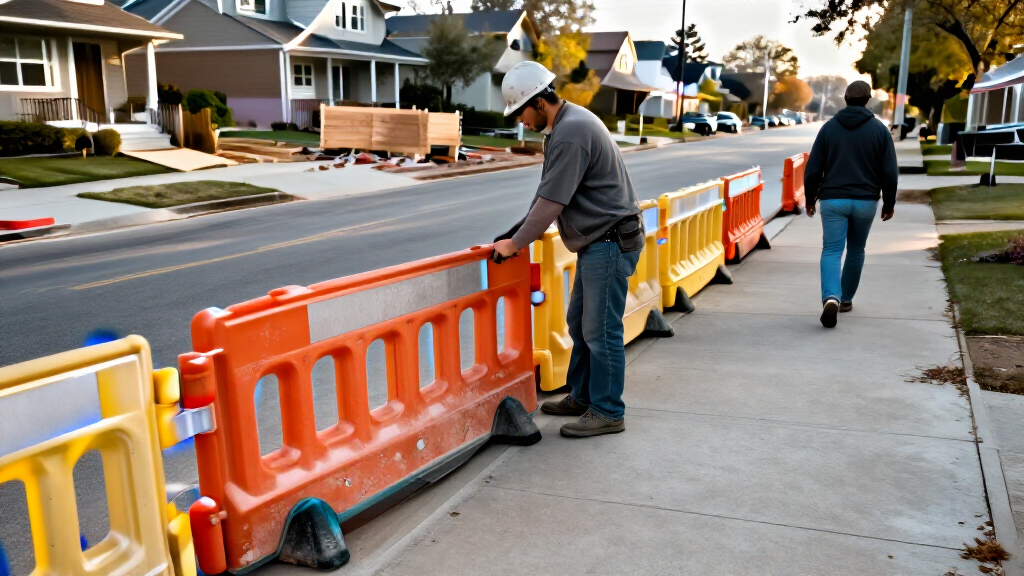
A Family Handyman report explains that construction barricade colors carry different meanings under U.S. workplace and road-safety standards. Red generally signals danger, yellow warns of physical hazards, and orange commonly marks construction or traffic changes; the exact meaning depends on the setting and applicable rules.
A Family Handyman report explains that construction barricade colors are tied to different safety uses, rather than being interchangeable decorations: red marks danger, yellow warns of physical hazards, and orange is common around construction and temporary traffic conditions. The meanings come from separate U.S. workplace and road standards, so a color’s purpose depends on where it appears.
According to the Occupational Safety and Health Administration (OSHA) workplace color rules cited in the Family Handyman report, red identifies danger, emergency stops and fire-protection equipment. A red danger sign at a worksite may warn of exposed electrical equipment or another hazard that could cause serious injury. OSHA’s general-industry rules also call for red warning lights at barricades and temporary obstructions.
The report says OSHA uses yellow to warn of physical hazards, including falls and falling objects. Yellow tape or signs may mark a damaged walkway or a maintenance area. It also describes orange workplace warnings for hazards that could cause serious injury, particularly around machinery or equipment being repaired. For roads, the report cites the Federal Highway Administration’s traffic-control guidance: orange barriers and signs alert drivers to construction, lane changes and other temporary traffic conditions.
The report also describes other colors in workplace guidance. Green signs can direct people to first aid or emergency equipment, while blue notices commonly provide workplace information, such as saying that a machine is out of service. Certain radiation warnings use a purple or magenta symbol on yellow. For roads, the Federal Highway Administration’s Manual on Uniform Traffic Control Devices covers orange-and-white striped barricades used to close or redirect traffic; the stripes’ slope indicates the side drivers should pass.
Reading Barriers Before You Approach
Recognizing a color can help workers, pedestrians and drivers understand whether they are approaching a hazard, a work area or a route around an obstruction. That is especially relevant when conditions change quickly: a road crew may shift traffic into another lane, while a workplace barrier may mark equipment or a walkway that is unsafe to use.
The colors are not a substitute for reading the sign or following directions. Workplace rules and road-control standards differ, and the same color may be used for distinct purposes in those settings. People should obey posted instructions, keep behind barricades and follow traffic-control devices rather than infer a complete explanation from color alone.
Popular right now

Dreame L50 Ultra Robot Vacuum and Mop

Bose QuietComfort Wireless Bluetooth Headphones with Active Noise Cancellation, Mic, USB‑C Charging, Deep Bass, 24‑Hour Battery – White Smok

Bose QuietComfort Wireless Noise-Cancelling Over-Ear Headphones, Black
As an affiliate, we earn on qualifying purchases.
Two Standards Shape Color Meanings
The Family Handyman report draws on OSHA workplace regulations, American National Standards Institute (ANSI) guidance and the Federal Highway Administration’s Manual on Uniform Traffic Control Devices. These sources cover different settings: OSHA rules address workplace safety colors and signs, ANSI publishes guidance on safety colors and barricade tape, and federal traffic-control standards address signs and devices used on roads.
That distinction helps explain why roadside orange-and-white barriers should not be read exactly like a workplace warning sign. The report’s account of federal traffic-control guidance says road barricades are designed to guide drivers around closures and work zones, including through the direction of their diagonal stripes. Local requirements and the specific sign or device still matter.
Color Alone Leaves Questions
The Family Handyman report describes common uses but does not establish that every barricade of a given color has the same meaning across the United States. It says meanings can vary by location and by whether the barrier is in a workplace or on a road. The applicable requirements for a particular site, as well as any local rules or additional signs, are not specified.
The report also does not provide a case involving a newly issued rule or a change to existing standards. It is an explanation of color guidance, not evidence that regulations have recently changed. Readers should rely on the accompanying words, symbols and instructions where a color alone does not clarify what is restricted or where to go.
Follow Signs at Each Worksite
No specific next regulatory milestone or announced change is identified in the source material. For now, the practical guidance is to treat barriers and signs according to the setting, read any accompanying instructions, and follow directions from road crews or site staff. Where a barricade’s purpose is unclear, do not cross it or drive around it without an authorized route.
Key Questions
What does a red construction barricade or sign usually mean?
Red is used in workplace safety to identify danger, emergency stops and fire-protection equipment, according to the OSHA rules described in the Family Handyman report. The exact hazard should be explained by the sign or other site instructions.
What is yellow tape used for?
Yellow warns of physical hazards, such as falls or falling objects. The Family Handyman report says it may mark a maintenance area or a damaged walkway.
Why are roadwork barriers often orange and white?
The Family Handyman report cites federal traffic-control guidance describing orange as a marker for road construction and temporary traffic conditions. Orange-and-white striped barricades can close roads or lanes and guide drivers around an obstruction; stripe direction indicates the side to pass.
Do barricade colors mean the same thing everywhere?
No. The Family Handyman report says meanings depend on the setting and applicable standards. Workplace rules and road-control rules differ, so read the sign and follow local traffic or site instructions.
Source: rss