
TL;DR

Get business pricing on tools and workshop supplies
- Business-only prices and quantity discounts
- Tax-exempt purchasing
- Multiple users, one account, clear invoices
Choose a dust mask or respirator only after identifying the material, exposure level, and task; fine particles such as silica and wood dust can cause serious harm. Filter ratings describe performance under specific tests, but protection also depends on a reliable fit, correct use, and dust controls such as wet methods or local exhaust. For unknown or regulated hazards, follow local requirements and get a qualified assessment instead of guessing from a label.
A mask can look sturdy, feel snug, and still let fine dust slip past your cheeks. That matters when you cut concrete, sand old paint, or sweep a dusty renovation site: fine particles can reach deep into your lungs, and some, such as silica, wood dust, metal fumes, and certain biological particles, can cause serious harm.
This guide shows you how to choose a dust mask or respirator by starting with the hazard, not the packaging. You’ll learn what filter labels mean, why fit changes protection, when reusable designs or powered options may suit the job, and what respirators cannot protect you from.
You’ll also get a practical decision process for a real workday, from checking the material’s safety data sheet to storing a reusable mask. For household projects, that can help you spot when a simple facepiece may fit the task—and when asbestos, lead, unknown dust, or heavy exposure calls for a professional assessment.
Identify the material and exposure before selecting a respirator; “dust” is not a complete hazard description.
Treat N95, N99, N100, and FFP ratings as standard-specific filter classifications, not guarantees of real-world protection.
A good face seal matters as much as filtration; perform a user seal check each time and follow workplace fit-testing rules.
Particulate filters do not automatically protect against gases, vapors, oxygen deficiency, or immediately dangerous atmospheres.
Use dust controls, compatible equipment, and correct maintenance; get qualified help for unknown or regulated hazards.
Field guide / respiratory protection
Selecting the Right Dust Mask or Respirator for Fine Particulate Work
Choose protection only after identifying the material, exposure, and task. Fine particles such as silica and wood dust can cause serious harm. Filter ratings describe performance under specified tests; real protection also depends on fit, correct use, and effective dust controls.
Start with the hazard, not the packaging
A sturdy-looking facepiece can still leak around the cheeks or nose. Use this quick read before choosing equipment for sanding, cutting, sweeping, or renovation work.
“Fine dust” is not a complete hazard description. Silica, lead, asbestos, wood dust, metal fumes, and biological particles can call for different controls and protection.
Identify the material and exposure before selecting a respirator.
Treat N95, N99, N100, and FFP labels as standard-specific classifications.
Check the seal every time. Workplace fit-testing rules may also apply.
Particulate filters do not automatically protect against gases, vapors, or low oxygen.
Use dust controls, compatible equipment, and correct maintenance.
Filter ratings, decoded
Numbers indicate minimum filter efficiency under specified test conditions. They are not a universal score for personal protection on every job.
Filter class and oil resistance
The “N” class is not resistant to oil. “R” is somewhat resistant to oil, subject to use limits; “P” is strongly resistant. Choose the class for the aerosol and task.
Different standards, related purpose
FFP1, FFP2, and FFP3 belong to a separate standard. N95 and FFP2 are related particulate classifications, but are not automatically interchangeable.
Use this five-step check to match protection to the job
Work through the hazard, controls, complete respirator configuration, and fit before starting. Reassess if the task or material changes.
Name the material
Check the safety data sheet, work plan, or qualified assessment.
Describe the task
Note whether you will drill, cut, sand, sweep, or work indoors.
Control the dust
Use wet methods, local exhaust, enclosure, or dust collection where suitable.
Select the whole respirator
Check approval, facepiece, filter, and any required combination cartridge.
Check fit and use
Follow donning directions; do a seal check and workplace fit testing as required.
For cabinet sanding in a small workshop, use dust extraction, eye protection, and a correctly selected particulate respirator that fits. If the task changes to spraying solvent-based finish, reassess: a particulate filter alone does not protect against vapors.
Keep dust from taking the shortcut
Air follows the path of least resistance. A gap at the nose, cheeks, or chin can let contaminated air bypass even a high-rated filter.
✓ Check the seal each time
Follow the manufacturer’s donning instructions and user seal check. Workplace programs commonly require medical evaluation and fit testing for tight-fitting respirators; a seal check does not replace a fit test.
× Avoid anything that breaks the seal
Facial hair crossing the sealing surface can prevent a reliable fit. Face shape and respirator design vary, so a model that seals for one person may leak for another.
Match respirator style to the work
Protection depends on the complete approved configuration and applicable program, not on a cartridge or filter alone.
Filtering facepiece
N95 or FFP2 models can suit some particulate tasks when correctly selected, approved, and fitted.
Elastomeric respirator
Replaceable filters and half-mask or full-face designs. Full-face models also cover the eyes.
PAPR
A battery-powered blower may help when tight-fitting designs are unsuitable or a higher protection level is needed. Training and maintenance matter.
What particulate filters cannot do
Some jobs involve hazards beyond airborne particles. Do not infer protection from a dust rating alone.
Particles are not chemicals
Particulate respirators do not automatically protect against gases or vapors. Mixed hazards may require a combination cartridge or another solution chosen for the specific contaminant.
Stop and get qualified help
Air-purifying respirators are unsuitable for oxygen-deficient or immediately dangerous atmospheres. Follow specialized procedures and equipment requirements.
Keep protection ready for the next task
Correct use includes inspection, cleaning, replacement, and storage. Never alter the respirator or combine parts unless the manufacturer approves the configuration.
Replace when damaged, soiled, hard to breathe through, or no longer secure.
Use the correct filters; clean and inspect as instructed.
Store clean and protected from damage, dust, and contamination.
For suspected asbestos, lead, or unknown dust, stop work and arrange qualified assessment.
Identify the Dust Before You Buy a Mask
A dust mask or respirator is suitable only when its protection matches the material, exposure level, and task. Start with the product label and safety data sheet, then ask how dust gets into the air, how long you’ll work, and whether rules apply; “fine dust” alone does not identify the hazard.
Think of dust like water: a trickle from a sanding block differs from a spray cloud thrown by a grinder. Cutting concrete can release respirable crystalline silica; sanding hardwood creates wood dust; scraping old paint may raise lead-containing dust. Their appearance can overlap, but the controls and required protection may differ sharply.
Use engineering controls first where practical. A wet-cutting setup, local exhaust ventilation, enclosure, and a properly connected dust collector can reduce what becomes airborne. When you drill a few holes in drywall, a vacuum attachment and cleanup may keep dust down; when you grind a concrete slab indoors, the exposure and regulatory picture can be far more serious.
For workplace tasks, follow the employer’s respiratory protection program and local occupational-safety requirements. If you’re renovating a home and suspect asbestos, lead, or another unknown hazardous material, stop disturbing it and arrange qualified assessment. A disposable facepiece cannot turn an unidentified hazard into a safe DIY job.
Popular right now

Dreame L40 Ultra Gen 2 Robot Vacuum and Mop

KitchenAid Artisan Series 5-Quart Tilt-Head Stand Mixer, Dried Rose (KSM150PS)

Vitamix Propel Series 510 Professional-Grade Blender, 3 Programs, Black
As an affiliate, we earn on qualifying purchases.
Read N95, N99, N100, and FFP Labels Correctly
A dust mask or respirator label tells you which standard and filter class the product meets, not how much protection you personally receive in every situation. In the United States, NIOSH-approved particulate filters include N95, N99, and N100; the number indicates minimum filter efficiency under specified test conditions, while “N” means the filter is not resistant to oil.
“P” filters are strongly resistant to oil, and “R” filters are somewhat resistant subject to use limits. These letters matter when the work environment includes oil aerosols, but they do not tell you whether the facepiece seals to your face or whether the selected filter suits every contaminant. A rating is one piece of the specification, not a universal safety score.
Europe uses labels such as FFP1, FFP2, and FFP3 under a different standard. N95 and FFP2 are related particulate classifications, but they come from distinct testing systems and are not automatically interchangeable. If a job specification names a particular approval, use that approval and check local guidance instead of translating labels by guesswork.
Buy from a reputable supplier and inspect the approval marking, model, and manufacturer information. A package covered in bold “dust protection” language does not prove certification. For example, if an online listing offers a suspiciously cheap box with no clear approval details, set it aside; a neat fold and elastic straps cannot verify the filter inside.
Use This Five-Step Check to Match Protection to the Job
A dust mask or respirator should be chosen through a short hazard check: identify the contaminant, reduce exposure, select an approved respirator configuration, confirm fit, and plan for care. That sequence prevents the common mistake of buying a high-number filter before asking whether the facepiece suits the task.
- Name the material. Check the safety data sheet, work plan, or qualified assessment. If you cannot identify an old coating or insulation, do not disturb it to “see what happens.”
- Describe the task. Note whether you’ll drill, cut, sand, sweep, or work in an enclosed room. A quick outdoor sanding job and hours of indoor grinding create different conditions.
- Control the dust. Set up wet methods, local exhaust, enclosure, or dust collection where appropriate. Keep other people out of the work area and clean with methods that do not put dust back into the air.
- Select the complete respirator. Check the approval, filter type, facepiece, and any combination cartridge required for the identified contaminant and local rules.
- Check fit and use. Follow donning instructions and perform a user seal check each time. Workplace tight-fitting respirators commonly require medical evaluation and fit testing under the applicable program; a seal check does not replace a fit test.
Imagine a contractor sanding a cabinet in a small workshop. The sensible setup includes dust extraction, eye protection, and a correctly selected particulate respirator that fits the worker. If the job shifts to spraying a solvent-based finish, the hazard changes: a particulate filter alone does not cover the vapors, so the work plan and respiratory protection need reassessment.
Get a Seal That Keeps Dust from Taking the Shortcut
A respirator protects only when contaminated air passes through its filter instead of leaking around the face seal. Air follows the path of least resistance, so a small gap beside the nose, across the cheeks, or under the chin can undermine an otherwise high-rated filter. The filter rating describes the media; the seal determines whether much of the air you inhale actually goes through it.
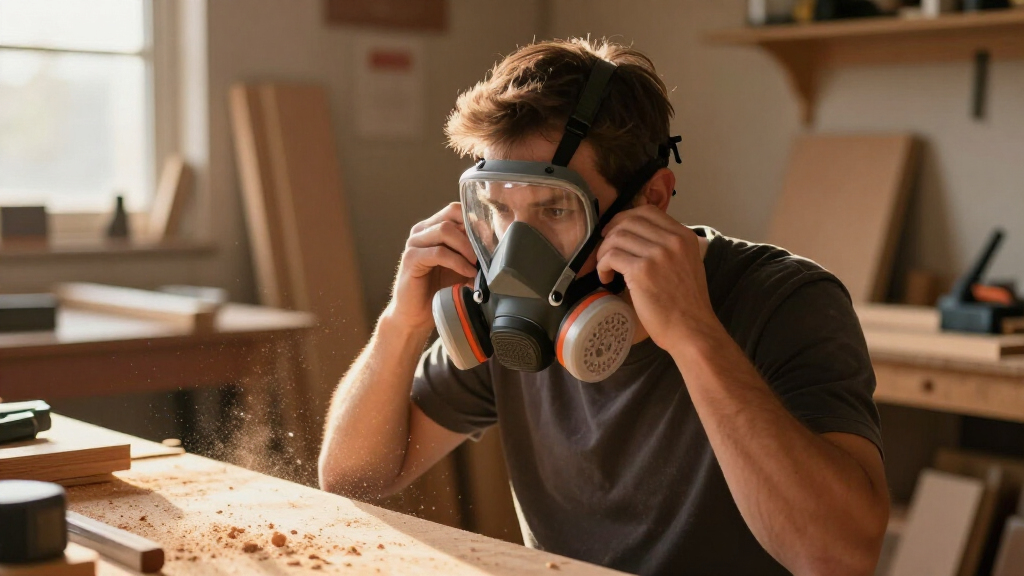
Fit varies by face shape and by respirator design. A molded disposable model might sit well on one person but press against another’s nose; a folded style may feel better yet still leak at the chin. Comfort helps because a mask that constantly shifts is less likely to stay in position, but comfort alone cannot confirm a seal. Try only approved models suited to the task, and follow the manufacturer’s instructions for positioning the nose clip and straps.
For a tight-fitting respirator, facial hair that crosses the sealing surface can prevent a reliable seal. Stubble can matter, too, because the seal needs contact with skin rather than a channel through hair. If a beard prevents a seal, ask whether an approved loose-fitting option such as an appropriate powered air-purifying respirator (PAPR) is suitable for the hazard and permitted by the relevant program. That option brings its own needs, including compatible equipment, power, and maintenance.
At work, a user seal check every time you put on the respirator is a useful immediate check, but it is not fit testing. A seal check can catch an obvious positioning problem; fit testing assesses whether that specific model and size can seal on you. Workplace programs commonly require fit testing for tight-fitting models and medical evaluation, with exact rules depending on jurisdiction and use. If you’re helping a crew member don a mask before cutting tile, pause long enough to check the fit; straps twisted behind the ears can leave a clear path for dust.
Choose a Facepiece That Matches Your Hours and Work Area
A disposable filtering facepiece, reusable elastomeric respirator, and powered air-purifying respirator serve different needs, and none is automatically best for every worker. Choose based on the hazard, required protection, fit, duration, comfort, training, and the complete approved configuration—not on filter style alone. A lighter option may be easier to wear for a short task, while repeated or demanding work can make cleaning, replacement filters, and a maintenance routine more important than convenience.
| Style | Where it may fit | What to watch |
|---|---|---|
| Filtering facepiece, such as N95 or FFP2 | Some particulate tasks where the model is approved, fits the wearer, and meets applicable requirements | Single-use care and disposal guidance; fit and facial hair can limit protection |
| Reusable elastomeric half-mask | Repeated work when compatible replaceable filters and a respiratory program are available | Correct filter selection, cleaning, inspection, storage, and fit |
| Reusable full-face respirator | Tasks that call for eye protection and a higher assigned protection factor when properly fitted and used | Training, approved components, visibility, cleaning, and fit requirements |
| Powered air-purifying respirator | Some situations where a tight-fitting facepiece is unsuitable or a higher protection level is needed | Battery, blower, compatible components, maintenance, and training |
These tradeoffs matter because a respirator is only useful if it can be selected, maintained, and worn correctly for the whole task. A DIYer who sands one door may reasonably choose an approved disposable facepiece if the hazard assessment supports it and the fit is sound. A renovation crew that sands all day may find reusable equipment worthwhile, but the time saved on replacements comes with cleaning and inspection responsibilities. When an unusual high-hazard job calls for specialized gear, renting through a qualified supplier or hiring a professional can make more sense than buying equipment you cannot properly select or maintain.
Know When a Particulate Filter Is the Wrong Tool
A particulate respirator filter does not automatically protect you from gases or vapors. Dust, liquid droplets, and fumes are not all the same airborne hazard, so some jobs that produce both particles and chemical vapors need a combination cartridge or another solution chosen for the specific contaminant. The distinction matters because a filter can appear to work—air still flows and the facepiece still feels snug—while a vapor passes through media designed for particles.
For example, sanding a dry wall compound produces particles, while using a solvent cleaner nearby may introduce vapors. An N95-type particulate filter does not become a vapor filter just because it feels tight or smells less sharp. Odor also cannot tell you reliably whether a contaminant is safe or whether a respirator is working; some substances have little warning odor, and a person’s ability to smell a chemical varies.
Air-purifying respirators are also unsuitable for oxygen-deficient or immediately dangerous atmospheres. They clean air drawn from the surrounding space and therefore cannot supply missing oxygen or make an unknown atmosphere safe. Those conditions require specialized procedures and equipment, not a more ambitious disposable mask. If the air hazard is unknown, do not enter to investigate with a consumer respirator; get qualified help and follow the site’s emergency procedures.
Exposure level matters as much as material name. An N95 may be part of an appropriate plan for some particulate tasks, but a silica-generating activity can require strict controls and a different level of respiratory protection under applicable rules. A homeowner using a small amount of product in a ventilated area and a worker using a grinder for an eight-hour shift do not face the same exposure profile. Duration, concentration, ventilation, and the work method all affect the protection needed, so choose from an assessment rather than assuming one filter class fits every use.
Replace, Clean, and Store Respirators Before They Fail
A respirator stays useful only while its facepiece, filters, and storage condition remain sound. Replace a disposable model when it is damaged, dirty, hard to breathe through, or no longer fits securely, and follow the manufacturer’s instructions and workplace policy on reuse. These signs matter because damage can create a leak, while loading with dust can make breathing harder and encourage the wearer to loosen or remove the mask.
After cutting a few concrete blocks, a disposable facepiece may look gray and feel damp; that is a practical cue to inspect it rather than keep wearing it by habit. Increased breathing resistance can signal a clogged or damaged filter or another problem. Leave the contaminated area safely, then remove the respirator only in a safe location and address the cause.
Reusable elastomeric models need the correct compatible filters, cleaning, inspection, and storage. Check straps, valves, the sealing surface, and connections before use. Each part contributes to the seal and airflow, so a worn strap or sticking valve can compromise protection even when the filter itself is new. Let the unit dry as directed and store it in a clean container away from dust, sunlight, and chemicals that could damage materials.
Never modify a respirator or mix components unless the manufacturer approves the combination. A filter that threads onto a mask is not necessarily an approved match; an apparently compatible connection does not establish that the assembled unit has been tested for the intended use. A small workshop can keep a labeled storage bin and a simple inspection log; that low-tech routine can prevent a cracked valve or wrong cartridge from showing up midway through a dusty shift.
Frequently Asked Questions
Is an N95 the same as an FFP2?
They are both particulate respirator classifications, but they come from different standards and testing systems. Treat them as related, not automatically identical or interchangeable; check the approval named by your workplace or local guidance.
Will an N95 protect me from silica or wood dust?
It may be part of a suitable plan for some tasks, but adequacy depends on exposure level, duration, fit, controls, and applicable rules. Silica work can require strict dust controls and specified protection, so do not choose by material name alone.
Can I wear a respirator over a beard?
Beard hair or stubble across the sealing surface can interfere with a tight-fitting respirator. Ask whether an approved loose-fitting option, such as an appropriate PAPR, suits the hazard and the relevant program.
How do I know if my respirator fits?
Follow the manufacturer’s donning instructions and perform a user seal check each time you put it on. For workplace use, ask the respiratory protection program about fit testing and medical evaluation; a seal check is not a substitute for fit testing.
Can I reuse a disposable respirator?
Reuse depends on the model, contamination, condition, and workplace or manufacturer guidance. Discard it if it is damaged, dirty, difficult to breathe through, or unable to maintain a secure fit.
Do particulate respirators protect against fumes, solvents, or odors?
A particulate filter alone does not protect against gases or vapors. Some tasks need a combination cartridge selected for the specific contaminant, and odor is not a reliable safety gauge.
Conclusion
Choose respiratory protection by working through the hazard, the exposure, the controls, and the fit—in that order. A filter label can tell you something useful, but it cannot identify old insulation, seal a gap at your nose, or make a particulate filter handle solvent vapor.
Control the dust at the tool, follow the applicable safety program, and get professional assessment when the material or exposure is uncertain. Your lungs do not come with a shop vacuum attachment; keep the dust cloud out of the room in the first place.