For most workers, I’d start with the Timberland PRO Boondock, a waterproof composite-toe boot suited to demanding jobs where protection and wet-weather coverage matter. The Wolverine Overpass is a flexible alternative, while the Timberland PRO Pit Boss gives steel-toe protection in a more traditional work-boot design. The main tradeoffs are safety-toe type, weight, waterproofing, and how much support or flexibility your workday calls for. A boot that fits a wet outdoor site may feel unnecessarily stiff or warm on an indoor floor. Read on for my comparison of all 12 picks and guidance on matching a boot to your work.

Get business pricing on tools and workshop supplies
- Business-only prices and quantity discounts
- Tax-exempt purchasing
- Multiple users, one account, clear invoices
Complete the kit


Key Takeaways
- The Boondock leads for demanding wet jobs: It pairs composite safety-toe protection with waterproof construction, making it a strong all-around choice when the worksite calls for both.
- The Overpass favors flexibility: Its composite-toe waterproof design makes it a better fit for buyers who want a less rigid feel than a heavy-duty boot may provide.
- Steel toe and composite toe serve different priorities: The Pit Boss, Keele Ridge, and Furuian offer steel-toe options, while the Boondock, Overpass, Cincinnati, and Gibson Chelsea use composite toes.
- Waterproofing is not universal across the lineup: Several Timberland PRO and Wolverine options specify waterproof construction, while the HEYDUDE Bradley II is described as water-repellent—a distinction that matters in persistent wet conditions.
- Convenience and protection can pull in different directions: The KEEN Gibson Chelsea offers pull-on convenience, while lace-up styles give buyers more ways to adjust fit and hold.
| Timberland PRO Men’s Gridworks Wedge 6 Inch Moc Soft Toe Waterproof Industrial Work Boot |  | Best for Wet, Demanding Job Sites | Shaft height: Ankle | Shaft circumference: 9.25 inches | Sole material: Thermoplastic polyurethane | VIEW LATEST PRICE | See Our Full Breakdown |
| Wolverine Men’s Floorhand Waterproof Soft Toe 6″ Boot |  | Best Basic Waterproof Value | Material: Full-grain waterproof leather | Sole material: Rubber | Shaft height: Ankle | VIEW LATEST PRICE | See Our Full Breakdown |
| Wolverine Men’s Overpass Composite Toe Waterproof Work Boots |  | Best for Flexible Safety-Toe Work | Fabric type: 100% leather | Origin: Imported | Sole material: Rubber | VIEW LATEST PRICE | See Our Full Breakdown |
| Furuian Steel Toe Work Boots for Men and Women – Lightweight, Puncture Resistant, Slip Resistant |  | Best Lightweight Steel-Toe Pick | Fabric type: 100% suede | Sole material: Rubber | Shaft height: Ankle | VIEW LATEST PRICE | See Our Full Breakdown |
| KEEN Utility Men’s Cincinnati 6-Inch Composite Toe Waterproof Work Boots |  | Best Premium Comfort-and-Protection Pick | Fabric type: 100% textile and synthetic | Origin: Imported | Sole material: Rubber | VIEW LATEST PRICE | See Our Full Breakdown |
| Skechers Men’s Respected Boswell Boot |  | Best for Casual, Cushion-First Workdays | Upper material: Leather and synthetic | Sole material: Rubber | Shaft height: Ankle | VIEW LATEST PRICE | See Our Full Breakdown |
| Timberland PRO Men’s Keele Ridge Steel Safety Toe Waterproof Industrial Hiker Work Boot |  | Best Steel-Toe Waterproof Hiker | Shaft height: Ankle | Shaft circumference: 9.25 inches | Safety standards: ASTM F2412-18a, ASTM F2413-18, ASTM F1671-07, ASTM F2892-18 | VIEW LATEST PRICE | See Our Full Breakdown |
| Work Boots for Men Soft Toe – 6-inch Leather Boots with Rubber Sole | 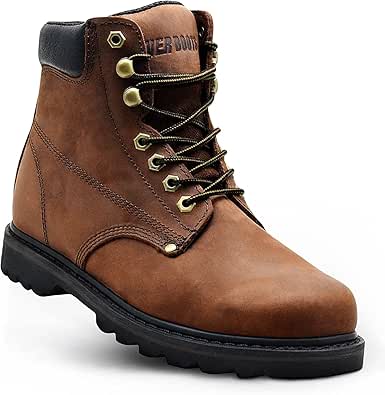 | Best Basic Soft-Toe Option | Shaft height: 6 inches | Outer material: Leather | Sole material: Rubber | VIEW LATEST PRICE | See Our Full Breakdown |
| Timberland PRO Men’s Boondock 6-Inch Composite Safety Toe Waterproof Work Boot |  | Best for Lightweight Toe Protection | Shaft height: Ankle; described as a 6-inch boot | Shaft circumference: 10 inches | Safety standards: ASTM F2412-18a, ASTM F2413-18, ASTM F1671-07, ASTM F2892-18 | VIEW LATEST PRICE | See Our Full Breakdown |
| Timberland PRO Men’s Pit Boss 6 Inch Steel Safety Toe Industrial Work Boot |  | Best for Steel-Toe Shift Comfort | Shaft height: 6 inches | Shaft circumference: 9.75 inches | Material: Waterproof leather | VIEW LATEST PRICE | See Our Full Breakdown |
| HEYDUDE Men’s Bradley II Work CT Leather Boot | Water Repellant |  | Best for Easy-On, Metal-Free Wear | Upper: Water-repellent leather | Toe: Composite; metal-free | Toe standard: ASTM F2413 | VIEW LATEST PRICE | See Our Full Breakdown |
| KEEN Utility Men’s Gibson Chelsea Composite Toe Non Slip Pull-On Work Boots |  | Best Pull-On for Medium-Duty Work | Upper: Water-resistant full-grain leather | Toe: Composite | Standards: ASTM F3445; ASTM F2413 M I/75, C/75 | VIEW LATEST PRICE | See Our Full Breakdown |
| work boot | Shaft height | Sole material | Shaft circumference |
|---|---|---|---|
| Timberland PRO Men’s Gridworks | Ankle | Thermoplastic polyurethane | 9.25 inches |
| Wolverine Men’s Floorhand Wate | Ankle | Rubber | — |
| Wolverine Men’s Overpass Compo | — | Rubber | 25.12 inches |
| Furuian Steel Toe Work Boots f | Ankle | Rubber | 11.8 inches |
| KEEN Utility Men’s Cincinnati | 6 inches | Rubber | — |
| Skechers Men’s Respected Boswe | Ankle | Rubber | — |
| Timberland PRO Men’s Keele Rid | Ankle | — | 9.25 inches |
| Work Boots for Men Soft Toe | 6 inches | Rubber | 8 inches |
| Timberland PRO Men’s Boondock | Ankle; described as a 6-inch boot | Thermoplastic polyurethane | 10 inches |
| Timberland PRO Men’s Pit Boss | 6 inches | Rubber | 9.75 inches |
| HEYDUDE Men’s Bradley II Work | Ankle | Ethylene vinyl acetate (EVA) | — |
| KEEN Utility Men’s Gibson Chel | Ankle | Rubber | — |
More Details on Our Top Picks
Timberland PRO Men’s Gridworks Wedge 6 Inch Moc Soft Toe Waterproof Industrial Work Boot
The Gridworks Wedge is the strongest fit here for workers who need waterproof coverage and steady footing more than a light feel. Its waterproof full-grain leather and slip-resistant outsole suit damp, hard-surface jobs, while the anti-fatigue technology is intended to reduce strain over long shifts. Compared with the Wolverine Floorhand, it adds stated electrical-hazard protection and a more specialized comfort feature, making it the more safety-focused choice from the soft-toe options. The tradeoff is weight: its protective build may feel cumbersome for workers who walk long distances or move quickly. It also lacks a safety toe, so it is not the right pick where impact protection is required. I’d choose it for wet industrial work, not for buyers prioritizing a lightweight boot.
Pros:- Waterproof full-grain leather helps keep feet dry in wet conditions.
- Slip-resistant outsole is suited to slick work surfaces.
- Anti-fatigue technology is designed for comfort during long shifts.
- Electrical-hazard protection is specified, unlike the Wolverine Floorhand.
Cons:- May feel heavy during long walks or fast-paced work.
- Soft toe does not provide impact protection.
- Premium feature set may be more than buyers need for basic, dry jobs.
Best for: Workers on wet industrial floors who want waterproofing, slip resistance, and electrical-hazard protection in a soft-toe boot.
Not ideal for: Workers who need a safety toe or a lighter boot for frequent walking and fast-paced shifts.
- Shaft height:Ankle
- Shaft circumference:9.25 inches
- Sole material:Thermoplastic polyurethane
- Waterproof:Yes
- Electrical-hazard protection:Yes
- Upper materials:Full-grain waterproof leather and ReBOTL fabric
Our verdict“Choose the Gridworks for wet, demanding job sites where soft-toe protection and electrical-hazard features matter more than low weight.”
Wolverine Men’s Floorhand Waterproof Soft Toe 6″ Boot
The Wolverine Floorhand keeps the formula straightforward: waterproof full-grain leather, a cushioned removable footbed, and a rubber outsole. That makes it a practical choice for workers who want everyday wet-weather coverage without the more specialized features of the Timberland PRO Gridworks. The removable footbed also gives buyers a way to replace it or make room for an insert, a useful advantage for long shifts. Its simpler feature set is the tradeoff: the supplied details do not specify electrical-hazard protection or anti-fatigue technology, and this is still a soft-toe boot, not a substitute for impact protection. I’d put it ahead of feature-heavy alternatives for routine work where comfort, traction, and waterproofing matter most, but not for a job requiring documented safety features.
Pros:- Waterproof full-grain leather helps protect against wet conditions.
- Rubber outsole provides traction on slippery surfaces.
- Removable footbed can be replaced or accommodated with an insert.
- Straightforward design avoids features some basic job-site buyers may not need.
Cons:- Soft toe offers no stated impact protection.
- No electrical-hazard protection is listed in the supplied specifications.
- May feel heavy for workers who cover long distances on foot.
Best for: Workers doing routine outdoor or wet-surface jobs who want a waterproof soft-toe boot with a replaceable footbed.
Not ideal for: Workers whose job requires a safety toe, specified electrical-hazard protection, or advanced fatigue-focused support.
- Material:Full-grain waterproof leather
- Sole material:Rubber
- Shaft height:Ankle
- Removable footbed:Yes
- Toe type:Soft toe
Our verdict“Pick the Floorhand for everyday waterproof coverage and a removable footbed, but skip it when your work requires a safety toe or specified electrical protection.”
Wolverine Men’s Overpass Composite Toe Waterproof Work Boots
The Wolverine Overpass is the safety-toe choice for buyers who want protection without giving up as much flexibility as a more rigid work boot. Its composite toe, waterproof leather, and ContourWelt construction pair protection with a design intended to move more naturally; the shock-absorbing rubber outsole adds cushioning underfoot. Compared with the soft-toe Wolverine Floorhand, it is better suited to jobs with toe-impact requirements, while the KEEN Utility Cincinnati offers a different composite-toe route with a specified waterproof membrane and Goodyear welt. The Overpass tradeoff is fit uncertainty: sizing may vary, and it may feel heavy despite its flexible construction. I’d favor it for active jobs that need a safety toe, but buyers should check fit carefully before relying on it for daily shifts.
Pros:- Composite toe provides safety-toe protection.
- Waterproof leather helps keep feet dry.
- ContourWelt construction is designed to improve flexibility.
- Shock-absorbing rubber outsole and abrasion-resistant toe support demanding use.
Cons:- Sizing may vary, so finding a secure fit can take extra care.
- May feel heavy during extended walking.
- Limited color options are noted in the supplied product information.
Best for: Workers who need composite-toe protection and waterproofing but want a boot designed to flex during active work.
Not ideal for: Buyers who need a predictably consistent fit without trying sizes, or who prioritize the lightest possible boot.
- Fabric type:100% leather
- Origin:Imported
- Sole material:Rubber
- Shaft circumference:25.12 inches
- Toe type:Composite toe
- ASTM standard:F2413-11 M I/75 C/75 EH
- Lining:Moisture-wicking
Our verdict“Choose the Overpass for waterproof composite-toe protection with a flexible design, provided you can confirm the fit works for you.”
Furuian Steel Toe Work Boots for Men and Women – Lightweight, Puncture Resistant, Slip Resistant
The Furuian Steel Toe stands apart from the heavier leather-focused choices by centering its appeal on a lightweight build with both toe and underfoot protection. Its steel toe and puncture-resistant midsole address different hazards, while the slip-resistant rubber sole is suited to varied work surfaces. That combination gives it a broader safety focus than the soft-toe Gridworks, though the Gridworks lists waterproof construction and electrical-hazard protection that Furuian does not specify. The Furuian’s suede upper is also a different proposition from the waterproof full-grain leather on the Wolverine Floorhand: it is described as easy to clean, but no waterproof rating is provided. A break-in period may be needed, so this is better for buyers who value lighter wear and protective features over proven wet-weather coverage.
Pros:- Steel toe provides impact protection.
- Puncture-resistant midsole adds protection beneath the foot.
- Lightweight design is intended to reduce the burden of all-day wear.
- Slip-resistant rubber sole supports traction on varied surfaces.
Cons:- Waterproofing is not specified, unlike the Gridworks and Floorhand.
- May require a break-in period before it feels comfortable.
- Suede upper may not suit consistently wet work conditions.
Best for: Workers seeking a lightweight steel-toe boot with puncture-resistant underfoot protection for daily jobs in conditions that are not consistently wet.
Not ideal for: Workers who need specified waterproofing, electrical-hazard protection, or a boot that feels comfortable with little break-in.
- Fabric type:100% suede
- Sole material:Rubber
- Shaft height:Ankle
- Shaft circumference:11.8 inches
- Toe type:Steel toe
- Toe standard:ASTM F2413-18
- Midsole:Puncture-resistant
Our verdict“Pick the Furuian for a lighter steel-toe boot with puncture protection, but choose a specified waterproof option for persistently wet jobs.”
KEEN Utility Men’s Cincinnati 6-Inch Composite Toe Waterproof Work Boots
The KEEN Utility Cincinnati combines waterproofing, composite-toe protection, and cushioning in a boot aimed at demanding full-shift wear. Its KEEN.DRY membrane is described as breathable as well as waterproof, while the Luftcell midsole uses aerated cushioning to soften each step. The specified ASTM protection and electrical-hazard rating give it a stronger safety profile than the soft-toe Timberland PRO Gridworks; compared with the Wolverine Overpass, it adds named membrane and midsole technologies plus Goodyear welt construction. Those features come with compromises: the boot may feel heavy compared with casual footwear, and its initial fit can be stiff. I’d choose it when waterproof comfort and listed safety standards carry more weight than an easy break-in or a light, flexible feel.
Pros:- Waterproof, breathable KEEN.DRY membrane is suited to wet work conditions.
- Composite toe and listed ASTM standards provide specified safety protection.
- Luftcell midsole adds aerated cushioning for extended wear.
- Goodyear welt construction and slip- and oil-resistant rubber outsole support work use.
Cons:- May feel heavy compared with casual footwear.
- Initial fit may be stiff and require a break-in period.
- The comfort and safety features may be unnecessary for jobs that do not require a toe-protection boot.
Best for: Workers who need waterproof composite-toe protection, electrical-hazard rating, and cushioned support for demanding full shifts.
Not ideal for: Workers who want a lightweight boot with a flexible feel straight out of the box, or who dislike a stiff initial fit.
- Fabric type:100% textile and synthetic
- Origin:Imported
- Sole material:Rubber
- Shaft height:6 inches
- Toe type:Composite carbon toe
- Waterproofing:KEEN.DRY membrane
- Standards:ASTM F2412 and F2413 M I/75, C/75 EH
- Construction:Goodyear welt
- Support and comfort:KEEN Luftcell midsole with aerated cushioning
Our verdict“Choose the Cincinnati when you want waterproof composite-toe protection and cushioned support, and can accept a heavier, initially stiff boot.”
Skechers Men’s Respected Boswell Boot
The Skechers Respected Boswell is the comfort-led choice here for buyers who want an ankle-height boot for lighter-duty work, errands, or jobs without a required safety toe. Its cushioned insole and relaxed fit favor everyday wear, while the water-repellent leather-and-synthetic upper can handle light exposure to damp conditions. Compared with the Timberland PRO Keele Ridge, it lacks a steel toe, stated waterproof protection, and job-specific safety features, but it makes a less industrial-looking option for flexible workdays. The tradeoff is that water-repellent does not mean waterproof, and the boot may feel heavier than a lightweight shoe. I’d choose it for comfort and versatile styling, not for hazardous sites or prolonged wet work.
Pros:- Cushioned insole and relaxed fit suit extended everyday wear
- Water-repellent upper offers some protection in light wet conditions
- Rubber outsole is designed to provide traction
- Lace-up ankle-height design gives a secure, adjustable fit
Cons:- No safety toe or job-specific protection is listed
- Water-repellent construction is not stated to be waterproof
- May feel heavier than lightweight footwear
Best for: Workers and DIYers who want cushioned ankle boots for light-duty tasks, commuting, and occasional damp weather without needing a safety toe.
Not ideal for: Industrial workers who need certified toe protection or reliable waterproofing; the listed features do not provide either.
- Upper material:Leather and synthetic
- Sole material:Rubber
- Shaft height:Ankle
- Closure:Lace-up
- Water resistance:Water-repellent
- Fit and cushioning:Relaxed fit with cushioned insoles
- Origin:Imported
Our verdict“Choose the Boswell for cushioned, casual workday wear, but pick the Keele Ridge or another safety-rated boot for hazardous job sites.”
Timberland PRO Men’s Keele Ridge Steel Safety Toe Waterproof Industrial Hiker Work Boot
For demanding jobs that call for a steel toe and wet-weather coverage, the Timberland PRO Keele Ridge brings together waterproof nubuck, a steel safety toe, and electrical hazard protection. Its slip- and abrasion-resistant rubber outsole is aimed at work surfaces where grip and wear matter more than a casual profile. Compared with the Skechers Respected Boswell, this is the more protective, job-focused pick; compared with the Timberland PRO Boondock, it uses a steel rather than composite toe. That distinction may appeal to buyers who specifically need steel, though it can add weight. Expect a potentially stiff initial fit, and choose another option if a lighter feel matters more than steel-toe protection. The ReBOTL lining, made with at least 50% recycled PET, is an added material detail rather than the main reason to buy.
Pros:- Waterproof nubuck construction is suited to wet work conditions
- Steel safety toe meets the listed ASTM safety standards
- Outsole is described as slip- and abrasion-resistant
- Electrical hazard protection and recycled-content lining add job-site and material features
Cons:- Steel toe can make the boot heavy for all-day walking
- Initial fit may feel stiff
- The listed information gives no alternative toe style for workers who prefer composite protection
Best for: Industrial and construction workers who need a waterproof hiker-style boot with a steel safety toe and electrical hazard protection.
Not ideal for: Workers prioritizing a lightweight boot or a soft, flexible feel from the first wear; the steel toe and potentially stiff initial fit may not suit them.
- Shaft height:Ankle
- Shaft circumference:9.25 inches
- Safety standards:ASTM F2412-18a, ASTM F2413-18, ASTM F1671-07, ASTM F2892-18
- Outsole material:Rubber
- Waterproof:Yes
- Safety toe:Steel
- Electrical hazard protection:Yes
- ReBOTL fabric content:At least 50% recycled PET
Our verdict“Pick the Keele Ridge when waterproof coverage and a steel toe are priorities; choose the composite-toe Boondock if reducing toe weight matters more.”
Work Boots for Men Soft Toe – 6-inch Leather Boots with Rubber Sole
This 6-inch nubuck boot is the straightforward choice for buyers who want a soft toe, a supportive collar, and a rubber sole without the bulk of a steel-toe design. Reinforced stitching and stated arch support give it a practical foundation for manual labor and outdoor tasks where toe-impact protection is not required. Compared with the Timberland PRO Pit Boss, it skips the steel toe and listed electrical hazard protection, which can mean less weight and a simpler fit but also less protection on regulated sites. Its sizing runs big, so buyers may need to size down. The description does not specify waterproofing, making this a less suitable pick than the Timberland PRO Keele Ridge for persistently wet conditions. I’d keep it on the shortlist for basic, dry-work footwear, not specialized hazards.
Pros:- Soft toe avoids the rigid protective cap of the Pit Boss and Keele Ridge
- Nubuck leather upper has reinforced stitching
- Padded collar and stated arch support add support for extended wear
- Rubber sole is described as stable with good grip
Cons:- Sizing runs big, so some buyers may need to size down
- No waterproof feature is specified
- Soft toe is not suited to jobs requiring impact protection
Best for: DIYers and workers in dry, lower-risk settings who need a supportive 6-inch leather boot and do not require a safety toe.
Not ideal for: Workers on wet sites or jobs requiring certified toe and electrical hazard protection; waterproofing and those safety features are not listed.
- Shaft height:6 inches
- Outer material:Leather
- Sole material:Rubber
- Shaft circumference:8 inches
- Toe type:Soft toe
- Support features:Reinforced stitches, padded collar, and arch support
- Fit note:Sizing runs big
Our verdict“Choose this boot for basic, supportive work in dry settings, but move to the Pit Boss or Keele Ridge if your job requires a safety toe.”
Timberland PRO Men’s Boondock 6-Inch Composite Safety Toe Waterproof Work Boot
The Timberland PRO Boondock is the lineup’s choice for buyers who need a safety toe but would rather avoid steel. Its composite toe, waterproof membrane, slip-resistant outsole, and anti-fatigue technology target long shifts in wet or demanding conditions. Compared with the steel-toe Timberland PRO Keele Ridge and Pit Boss, the Boondock offers a lighter toe option; it is still a substantial waterproof work boot, not a lightweight shoe. The listed ASTM standards support its job-site focus, while the thermoplastic polyurethane sole differs from the rubber outsoles listed for those steel-toe alternatives. The tradeoffs are weight compared with non-waterproof boots and a more specialized build that may be unnecessary for dry, low-risk work. I’d favor it when toe protection and weather coverage both matter.
Pros:- Composite safety toe offers an alternative to the steel toes in the Keele Ridge and Pit Boss
- Waterproof membrane is suited to wet conditions
- Anti-fatigue technology is intended to support long shifts
- Outsole is described as slip-resistant for all-weather use
Cons:- May be heavier than non-waterproof work boots
- Offers more protective construction than many low-risk jobs require
- Limited color options are noted in the product information
Best for: Workers who need ASTM-listed safety-toe protection for wet shifts and prefer a composite toe to steel.
Not ideal for: Buyers seeking a minimal, light boot for dry, low-risk tasks; the waterproof safety build may be more boot than they need.
- Shaft height:Ankle; described as a 6-inch boot
- Shaft circumference:10 inches
- Safety standards:ASTM F2412-18a, ASTM F2413-18, ASTM F1671-07, ASTM F2892-18
- Sole material:Thermoplastic polyurethane
- Safety toe:Composite
- Waterproof protection:Waterproof membrane
- Comfort feature:Anti-fatigue technology
- Origin:Imported
Our verdict“Choose the Boondock for waterproof work and composite-toe protection, especially if you want to avoid the steel toe used by the Keele Ridge and Pit Boss.”
Timberland PRO Men’s Pit Boss 6 Inch Steel Safety Toe Industrial Work Boot
The Timberland PRO Pit Boss suits workers who want a traditional 6-inch steel-toe boot with waterproof leather and comfort features for long shifts. Its 24/7 Comfort System and removable sock liner are intended to help manage foot fatigue, while the listed electrical hazard protection and impact standards make it more job-focused than the soft-toe 6-inch boot in this roundup. Compared with the Boondock, the Pit Boss uses a steel toe rather than a composite one; that may fit buyers who specifically prefer steel, though it can feel heavier. The waterproof leather and traction on wet or slippery surfaces add useful coverage, but the listed break-in period means comfort may take time. Skip it if you need a lighter boot or immediate flexibility.
Pros:- Steel safety toe meets the listed ASTM impact and compression standards
- Waterproof leather is suited to wet work conditions
- 24/7 Comfort System and removable sock liner support long-shift wear
- Outsole is described as offering traction on wet or slippery surfaces
Cons:- Steel toe may feel heavy compared with the composite-toe Boondock
- A break-in period is required for maximum comfort
- Not the best fit for buyers seeking a light, flexible boot
Best for: Workers who need a 6-inch steel safety toe, waterproof leather, and comfort features for extended industrial shifts.
Not ideal for: Workers who prioritize a lighter toe or a flexible feel right away; the steel toe can add weight, and a break-in period is noted.
- Shaft height:6 inches
- Shaft circumference:9.75 inches
- Material:Waterproof leather
- Sole material:Rubber
- Safety features:Steel safety toe and electrical hazard protection
- Comfort system:Timberland PRO 24/7 Comfort System
- Impact protection:ASTM F2412-18a and ASTM F2413-18 I and C
- Sock liner:Removable
Our verdict“Choose the Pit Boss for waterproof steel-toe protection and shift-focused comfort, but consider the Boondock if you prefer a composite toe.”
HEYDUDE Men’s Bradley II Work CT Leather Boot | Water Repellant
The Bradley II suits workers who want a metal-free composite toe and a boot that is easy to pull on and off. Its water-repellent leather can help with light splashes, while the slip-resistant outsole and removable arch-support foam add useful features for routine workdays. Compared with the KEEN Utility Gibson Chelsea, the Bradley II also has a pull-on design, but its listed sole is EVA rather than rubber, and the available details provide less evidence of heavy-duty outsole performance. It is a more straightforward choice for light-duty jobs and daily wear than the Timberland PRO Boondock, which is built around a more demanding waterproof work-boot brief. The tradeoff is that water repellency is not the same as waterproofing, and long-term durability details are limited.
Pros:- Composite toe is metal-free and listed with an ASTM F2413 rating
- Water-repellent leather helps shed light splashes
- Slip-resistant outsole supports footing on slick work surfaces
- Removable foam insole with arch support and heel pull make daily wear and removal easier
Cons:- Water repellency does not provide the same coverage as a waterproof construction
- EVA sole material may be less suited to buyers seeking a substantial rubber work outsole
- The product details provide limited information about long-term durability
Best for: Workers who need a metal-free safety toe, quick pull-on access, and protection for light-duty indoor or everyday work.
Not ideal for: People working in persistent rain, demanding industrial conditions, or jobs requiring a specifically waterproof boot; the listed protection is water-repellent, not waterproof.
- Upper:Water-repellent leather
- Toe:Composite; metal-free
- Toe standard:ASTM F2413
- Sole material:Ethylene vinyl acetate (EVA)
- Outsole:Slip-resistant
- Shaft height:Ankle
- Insole:Removable foam with arch support
- Entry:Easy-on design with heel pull
Our verdict“Choose the Bradley II for convenient, metal-free protection in lighter work settings, but pick a waterproof boot for wet or demanding job sites.”
KEEN Utility Men’s Gibson Chelsea Composite Toe Non Slip Pull-On Work Boots
The Gibson Chelsea pairs pull-on convenience with a more work-focused outsole package than the HEYDUDE Bradley II: its rubber sole is oil- and slip-resistant, non-marking, and rated for heat up to 572°F. Water-resistant full-grain leather and a composite safety toe make it a stronger match for medium-duty jobs where a quick slip-on boot still needs defined protective features. The KEEN.ReGEN foam midsole is intended to return energy with each step, an advantage for workers on their feet compared with simpler everyday styles such as the Skechers Respected Boswell. Its limits are also clear: cement construction and water-resistant leather do not establish the same waterproof protection offered by boots such as the KEEN Utility Cincinnati. The Chelsea profile may also feel too casual for more formal workplaces.
Pros:- Composite toe meets listed ASTM F2413 M I/75 and C/75 standards
- Full-grain leather is water-resistant
- Rubber outsole is oil- and slip-resistant, non-marking, and heat-resistant up to 572°F/300°C
- KEEN.ReGEN midsole is designed to provide energy return
Cons:- Water-resistant leather is not the same as a specified waterproof construction
- Cement construction may not suit buyers seeking a different, more repair-oriented build
- Casual Chelsea styling may not fit formal work settings
Best for: Workers in medium-duty roles who want a pull-on composite-toe boot with an oil- and slip-resistant outsole and heat-resistant sole features.
Not ideal for: Workers who need a specifically waterproof boot for prolonged wet exposure, or who need a more formal-looking style for customer-facing environments.
- Upper:Water-resistant full-grain leather
- Toe:Composite
- Standards:ASTM F3445; ASTM F2413 M I/75, C/75
- Sole material:Rubber
- Outsole features:Oil- and slip-resistant, non-marking, heat-resistant up to 572°F/300°C
- Construction:Cement
- Midsole:KEEN.ReGEN energy-returning foam
- Shaft height:Ankle
- Weight:540 g / 19 oz
Our verdict“Pick the Gibson Chelsea for convenient medium-duty wear and a feature-rich rubber outsole, but choose a waterproof model for sustained exposure to wet conditions.”

How We Picked
I compared the 12 boots by how well their stated features match common work demands: toe protection, wet-weather coverage, traction, and day-long wear. I also looked at construction cues and wearing style, including lace-up versus pull-on designs, since ease of adjustment and entry can affect daily use. A named safety toe or waterproof build carries more weight for buyers who need those features than a general comfort claim.
The ranking favors boots with a useful mix of protection and versatility, then separates specialist options by their tradeoffs. The Boondock ranks first for its combination of composite-toe protection and waterproofing; the Overpass follows for buyers prioritizing flexibility, and the Pit Boss stands out as a traditional steel-toe choice. Less specialized soft-toe, water-repellent, and convenience-first designs rank lower for broad jobsite use, though they may suit workers whose requirements are different. I do not treat product labels alone as proof that a boot meets a particular workplace standard, so buyers should confirm their employer’s safety requirements before choosing.
| work boot | Sole material |
|---|---|
| Timberland PRO Men’s Gridworks | Thermoplastic polyurethane |
| Wolverine Men’s Floorhand Wate | Rubber |
| Wolverine Men’s Overpass Compo | Rubber |
| Furuian Steel Toe Work Boots f | Rubber |
| KEEN Utility Men’s Cincinnati | Rubber |
| Skechers Men’s Respected Boswe | Rubber |
| Timberland PRO Men’s Keele Rid | — |
| Work Boots for Men Soft Toe | Rubber |
| Timberland PRO Men’s Boondock | Thermoplastic polyurethane |
| Timberland PRO Men’s Pit Boss | Rubber |
| HEYDUDE Men’s Bradley II Work | Ethylene vinyl acetate (EVA) |
| KEEN Utility Men’s Gibson Chel | Rubber |
Factors to Consider When Choosing Best Work Boots
Choosing work boots starts with your worksite requirements, not a feature checklist. I’d first identify the hazards and conditions you face, then balance protection against comfort, fit, and upkeep. These factors can help you avoid paying for features you will not use—or choosing a boot that falls short of your employer’s rules.
Match the Safety Toe to the Actual Hazard
Steel and composite toes are not interchangeable by default; the right choice depends on the protection standard your workplace requires. Steel is the traditional option represented by boots such as the Pit Boss and Keele Ridge, while composite toes appear on models including the Boondock and Overpass. Composite designs may appeal to workers who want to avoid a steel toe, but a material preference does not confirm that a boot is approved for a specific hazard. Check your site’s written requirements and the boot’s product documentation before buying. Do not assume that “work boot” or “safety toe” alone covers every impact or compression requirement. If your job does not require a safety toe, a soft-toe boot may reduce unnecessary bulk, but it is not a substitute where protective footwear is mandatory.
Choose Waterproofing for Your Exposure, Not the Label
Waterproof construction can help when you work in persistent rain, wet grass, or damp outdoor areas, but it may not be necessary for a dry indoor job. Water-repellent treatments, such as the description given for the HEYDUDE Bradley II, should not be assumed to provide the same coverage as a waterproof build. Think about how often water reaches the boot, how long you are exposed, and whether you also need breathability during warm shifts. A waterproof boot can feel warmer, while a non-waterproof boot may be more comfortable in dry conditions. Also check care instructions: finishes and materials can require maintenance to keep their water resistance in good condition. For repeated standing water, verify the maker’s stated limits rather than relying on the word “waterproof” alone.
Treat Traction as a Surface-Specific Choice
Slip resistance is useful, but jobsite surfaces differ: a dry warehouse floor, oily workshop, muddy path, and wet metal stair each challenge a sole in different ways. Product descriptions that call a sole slip-resistant do not tell you how it will perform on every hazard. If your workplace has known oil, chemical, or wet-floor exposure, check whether the boot’s documentation addresses those conditions. Tread depth and sole material also affect how easily mud or debris clears, which can matter outdoors. A heavily lugged sole may be less suited to smooth indoor flooring than a work pattern designed for flatter surfaces. Ask your employer which hazards the footwear must address before treating a broad traction claim as sufficient.
Get Fit Right Before Adding Extra Features
A safety toe that presses against your toes can make a long shift miserable, while a boot that slips at the heel may cause rubbing and instability. Try boots with the socks you wear at work and leave room for natural toe movement without allowing excessive sliding. Foot shape matters as much as the marked size, so check width options and the maker’s fit guidance where available. Lace-up boots allow more adjustment across the foot; pull-on Chelsea styles trade some adjustability for faster entry. Do not count on a break-in period to fix sharp pressure or toe contact. If possible, try footwear later in the day, when feet may be more swollen than in the morning.
Balance Support, Weight, and Flexibility for Your Shift
Workers who climb, kneel, or move repeatedly may prefer a boot that bends comfortably, while those carrying heavy loads or working on uneven ground may value a more supportive feel. Flexible designs such as the Overpass can suit frequent movement, whereas a more substantial boot may make sense for rougher conditions. Extra structure can add weight, warmth, and stiffness, so protection should be matched to the job rather than maximized without reason. Consider how many hours you stand, whether you move between indoor and outdoor areas, and how often you climb ladders. A boot that feels manageable for a quick fitting can feel different after a full shift, so fit and intended use deserve priority over feature count.
Check Maintenance and Replacement Needs
Work boots collect dust, mud, oil, and moisture, and neglect can shorten their useful life or weaken comfort. Clean materials according to the manufacturer’s instructions and let wet boots dry fully before wearing them again. Waterproofing treatments may need renewal, while damaged soles or compromised toe areas call for closer inspection. Look at the outsole and upper regularly for separation, deep wear, or damage that could affect grip and protection. Do not keep wearing a boot simply because its exterior still looks presentable if its safety features or sole condition are in doubt. Before purchasing, check care directions and replacement guidance so the boot’s upkeep fits your routine.
Frequently Asked Questions
Should I choose a steel-toe or composite-toe boot?
Start with your employer’s safety requirements, since the boot must meet the rules for your specific hazards. The Pit Boss, Keele Ridge, and Furuian are steel-toe options in this lineup, while models such as the Boondock, Overpass, and Cincinnati use composite toes. Material alone does not establish that a boot satisfies a particular impact or compression standard. Check the product documentation for the rating your workplace requires. If both types are permitted, compare fit, weight, and comfort rather than assuming one is always safer.
Is a water-repellent work boot enough for outdoor work?
It may be enough for brief exposure to splashes or light moisture, but it should not be treated as equivalent to a waterproof boot for persistent wet conditions. In this roundup, the HEYDUDE Bradley II is described as water-repellent, while several other options are identified as waterproof. Think about whether you work in rain, wet grass, or standing water and how long your boots remain exposed. Read the maker’s product details for the limits of the treatment. For frequent wet work, a boot specifically described as waterproof is generally the clearer starting point.
Can I wear soft-toe boots if I work on a construction site?
That depends on the hazards and the site’s footwear rules, not just the job title. Soft-toe options in this roundup may suit tasks where a safety toe is not required, but they do not offer the same toe protection as the steel- or composite-toe models. Ask your supervisor or check the written safety policy before purchasing. Also check whether the site requires other features, such as puncture resistance or a particular sole rating. If the rules call for protective toe footwear, do not substitute a soft-toe boot for convenience.
Should I buy a waterproof boot if I work mostly indoors?
Not automatically. Waterproofing may be helpful if your indoor work involves washdowns, wet floors, or regular movement outside, but a dry indoor shift may call for a cooler, less weather-focused boot. The extra coverage can feel warm during active work, so balance exposure against comfort. Consider whether spills are occasional or part of your daily environment and whether your employer specifies waterproof footwear. If wet conditions are rare, traction and fit may matter more to your day than waterproof construction.
Are pull-on Chelsea work boots a good choice for long shifts?
They can be convenient if you value quick entry and exit, as with the KEEN Gibson Chelsea, but convenience does not guarantee a good fit. Lace-up boots usually offer more ways to adjust how tightly the upper holds your foot. A pull-on style may work well when its shape matches your foot and your tasks do not require frequent changes in fit. Try it with work socks and check for heel movement or pressure near the toe. If you need fine adjustment during a shift, a lace-up boot may be the safer fit choice.
Conclusion
For a broad mix of wet-weather coverage and jobsite protection, I’d choose the Timberland PRO Boondock as the best overall pick. The Wolverine Floorhand is the best value-style option for buyers seeking a straightforward waterproof soft-toe boot, while the Timberland PRO Boondock is my premium choice for workers who need a more protective composite-toe design. For beginners, I’d start by checking the Wolverine Overpass if flexibility is a priority, then confirm that its protection matches the job. For specific needs, choose the Pit Boss for steel-toe protection, the Gibson Chelsea for pull-on convenience, or the KEEN Cincinnati for a waterproof composite-toe alternative. Before buying, match the toe and sole requirements to your worksite rules and confirm the fit with your usual work socks.