For drywall sanding, the right dust collection setup depends on whether you need a sander, a separator for an existing vacuum, or both. I rank the Hyde Tools 09165 first for straightforward hand sanding because it connects directly to a wet/dry vacuum and includes adapters for several hose sizes. The 1000W Electric Drywall Sander is the more capable choice for broad ceiling and wall work, while the Dustopper PRO makes sense when you want a pail-based separator designed to handle drywall powder.

Get business pricing on tools and workshop supplies
- Business-only prices and quantity discounts
- Tax-exempt purchasing
- Multiple users, one account, clear invoices
These picks solve different parts of the same problem, so they are not interchangeable. A vacuum-connected sander collects dust at the sanding head; a cyclone separator sits between a tool and a shop vacuum to catch debris before it reaches the vacuum. I compare them by how directly they address drywall sanding, what equipment they require, how much setup they add, and what their stated features mean for a typical project. The main tradeoff is simplicity versus coverage: a hand sander is easy to understand but slower across large surfaces, while an electric sander covers more area and brings more equipment to store.
Complete the kit


Key Takeaways
- The Hyde 09165 is the most direct pick for hand sanding, but you need to supply a wet/dry vacuum and additional screens.
- The 1000W electric sander offers adjustable speed, an extendable handle, and a dust bag for larger wall and ceiling jobs; its stated extraction figure is a manufacturer claim.
- The DEWALT 6-gallon separator adds a wheeled cyclone stage to a compatible vacuum, but the vacuum is sold separately and port sizing matters.
- The Dustopper PRO uses a standard 5-gallon pail and includes sweep elbows; choose it when a compact separator that handles drywall powder suits your vacuum setup.
- A sander with built-in collection and a cyclone separator solve different problems, so match the purchase to the tool and vacuum arrangement you already have.
| Hyde Tools 09165 Dust-Free Drywall Hand Sander with 6-Foot Hose |  | Best Overall for Hand Sanding | Model: 09165 | Hose length: 6 feet | Vacuum hose sizes: 1 3/4 in, 1 1/2 in, and 2 1/2 in | VIEW LATEST PRICE | See Our Full Breakdown |
| 1000W Electric Drywall Sander with Vacuum Dust Collection |  | Best for Large Walls and Ceilings | Motor power: 1000W | Speed settings: 9 | Speed range: 800–2100 RPM | VIEW LATEST PRICE | See Our Full Breakdown |
| DEWALT 6-Gallon Dust Separator for Wet/Dry Shop Vacuums | 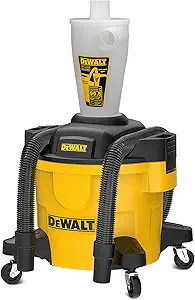 | Best Wheeled Separator | Capacity: 6 gallons | Filter type: Cyclonic separator | Maximum debris separation: Up to 99.5% | VIEW LATEST PRICE | See Our Full Breakdown |
| Dustopper PRO Cyclone Dust Separator |  | Best Compact Pail-Mounted Separator | Material: Anti-static resin | Compatibility: Standard five-gallon pails | Included elbows: Two high-flow sweep elbows | VIEW LATEST PRICE | See Our Full Breakdown |
| dust collection system for drywall | Material |
|---|---|
| Hyde Tools 09165 Dust-Free Dry | — |
| 1000W Electric Drywall Sander | — |
| DEWALT 6-Gallon Dust Separator | Hard plastic |
| Dustopper PRO Cyclone Dust Sep | Anti-static resin |
More Details on Our Top Picks
Hyde Tools 09165 Dust-Free Drywall Hand Sander with 6-Foot Hose
The Hyde Tools 09165 earns my overall spot because it makes dust collection part of the hand-sanding step itself. Connect it to a wet/dry vacuum, attach the supplied hose and adapter, and the tool is ready to help draw dust away while you smooth a repair or finish a smaller section. That direct connection is a simpler starting point than buying a cyclone separator and then figuring out how to connect it to a separate sanding tool.
The six-foot hose gives some room to move around the work, and the adapter is listed for vacuum hose sizes of 1 3/4, 1 1/2, and 2 1/2 inches. That range may help owners of different vacuums, although buyers should still check their own connections before starting. The EasyClamp mechanism also makes screen changes quick, which is useful when a sanding sheet wears or the task calls for a fresh surface. The package includes one reversible screen, so plan on supplying more abrasives for work beyond a small patch.
Compared with the 1000W electric sander, this Hyde model keeps the task manual and the kit compact. That is an advantage for touch-ups, corners, and people who want familiar hand control, but it will take more effort across an entire room. Compared with the DEWALT and Dustopper separators, it includes the actual sanding head, yet it does not add a pre-separator stage to protect a vacuum filter. I would choose it for a focused drywall job when the vacuum is already available; I would skip it for large ceilings or if you need a separator for several different tools.
Pros:- Connects a wet/dry vacuum to the sanding head to help collect dust at the work surface.
- EasyClamp system supports quick sanding-screen changes.
- Included adapter is listed for three common vacuum hose sizes.
- Handheld format suits small repairs and controlled finishing.
Cons:- Requires a wet/dry vacuum, which is not included.
- Only one reversible sanding screen comes with the tool.
- Manual sanding is slower and more physically demanding over broad walls or ceilings.
Best for: DIYers with a wet/dry vacuum who need a straightforward dust-collecting hand sander for repairs, seams, or smaller drywall areas.
Not ideal for: Anyone sanding large walls or ceilings at speed, or a buyer who needs a cyclone separator for general shop-vac cleanup rather than a sanding head.
- Model:09165
- Hose length:6 feet
- Vacuum hose sizes:1 3/4 in, 1 1/2 in, and 2 1/2 in
- Included adapter:Coupling adapter
- Included abrasive:One reversible sanding screen
- Power source:Wet/dry vacuum required
Our verdict“I recommend the Hyde 09165 for vacuum owners who want a simple, direct way to collect dust while hand-sanding drywall repairs.”
1000W Electric Drywall Sander with Vacuum Dust Collection
If your project involves more than a handful of patches, an extendable electric sander can save repeated hand effort. This model pairs a 1000W motor with nine speed settings from 800 to 2100 RPM, letting the operator adjust the sanding pace for different surfaces and stages of finishing. Its digital display makes the selected speed visible, and the rotating head is designed to follow changes in angle as you work across walls, corners, and ceilings.
The handle adjusts from 4.9 to 6.2 feet, a useful reach range for overhead areas and higher walls. LED lighting can make surface irregularities easier to see, particularly when room lighting is poor. The package also includes 30 sanding sheets, a 6.5-foot hose, a dust bag, adapters, a carrying bag, and basic safety equipment. This is a fuller kit than the Hyde hand sander, and that can reduce the need to assemble accessories separately. It also means more pieces to keep together and store between jobs.
The listed dust extraction efficiency of up to 98.5% is a manufacturer claim; actual collection will depend on setup and working conditions. Compared with the Hyde, this machine is better suited to covering broad surfaces, but it is bulkier and less minimal for a quick repair. Compared with the DEWALT separator or Dustopper PRO, its collection is integrated into a sanding tool, so it does not serve as a general pre-separator for other vacuum tasks. I would put it first for frequent room-scale sanding, but not for a one-off patch where a hand sander is easier to handle and put away.
Pros:- Nine speed settings offer control across different sanding tasks.
- Extendable handle and rotating head help reach ceilings and angled areas.
- LED lighting can help reveal surface marks while sanding.
- Includes 30 sanding sheets, hose, dust bag, adapters, carrying bag, and safety accessories.
Cons:- The stated extraction efficiency is a manufacturer claim, not a guaranteed result for every setup.
- The accessory bundle takes more space to organize and store.
- The powered, extended format may be excessive for small repairs.
Best for: Home renovators or contractors sanding multiple walls and ceilings who want powered coverage, adjustable speed, and an extendable handle.
Not ideal for: People who only need to smooth a small patch, want a compact hand tool, or need a standalone separator for several shop-vac tools.
- Motor power:1000W
- Speed settings:9
- Speed range:800–2100 RPM
- Handle length:4.9–6.2 ft
- Head rotation:360°
- Extension rod swing:120°
- Included sanding sheets:30
- Dust collection:Vacuum hose and dust bag included; extraction claim up to 98.5%
Our verdict“I would choose this electric sander for larger drywall jobs where reach and powered coverage matter more than a small, simple setup.”
DEWALT 6-Gallon Dust Separator for Wet/Dry Shop Vacuums
The DEWALT separator is a pre-separator for a wet/dry vacuum, not a drywall sander. It uses cyclonic separation to capture debris in a six-gallon bucket before that material reaches the vacuum. For drywall work, the practical appeal is that less collected material may reach the vacuum filter, helping reduce clogs and loss of suction during longer cleanup sessions. Its four-caster base also makes it easier to move around a work area than a stationary bucket setup.
This model is a sensible match for a buyer who already owns a compatible shop vacuum and wants to add a debris-catching stage. It is listed for vacuum ports measuring 1 7/8 or 2 1/2 inches, so compatibility deserves a check before purchase. The stated maximum separation figure is up to 99.5%, but I would treat that as a product specification rather than a promise of identical performance with every material, hose arrangement, or vacuum. The vacuum itself is not included, so this is an addition to an existing system rather than a ready-to-sand kit.
Compared with the Dustopper PRO, the DEWALT provides a wheeled six-gallon bucket and a more complete separator body, which favors moving a larger collection setup around a job. The Dustopper is a pail-mounted option and may be easier to fit into a compact storage arrangement if a suitable pail is on hand. Compared with the Hyde and electric sander, neither separator provides the sanding tool or captures dust at the sanding head by itself. I recommend the DEWALT to buyers who value mobility and capacity in a shop-vac system; skip it if you need a complete drywall sanding setup or if your vacuum connection does not match.
Pros:- Cyclonic design helps capture debris before it reaches the vacuum filter.
- Six-gallon bucket offers collection capacity for cleanup sessions.
- Four-caster base supports movement around a work area.
- Listed for common 1 7/8-inch and 2 1/2-inch vacuum port sizes.
Cons:- Wet/dry vacuum is sold separately.
- Port-size mismatch can prevent a straightforward connection.
- Adds a separate separator and bucket to store and move.
Best for: Shop-vac owners who want a wheeled, six-gallon cyclone separator to collect debris before it reaches the vacuum during drywall cleanup.
Not ideal for: A buyer seeking a sander with built-in collection, anyone without a compatible wet/dry vacuum, or someone who cannot match the listed port sizes.
- Capacity:6 gallons
- Filter type:Cyclonic separator
- Maximum debris separation:Up to 99.5%
- Compatible port sizes:1 7/8 in and 2 1/2 in
- Mobility:Four-caster base
- Material:Hard plastic
- Warranty:3-year limited warranty
- Vacuum included:No
Our verdict“I recommend the DEWALT when a compatible shop vacuum is already part of the plan and a mobile, higher-capacity separator is the priority.”
Dustopper PRO Cyclone Dust Separator
The Dustopper PRO is a compact way to add a cyclone stage to a shop-vac setup, with a particular advantage for drywall buyers: the product is described as designed for fine and coarse sawdust as well as drywall powder. It uses a preinstalled gasket intended for a standard five-gallon pail, and the included high-flow sweep elbows shape the hose connection. For someone who already has a compatible pail and vacuum, that arrangement can provide a straightforward separator without the wheeled six-gallon body of the DEWALT.
Its anti-static resin construction is a distinguishing material detail, and the product information says it has been third-party tested with fine sawdust, coarse sawdust, and drywall powder. I would still treat that as context for the intended use, not a guarantee that no dust will escape in every setup. The gasket is designed to form a seal, but the fit depends on the pail and connections being suitable. Unlike the DEWALT, this package does not include a dedicated wheeled bucket; the user supplies the standard five-gallon pail.
Compared with the DEWALT separator, the Dustopper PRO emphasizes pail compatibility and a smaller separator format, while the DEWALT comes with a six-gallon wheeled bucket for easier movement. Compared with the Hyde hand sander and the electric model, the Dustopper is not a sanding tool and cannot collect at the sanding surface without an appropriate tool and vacuum arrangement. I would pick it for a buyer assembling a compact shop-vac separator setup who has a suitable pail already. If mobility, an included collection bucket, or an all-in-one sanding kit matters more, the other picks fit better.
Pros:- Designed for drywall powder as well as fine and coarse sawdust.
- Preinstalled gasket is intended to seal against a standard five-gallon pail.
- Includes two high-flow sweep elbows.
- Anti-static resin construction distinguishes it from the hard-plastic DEWALT separator.
Cons:- Requires a compatible five-gallon pail and a vacuum setup.
- Does not include a sander or wet/dry vacuum.
- Pail fit and hose connections need to match the rest of the system.
Best for: Shop-vac owners who want a pail-mounted cyclone separator intended to handle drywall powder and already have a compatible standard five-gallon pail.
Not ideal for: Buyers who want a complete sander, an included wheeled collection bucket, or a setup that avoids checking pail and hose compatibility.
- Material:Anti-static resin
- Compatibility:Standard five-gallon pails
- Included elbows:Two high-flow sweep elbows
- Weight:1.63 kg
- Dimensions:13 in L × 13 in W
- Item length:7 in
- Outside diameter:2.25 in
- Origin:Made in the USA
Our verdict“I recommend the Dustopper PRO for a compact pail-based shop-vac system when drywall powder compatibility matters and the required pail is already available.”

How We Picked
I ranked these four products around the specific demands of drywall sanding: fine powder, overhead work, repeat passes across broad surfaces, and the need to control dust at the source. I gave priority to options that connect collection to sanding directly, since capturing powder near the sanding head is useful when the task is finishing joints or smoothing patches. That puts the Hyde hand sander and the electric drywall sander ahead of standalone separators for a buyer who does not already own a suitable collection tool.
I also considered what each setup asks a buyer to provide. The Hyde requires a wet/dry vacuum. The DEWALT separator and Dustopper PRO both require a compatible vacuum, and the Dustopper also relies on a standard 5-gallon pail. Those dependencies affect convenience as much as the product itself: a separator can help protect a vacuum from debris, but it does not sand a wall. I treated the listed extraction percentages as product claims rather than guaranteed results in every home or with every vacuum.
Finally, I separated the picks by use case instead of pretending that all four compete on the same feature. I looked at hand control, coverage, included accessories, vacuum compatibility, mobility, and storage demands. My ranking gives the top position to the most direct all-around entry for dust-conscious drywall hand sanding, then recognizes the electric sander for higher coverage and the two separators for buyers building around an existing shop vacuum. The order is a guide to fit, not a claim that one product replaces every other category.
| dust collection system for drywall | Material |
|---|---|
| Hyde Tools 09165 Dust-Free Dry | — |
| 1000W Electric Drywall Sander | — |
| DEWALT 6-Gallon Dust Separator | Hard plastic |
| Dustopper PRO Cyclone Dust Sep | Anti-static resin |
Factors to Consider When Choosing Best Dust Collection System For Drywall
I would start by deciding whether you need to sand drywall or improve the vacuum system used for sanding and cleanup. That choice narrows the field quickly: the Hyde and 1000W model are sanders, while the DEWALT and Dustopper PRO are separators.Choose a sander or a separator first
A dust-collecting sander connects collection to the surface where powder is created. The Hyde is a manual hand sander for controlled work; the 1000W model adds powered sanding, speed adjustment, an extendable handle, and a rotating head. A separator sits upstream of the vacuum and captures debris before it reaches the vacuum. It can support a sanding setup, but it does not replace the sanding tool.
If you are buying your first drywall dust system for one room, a sander with collection is often the more direct purchase. If you already have a sander and shop vacuum, a separator may improve the vacuum side of the setup. The four picks do not all answer the same need, so decide which part of your current arrangement is missing before comparing smaller details.
Match the tool to the size of the job
For nail holes, a patched area, or a short run of joints, the Hyde’s hand-controlled format is easier to justify than setting up a powered pole sander. It uses a wet/dry vacuum and gives the operator direct feedback through the sanding head. Broad walls and ceilings shift the balance toward the electric model: its adjustable handle and powered sanding are intended to cover more area with less repeated hand motion.
That reach and coverage bring their own cost in effort: the powered model has a longer list of accessories and takes more room to store. I would not choose it just because it has more features if the work is limited to a small repair. Conversely, hand sanding a full room can turn a simple tool into a slow, tiring choice.
Check vacuum and hose compatibility
Before choosing a separator or sander, compare the listed connections with the equipment you own. The Hyde adapter is listed for 1 3/4-inch, 1 1/2-inch, and 2 1/2-inch vacuum hose sizes. The DEWALT separator lists 1 7/8-inch and 2 1/2-inch ports. The Dustopper PRO requires a suitable standard five-gallon pail and compatible hose arrangement. A matching nominal size is a useful starting point, but connection shape and fit still matter.
Both separators require a wet/dry vacuum, and neither includes one. If you have no vacuum, account for that as part of the system you need. If you already own a vacuum, check whether you want dust collection at the sander, a pre-separator to reduce debris reaching the vacuum, or both. A separator can help protect the vacuum from collected material, but collection still depends on a working, compatible setup.
Understand collection claims and expectations
The electric sander lists extraction efficiency of up to 98.5%, and the DEWALT lists maximum debris separation of up to 99.5%. I treat both figures as stated product claims, not as a guarantee for every drywall compound, vacuum, hose path, or work technique. The Dustopper PRO is described as designed for drywall powder, and the Hyde connects a vacuum at the hand-sanding head. Those details help compare intended use, but no setup should be read as a promise of a completely dust-free room.
For any option, keep the vacuum and collection components assembled as directed, check that connections fit, and use suitable protective equipment for sanding work. The electric kit includes goggles, earplugs, and a mask, but the other products do not list the same bundle. Included accessories affect convenience; they do not change the basic distinction between collecting at the tool and separating debris before it reaches the vacuum.
Balance capacity, mobility, and storage
The DEWALT’s six-gallon bucket and four-caster base suit buyers who want a larger collection vessel they can roll around the work area. The Dustopper PRO keeps the separator body compact and uses a pail the owner supplies. That means the DEWALT arrives with more of its collection structure, while the Dustopper can be a better fit when an appropriate pail and a smaller storage footprint are priorities.
The powered sander has the biggest accessory bundle, including sheets, hose, dust bag, adapters, and a carrying bag. The Hyde is simpler, though its single included screen means replacement abrasives are part of the plan. I would weigh how often the setup will move, where it will live between jobs, and whether you prefer a ready collection bucket or a pail-based configuration.
Frequently Asked Questions
Which pick is the best starting point for a small drywall repair?
I would start with the Hyde Tools 09165 if you already have a wet/dry vacuum. It connects collection directly to a hand sander and includes an adapter for several listed hose sizes. The electric model is a stronger fit for broad surfaces, while either separator requires a separate sanding tool and vacuum arrangement.
Do the DEWALT separator and Dustopper PRO include a vacuum?
No. The DEWALT listing states that the vacuum is not included, and the Dustopper PRO is a separator that attaches to a suitable pail and vacuum setup. Both are additions for buyers who already own a compatible wet/dry vacuum or plan to supply one.
Is the 1000W electric sander a better choice than the Hyde hand sander?
It depends on the amount of sanding. The electric model is better suited to larger walls and ceilings because it has powered sanding, an extendable handle, a rotating head, and nine speeds. The Hyde is a more direct choice for small patches and controlled hand work, with fewer accessories and no electric sanding motor.
Which separator is more convenient to move around?
The DEWALT includes a six-gallon bucket on a four-caster base, so its collection vessel can roll with the work. The Dustopper PRO mounts to a standard five-gallon pail supplied by the buyer. I would favor the DEWALT for a mobile collection setup and the Dustopper when a compact pail-based arrangement suits the workspace.
Do the listed extraction and separation percentages guarantee dust-free sanding?
No. The electric sander’s up-to-98.5% extraction efficiency and the DEWALT’s up-to-99.5% debris separation are product claims, and results can vary with the vacuum, connections, material, and setup. The products are intended to help collect or separate dust; I would not interpret their figures as a guarantee that a room will remain dust-free.
Conclusion
For most buyers focused on drywall hand sanding, I recommend the Hyde Tools 09165 when a wet/dry vacuum is already available and the work involves repairs or smaller areas. Choose the 1000W electric sander for larger walls and ceilings where reach, speed adjustment, and powered coverage matter more. If your sander is already sorted and you want a mobile separator with its own six-gallon bucket, the DEWALT is the better fit. If you prefer a compact pail-mounted separator designed for drywall powder and have a suitable five-gallon pail, pick the Dustopper PRO. The right choice comes down to the missing piece in your setup: sanding head, powered reach, or vacuum-side separation.