TL;DR

Get business pricing on tools and workshop supplies
- Business-only prices and quantity discounts
- Tax-exempt purchasing
- Multiple users, one account, clear invoices
A jobsite radio for extreme weather must do more than play loudly — it needs a published IP rating (IP55 or better for regular outdoor work), a manufacturer-verified operating-temperature range, and glove-friendly physical controls. Battery behavior matters as much as the enclosure: cold temporarily slashes lithium-ion runtime, heat ages batteries permanently, and you should never charge a frozen, wet, or damaged pack. Ruggedness never certifies a radio for hazardous atmospheres with flammable vapors or combustible dust.
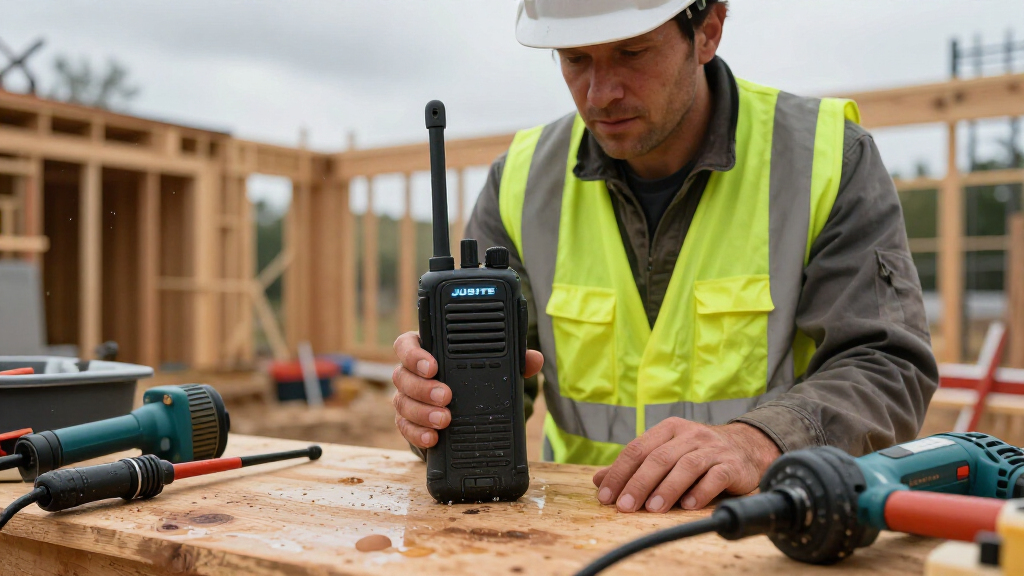
The radio that died on my crew wasn’t killed by a drop or a kick. It was killed by condensation — carried from a 15°F morning into a heated, humid drywall job, where moisture fogged the display and corroded the board within two weeks. The enclosure looked bulletproof. It wasn’t the weather outside that got it. It was the weather inside.
That’s the trap with jobsite radios. A jobsite radio for extreme weather must do more than play loudly. It has to shrug off water, dust, impacts, temperature swings, and unstable power — and still be operable by a guy wearing insulated gloves at 7 a.m. in February. Most buying decisions get made on speaker wattage and brand loyalty. That’s backwards.
In this guide, I’ll walk you through what actually separates a weather-survivable radio from a weather-resistant-looking one: how to read IP ratings honestly, what cold and heat really do to lithium-ion batteries, why drop-test claims need fine print, and the safety lines you should never cross. No product roundups. Just specs, hard-won lessons, and the questions to ask before you spend $150–$400.
Demand a published IP rating — IP55 minimum for regular outdoor work, IP65 as the all-weather baseline — and remember the rating is void the moment a port cove…
Check the manufacturer’s operating-temperature range against your actual site conditions; cold can cut lithium-ion runtime by half or more, and you should neve…
Choose a radio that runs on your crew’s existing tool-battery platform and supports AC, and verify whether it charges batteries or only consumes them.
Favor physical, tactile, glove-friendly controls over touch panels — touch controls routinely fail with wet hands and winter gloves.
A rugged enclosure is never certified for hazardous atmospheres; flammable vapor or combustible dust sites require intrinsically safe certified equipment.
Choosing the Right Jobsite Radio for Extreme Weather Conditions
What actually separates a weather-survivable radio from a weather-resistant-looking one: reading IP ratings honestly, understanding what cold and heat really do to lithium-ion batteries, and the safety lines you should never cross. No product roundups — just specs, hard-won lessons, and the questions to ask before you spend $150–$400.
IP Ratings Decoded: What “Waterproof” Actually Means
An IP rating is a two-digit code describing how well a sealed enclosure keeps out solids (first digit) and water (second digit) under controlled test conditions. An X in either position means that characteristic was never rated at all — an IPX4 radio on a dusty demo is a filter with speakers. “Weather-resistant” with no rating is marketing, not engineering. If the number isn’t in writing, it doesn’t exist.
| Rating | What It Survives | Where It Belongs |
|---|---|---|
| IPX4 | Splashing water only | Light rain, mostly indoor work |
| IP54 | Limited dust + splashes | Renovation interiors, covered porches |
| IP55/56 | Dust + water jets | Regular outdoor jobsites |
| IP65 | Dust-tight + water jets | All-weather outdoor work — the baseline |
| IP67 | Dust-tight + temporary immersion | Standing water or drop risks |
The rating holds only with every port cover, battery door, and seal fully closed. It’s a submarine with an open hatch — the hull rating means nothing. More radios are killed by an open charging flap in light rain than by any storm. And IP67 covers temporary immersion under test conditions only: not pressure washing, not saltwater, not a weekend in a puddle.
Why Cold Kills Your Battery Before It Kills Your Radio
Cold doesn’t break the radio — it starves the battery. Cold slows the chemical reaction inside the cell, like honey straight from the fridge: nothing is broken, the power just can’t get out fast enough. Heat is the slower, meaner twin — every hot hour permanently shortens battery life, like milk on a counter.
“The radio that died on my crew wasn’t killed by a drop or a kick. It was killed by condensation — carried from a 15°F morning into a heated, humid drywall job, where moisture fogged the display and corroded the board within two weeks. The enclosure looked bulletproof. It wasn’t the weather outside that got it. It was the weather inside.”
Hard-won lesson / 20+ years on jobsitesAC, Tool Batteries, and the Runtime Math Nobody Does
The most practical extreme-weather radios run on both AC and your crew’s existing tool-battery platform. Extension cords across wet ground are a genuine hazard — running a cord across a mud-slick grade after rain is how people get hurt. Verify whether the radio charges batteries or only consumes them.
Match the Platform
Run on batteries your crew already owns — no orphan chargers in the van.
Dual Source
AC indoors and in covered areas; tool batteries everywhere else.
Do the Math
Check published runtime at normal listening volume, not max wattage.
Charge Smart
Never charge a frozen, wet, overheated, or damaged pack. Warm it to the approved charging temperature first.
Beyond the Enclosure: What Else Has to Survive
A rugged roll cage is the least of it. Controls, audio, connectivity, and emergency features all behave differently in gloves, cold, and noise.
Impact & Handling
Roll cage, rubberized corners, recessed controls, covered ports, stable base, corrosion-resistant hardware. A drop-test claim is only useful when the manufacturer states height, surface, and test standard.
Glove-Friendly Controls
Physical, tactile knobs and large volume controls over touch panels — touch controls routinely fail with wet hands and winter gloves at 7 a.m. in February. Handle must work with gloves on.
Audibility Over Wattage
Clear speech and midrange beat max wattage. Front or multidirectional speakers, low distortion, adjustable EQ. Position the radio above obstructions, not behind equipment or inside metal structures.
Reception & Bluetooth
FM/AM/DAB+, Bluetooth with auto-reconnect, durable antenna, preset controls. Bluetooth range shrinks with concrete, steel framing, vehicles, and electrical interference.
Weather Alerts
NOAA Weather Radio with alert functions and location-specific filtering — a supplement to, never a replacement for, official warnings. Check local systems outside the US.
Never Cross This
Ruggedness never certifies a radio for hazardous atmospheres. Flammable vapor or combustible-dust sites require intrinsically safe certified equipment — no exceptions.
Five Questions to Ask Before You Buy
Is the IP rating published? Demand IP55 minimum for regular outdoor work, IP65 as the all-weather baseline — and remember the rating is void the moment a port cover opens.
Does the temperature range match your site? Check the manufacturer’s operating range against real conditions; cold can halve runtime, and you should never charge a frozen pack.
Whose batteries does it run on? Choose your crew’s existing tool-battery platform, confirm AC support, and verify whether it charges batteries or only consumes them.
Can you operate it in gloves? Physical, tactile controls over touch panels — touch routinely fails with wet hands and winter gloves.
Is the site atmospheres-hazardous? A rugged enclosure is never intrinsically safe. Flammable vapor or combustible dust demands certified equipment.
The bottom line: the weather that kills radios usually isn’t outside the box — it’s inside it. Let cold gear acclimate before powering on, and never charge during condensation.
IP Ratings Decoded: What “Waterproof” Actually Means on a Spec Sheet
An IP (Ingress Protection) rating is the two-digit code that tells you, under controlled test conditions, how well a sealed enclosure keeps out solids and water. Think of it like a jacket’s weather rating: “water-resistant” shell versus a taped-seam rain shell — same shelf, wildly different performance in a downpour. The first digit covers dust and debris; the second covers water. An X in either position means that characteristic was simply never rated — so “IPX4” tells you nothing about dust protection at all. On a grinding-heavy interior demo, an IPX4 radio is a dust filter with speakers.
Here’s the practical ladder I use after twenty-plus years of leaving radios out in conditions I shouldn’t have:
| Rating | What it survives | Where it belongs |
|---|---|---|
| IPX4 | Splashing water | Light rain, mostly indoor work |
| IP54 | Limited dust + splashes | Renovation interiors, covered porches |
| IP55/56 | Dust + water jets | Regular outdoor jobsites |
| IP65 | Dust-tight + water jets | All-weather outdoor work — my baseline |
| IP67 | Dust-tight + temporary immersion | Sites with standing water or drop risks |
To make it concrete: IPX4 is a radio sitting on a table under an awning during a passing shower. IP55 is that same radio surviving the morning when a scaffolder pressure-rinses the facade next to it. IP67 is the radio your apprentice knocks off the coping into an inch of standing water on a flat roof — fish it out in a few minutes, and it lives.
Now the catch, and it’s a big one. That rating holds only with every port cover, battery door, and seal fully closed. It’s like a submarine with an open hatch — the hull rating means nothing. Leave the USB flap open to charge your phone in drizzle, and you’re running an unrated radio. I’ve seen more radios killed by an open charging flap in light rain than by any storm. IP67 also doesn’t mean waterproof in the way most people assume — it covers temporary immersion under specified test conditions, not pressure washing, not saltwater, not a weekend in a puddle.
When a spec sheet says “weather-resistant” with no IP rating at all, treat that as marketing, not engineering.
The fix costs nothing: look for the printed rating, and buy from manufacturers who publish the test conditions. If the number isn’t in writing, it doesn’t exist.
Popular right now

Bose QuietComfort Wireless Bluetooth Headphones with Active Noise Cancellation, Mic, USB‑C Charging, Deep Bass, 24‑Hour Battery – White Smok

KitchenAid Classic Series 4.5 Quart Tilt-Head Stand Mixer K45SS, Onyx Black

Ninja Specialty Coffee Maker CM401, 10-Cup Carafe, Fold-Away Frother, Black
As an affiliate, we earn on qualifying purchases.
Why Cold Kills Your Battery Before It Kills Your Radio
Temperature is the failure mode nobody budgets for. Cold doesn’t usually break the radio — it starves the battery. A lithium-ion pack that runs all day at 70°F might deliver half its runtime or less at 20°F, and below freezing, the electronics may throttle or shut down entirely. The science is simple: cold slows the chemical reaction inside the cell, like trying to pour honey straight from the fridge. Nothing is broken — the power just can’t get out fast enough. Plastics go brittle, cables stiffen, and LCDs get sluggish and dim, the way an old phone screen looks when left in a cold car overnight.
Heat is the slower, meaner twin. Sustained high temps accelerate permanent battery aging — think of it like milk on a counter: every hot hour shortens the shelf life, and the damage never reverses. Heat can also trip thermal protection. I’ve seen radios parked on dark asphalt in August shut themselves off mid-song, perfectly healthy, just hot — set the same radio two feet away in the shade of the saw table and it runs all afternoon.
And my condensation story from the intro? That’s the third temperature trap: moving a freezing radio into warm, humid air makes moisture form inside the enclosure where you can’t dry it. It’s the same reason eyeglasses fog the second you walk into a warm bar on a January night — except your glasses dry out, and the radio’s circuit board doesn’t.
So the spec that matters most is one most buyers skip: the manufacturer’s published operating and storage temperature range. If a radio is rated to 23°F and your site hits 5°F every January, that radio is the wrong tool no matter how tough the roll cage looks.
- Cold sites: verify the low-temp limit, keep a spare battery warm inside your jacket, and swap it in when runtime drops. A battery that read “dead” on the slab will often come back to life after twenty minutes warming against your chest — it wasn’t empty, just cold.
- Hot sites: park the radio in shade, check the high-temp limit and thermal-protection behavior.
- Temperature swings: let the radio adjust gradually before powering on — the same way you let cold camera gear acclimate before opening the bag — and never charge during condensation.
Never charge a frozen, overheated, wet, or damaged battery. Bring it to the manufacturer’s approved charging temperature first — every major battery platform states this, and every year someone ignores it and learns an expensive lesson when the pack swells or refuses to ever hold a charge again.
Power Strategy: AC, Tool Batteries, and the Runtime Math Nobody Does
The most practical extreme-weather radios run on both AC power and rechargeable tool batteries. That dual setup matters more outdoors than in, because extension cords across wet ground are a genuine hazard — running a cord across a mud-slick grade after a rain is how people get hurt. AC connections must be rated for the location or kept dry and protected, full stop.
Tool-battery compatibility is where you save real money. If your crew already runs one cordless platform, a radio that shares those batteries means zero new chargers, zero orphaned packs, and a free upgrade path as batteries improve. Say your crew runs DeWalt or Milwaukee tools: a radio on the same platform turns every battery you already own into a radio battery. But check the details, because they bite:
- Does it charge batteries or just run on them? A charging radio is bigger, heavier, and more expensive — but it doubles as a spare charger in the truck. Framers who rotate four packs a day love this; a one-battery painter never needs it.
- What’s the honest runtime? Manufacturer figures assume moderate volume, room temperature, and no USB loads. Real jobsites hit none of those. Example: a radio advertised at “10+ hours runtime” on a 5.0Ah pack might deliver six hours at jobsite volume on a 35°F morning — the math changes fast.
- Does USB charging drain the radio? Yes, significantly. Charging phones off the radio can cut music runtime dramatically — a crew topping up two phones every break can lose a third of the day’s music.
- Is there low-battery indication and auto-shutoff? A radio that dies without warning mid-shift is worse than a quiet one — nobody notices the warning-less cutoff until the day stalls because the phone charger died too.
Runtime claims deserve skepticism across the board. Volume, temperature, Bluetooth streaming, and signal strength all pull power. A radio advertised at “all-day runtime” on a 2.0Ah battery might genuinely do it — at half volume, indoors, at 72°F, with Bluetooth off. Double the battery capacity if you want that performance at 30°F on a windy slab. It’s the same logic as towing: the truck’s rated range assumes flat highway, not a mountain pass with a trailer.
Drop Tests, Roll Cages, and Controls You Can Work With Gloves On
Impact protection is about the frame and the details around it. The features that earn their keep are a protective roll cage or reinforced frame, rubberized corners, recessed controls and display, covered ports, corrosion-resistant hardware, and a wide, stable base. Think of the roll cage the same way you think of a truck’s bed liner — it’s not there to make the radio indestructible, it’s there to make ordinary abuse boring. A radio that tips over in wind on a scaffold isn’t portable — it’s a projectile.
When a manufacturer claims drop resistance, look for the specifics: height, surface, and ideally the test standard. “Drop-tested” means one thing at 3 feet onto plywood and something else entirely at 8 feet onto concrete. Real-world translation: 3 feet onto plywood is a radio knocked off a workbench in the shop; 8 feet onto concrete is a radio falling from a second-floor interior landing onto the slab. The number without the conditions is decoration.
Then there’s usability, which reviews almost never test properly. Extreme weather equipment has to work when conditions are at their worst. Every northerner knows the scenario: -5°F, sleet on everything, and you’re trying to skip a song with gloves like oven mitts. Touch controls register nothing; wet bare fingers register everything at once:
- Large, tactile physical buttons — touch-sensitive controls fail with wet hands or heavy gloves, every time. You should be able to find volume and power by feel alone, without pulling off a glove and losing a finger to the cold.
- A display readable in direct sun and in dawn dark. A display that washes out at noon glare is as useless as one you can’t read before sunrise.
- A big volume knob you can find without looking — the radio equivalent of a thermostat dial you can adjust in the dark.
- Clearly marked battery status and lockable settings so nothing gets bumped inside the truck. Everyone has had a radio arrive with the EQ reprogrammed and the alarm set to 4 a.m. because the buttons hit the tool box on the drive over.
One more hard rule: handles are for carrying, not for suspension. If a radio lives at height, it needs an approved, secure placement — not a bungee through the carry handle. The handle rating and the tie-down rating are different things, and manufacturers only claim the first one. A bungee that held all last summer fails the one cold morning the rubber goes stiff — and a five-pound radio falling from a second story is a reportable incident, not a mishap.
Loud Enough Without Getting Someone Hurt: Audio and Reception in Weather
Peak wattage is the most oversold number in the category. It’s like horsepower on a lawn mower — technically real, mostly irrelevant to the job. What determines whether you can hear the game over a table saw is speaker placement, distortion control, and midrange clarity — speech lives in the midrange, and a distorted 50-watt radio is less intelligible than a clean 20-watt one. Anyone who has tried to follow a broadcast at max volume through a cheap speaker knows the sound: all thump, no words. Prioritize front-facing or multidirectional speakers, an adjustable EQ, and clean output at the volume you actually use.
Positioning does more than any spec. A radio set above obstructions — on a stack of material, on a saw bench — carries across a site. The same radio behind a dumpster or inside a steel-framed structure sounds like it’s playing from another zip code. Metal buildings and vehicles also wreck reception; if broadcast radio matters on your site, antenna durability and FM/AM sensitivity deserve a look, not just Bluetooth. The classic case: a crew working inside a tilt-up concrete shell loses FM completely while the station comes in fine in the parking lot twenty feet away.
Bluetooth range shrinks around concrete, steel framing, vehicles, and electrical interference — all things jobsites have in abundance. The practical test is simple: set the phone where you actually keep it — cab of the truck, lunch table, your pocket — and walk the site before you commit. A radio that holds a connection from the trailer across the slab is a keeper; one that stutters every time you pass the panel saw will drive you nuts by Wednesday. Check how the radio handles reconnection when your phone drifts in and out of range — a model that auto-reconnects cleanly beats one that demands manual re-pairing every lunch break.
A jobsite radio should be clearly audible without masking alarms, backup beepers, or a coworker shouting a warning. If your crew can’t hear the forklift, the radio is too loud — and site rules may say so explicitly.
Which brings up the safety layer: in storm-prone U.S. regions — think Gulf Coast hurricane season or Tornado Alley spring — a radio with NOAA Weather Radio alert reception adds genuine value, ideally with location-specific alert filtering so you’re not evacuating for a county-over warning. Treat it as one layer in your emergency plan — never a replacement for evacuation procedures and official alerts.
Match the Radio to the Weather You Actually Work In
The right configuration depends entirely on your conditions. Here’s the shorthand I’d hand to any crew lead buying for a specific site:
| Condition | Prioritize these features |
|---|---|
| Heavy rain | IP65+, sealed compartments, covered ports, stable base |
| Dust or sand | Dust-tight enclosure, protected speaker grilles, easy-to-clean controls |
| Snow and freezing | Verified low-temp range, glove-friendly controls, removable warm-swap battery |
| Extreme heat | Published high-temp limit, thermal protection, shaded placement |
| Coastal sites | Corrosion-resistant build; salt spray destroys hardware that shrugs off rain |
| High humidity | Strong seals, condensation discipline, protected connectors |
| Storm-prone areas | Weather-alert reception, long battery runtime, clear speech reproduction |
Two things that table can’t say loudly enough. First, salt, concrete dust, and chemicals degrade materials that tolerate plain rainwater just fine. The proof is any marina parking lot: bolts that look fine inland come back from two coastal summers orange and flaky. Coastal crews and grinding-heavy crews — concrete dust is abrasive and slightly corrosive, and it works into everything an IP54 door leaves loose — should weight corrosion resistance heavily. Second, even a highly rated radio needs drying, inspection, and maintenance per the manufacturer’s instructions. Seals age. Port-cover gaskets flatten. The rating you bought is a starting point, not a permanent state — the same way a rain jacket needs re-waterproofing after a few seasons, not just once at purchase.
And one absolute line: around flammable gases, vapors, or combustible dust, an ordinary rugged radio is not sufficient — period. That environment requires equipment with specific hazardous-location or intrinsically safe certification. Think fuel-storage sites, spray-finishing booths, grain-handling facilities, anywhere a fuse or spark could land in the wrong air. No IP rating, no roll cage, and no price tag substitutes for it.
Frequently Asked Questions
What IP rating should I look for in a jobsite radio?
IP54 handles dust and occasional splashes for mostly indoor work. For regular outdoor use, target IP55 or IP65. Choose IP67 if temporary immersion is realistic — a drop into standing water, for example. Remember the rating applies only with all covers and seals closed, and it doesn’t cover saltwater, chemicals, or pressure washing.
Can I leave a jobsite radio outside in the rain?
Only if the rating and the manufacturer’s instructions permit that exposure. Even with an IP65 radio, close every port cover, keep it out of standing water, and protect any AC connections. Long-term outdoor storage is a bad idea regardless of rating — seals age, and UV degrades plastics and gaskets.
Will a jobsite radio work in freezing temperatures?
Some will — but only if the specified operating range includes your expected temperatures. Expect reduced battery runtime and a sluggish display in severe cold. Keep a spare battery warm inside your jacket and never attempt to charge a pack that’s still frozen or wet; let it reach the manufacturer’s approved charging temperature first.
Is an IP67 radio completely waterproof?
No. IP67 means temporary immersion under controlled test conditions — typically about 1 meter for around 30 minutes. It does not guarantee indefinite submersion, high-pressure washing, saltwater resistance, or any protection with compartments open. For most jobsites, IP65’s dust-tight plus water-jet protection is the more relevant standard anyway.
Can I use a regular jobsite radio around fuel vapors or combustible dust?
No — not unless it carries the correct hazardous-location or intrinsically safe certification for that environment. Ruggedness and IP protection address water and dust ingress, not ignition risk. Electrical arcing inside an uncertified radio can ignite flammable atmospheres; this is a hard safety line, not a judgment call.
Is a more expensive jobsite radio always more weatherproof?
No. Price often reflects audio quality, battery-charging capability, or brand ecosystem rather than sealing. Compare documented IP ratings, temperature limits, warranty terms, and certifications directly. A mid-priced radio with a published IP65 rating beats a premium model whose weather claims amount to the word “rugged.”
Conclusion
If you remember one thing: buy the spec sheet, not the sticker. A documented IP rating, a verified temperature range, and compatibility with the batteries your crew already owns will outlast any “rugged” branding — and they’re the three facts that separate a three-year radio from a one-season one. For most outdoor crews, the winning configuration is an IP65-class enclosure, a reinforced frame, a removable tool battery plus AC, Bluetooth and broadcast reception, and controls you can run in gloves.
Because the radio that’s still playing — clearly, safely, on a frozen February morning — isn’t the loudest one on the shelf. It’s the one somebody bought by reading the fine print.