📊 Full opportunity report: Backyard Home News For ADU Builders And Homeowners on IdeaNavigator AI — validation score, market gap, and execution plan.

Get business pricing on tools and workshop supplies
- Business-only prices and quantity discounts
- Tax-exempt purchasing
- Multiple users, one account, clear invoices
TL;DR
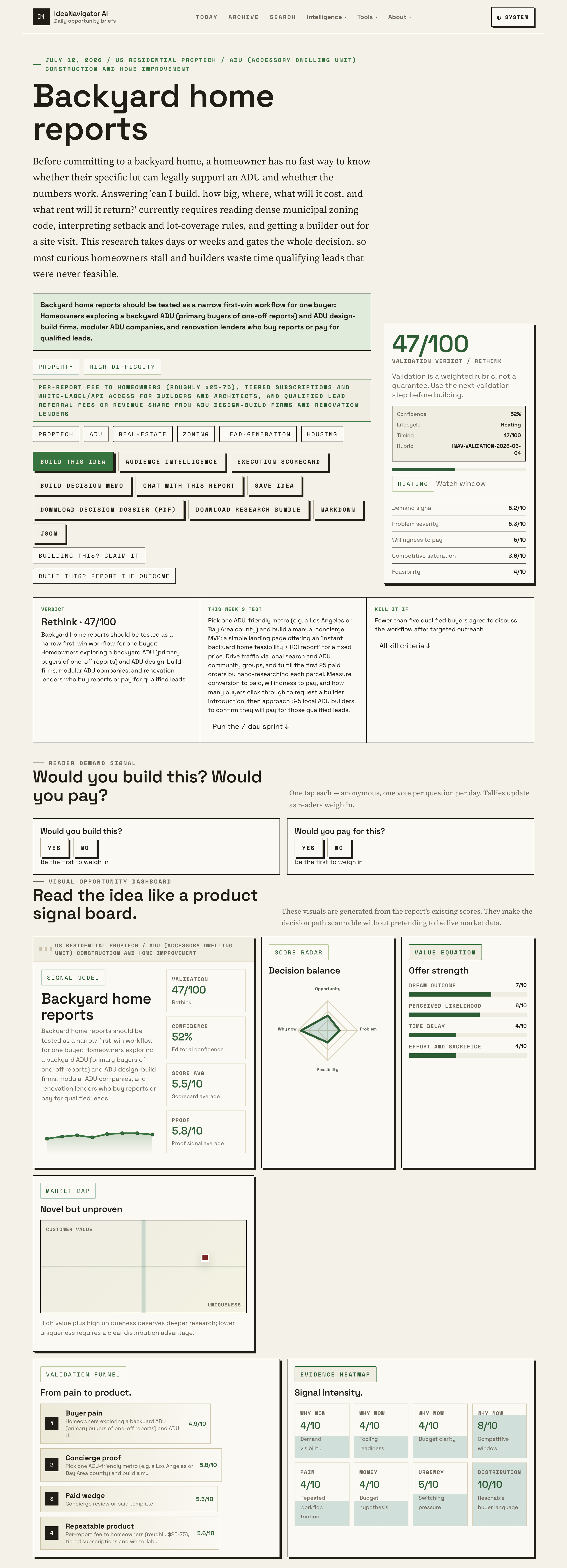
A proposal from IdeaNavigator AI outlines paid, address-specific reports to help homeowners assess whether a backyard ADU may fit their lot and budget. The idea has not been shown to be an operating service: its first proposed step is to manually fulfill 25 paid orders in one market and test homeowner demand and builder interest.
The proposed report would combine county parcel information—including lot boundaries, lot size and existing building footprint—with state ADU law and a manually curated set of local rules. It would estimate permitted ADU types and size, setback and lot-coverage limits, buildable area, a construction cost range and rental income based on local comparisons. Those estimates would be packaged in a homeowner-ready PDF after a customer enters an address.
The suggested first version would focus on one metro area, potentially a county in Los Angeles or the Bay Area, rather than attempt nationwide coverage. The proposal calls for a simple paid landing page and hand-researched fulfillment of the first 25 orders. It also suggests a button for customers to request an introduction to a vetted builder, allowing the pilot to test whether builders will pay for qualified prospective clients.
Potential revenue streams include a proposed $25 to $75 fee per homeowner report, subscriptions or white-label and API access for builders and architects, and referral fees or revenue sharing with ADU firms and renovation lenders. These are suggested prices and business models; no customer conversion rates, builder agreements or operating revenue are reported.
A Faster First Check for ADUs
An address-level screening report could help homeowners decide whether to spend time and money on professional design and site assessments. The questions it aims to address—whether an ADU may be allowed, where it could fit, what it could cost and what rent it might bring—often require both local rule research and property-specific review. A useful early estimate could help some owners rule out unsuitable projects sooner and help builders spend less time on leads that do not fit basic constraints.
The practical value would depend on accuracy and clear limits. A parcel-data review and curated ruleset can provide an initial screen, but a report’s estimates would not by themselves establish that a project will receive a permit or can be built at the stated cost. Local requirements, site conditions and project details may affect the result. The proposal does not specify a method for validating estimates against planning decisions or completed construction projects.
Popular right now

Dreame L40 Ultra Gen 2 Robot Vacuum and Mop

KitchenAid Artisan Series 5-Quart Tilt-Head Stand Mixer, Dried Rose (KSM150PS)

Vitamix Propel Series 510 Professional-Grade Blender, 3 Programs, Black
As an affiliate, we earn on qualifying purchases.
California’s ADU Rules Drive the Pilot
IdeaNavigator AI’s proposal points to California’s statewide ADU law, enacted in 2016, and subsequent loosening of rules as reasons to test the service there. The proposal says Los Angeles County permitted more than 45,000 ADUs in 2023 and that ADUs account for roughly one in five new housing units produced in California. It presents those figures as market context for the business idea, rather than as newly announced findings.
The proposal also cites the broader US housing shortage, which it describes as amounting to millions of units, along with the availability of parcel and zoning data and language-model-based code parsing. It argues these conditions may make address-specific reports more practical. The proposal does not provide a detailed inventory of data coverage, local jurisdictions or rule changes that the pilot would need to handle.
Demand and Report Accuracy Remain Untested
IdeaNavigator AI’s proposal provides no pilot results, and it is unclear whether homeowners will pay the proposed $25 to $75 price, how often reports would produce useful estimates, or how many customers would request builder introductions. The proposal also does not name a launch jurisdiction or describe agreements with parcel-data providers, builders or lenders.
Key operating details remain open, including how quickly reports could be delivered, how often local rules would be updated and how uncertainty in cost and rent estimates would be explained. It is also unclear what review or referral standards would apply before a builder is described as vetted. No specific company launch, product release date or confirmed customer commitment is reported.
A 25-Order Pilot Would Test Interest
IdeaNavigator AI’s proposal calls for choosing an ADU-friendly California market and offering a fixed-price feasibility report through a basic landing page. The team would research the first 25 customer properties manually, then measure paid conversion, willingness to pay and requests for builder introductions.
The proposed next step after that initial test is to speak with three to five local ADU builders about whether they would pay for the resulting leads. The proposal gives no launch date or commitment from those businesses. It identifies evidence from paid orders and builder conversations as the milestone for deciding whether to develop an automated product beyond the manual pilot.
Source: IdeaNavigator AI
Key Questions
Is the backyard ADU report service available now?
IdeaNavigator AI’s proposal describes a concept and a suggested pilot. It does not report that a service has launched or that customers can currently order a report.
What would a report estimate?
The proposal says a report would assess local ADU rules, possible size and placement constraints, estimated buildable area, a construction cost range and potential rent based on local comparisons.
How much might a homeowner pay?
IdeaNavigator AI’s proposal suggests a one-time report price of $25 to $75. It does not report sales validating that price.
Would the report guarantee a permit or project cost?
No such guarantee is described in the proposal. The report is presented as an early feasibility estimate; the proposal does not establish that it would replace jurisdictional review or a property-specific assessment.
How would the idea be tested?
The proposal suggests manually researching the first 25 paid orders in one California market, tracking interest in builder introductions and asking three to five local builders whether they would pay for qualified leads.
Source: IdeaNavigator AI