TL;DR

Get business pricing on tools and workshop supplies
- Business-only prices and quantity discounts
- Tax-exempt purchasing
- Multiple users, one account, clear invoices
Jobsite noise reduction works best as a layered system: quieter equipment and source controls first, then barriers, distance, and scheduling, and properly fitted hearing protection only for whatever exposure remains. Noise above roughly 85 dBA over a full shift can permanently damage hearing, and decibels are logarithmic, so small numerical jumps are big jumps in sound energy. A phone app can flag loud zones but a formal exposure assessment — not your ears — should drive compliance decisions.
The first thing that goes on a jobsite isn’t usually hearing — it’s the realization that it went. I spent fifteen years swinging hammers next to compressors and chop saws, and I can tell you exactly which crew members have tinnitus: they’re the ones who lean in and say “what?” when you talk to them at normal volume. Hearing damage is cumulative and permanent. There’s no fixing it after the fact.
Here’s what this guide covers: where jobsite noise actually comes from, how to kill it at the source with smarter equipment choices, how barriers and scheduling cheapen the problem, and how to pick hearing protection people will actually wear. Jobsite noise affects more than comfort — it can damage hearing, interfere with communication, mask alarms, and grind down crew energy over a ten-hour day.
One warning before we start: rules on noise exposure, permitted work hours, and hearing conservation vary by country, state, and even municipality. Check your local authority before making compliance claims. And if your project involves formal exposure monitoring, bring in a qualified assessor — this article gives you the framework, not a substitute for a measurement.
Decibels are logarithmic — a 10 dB increase sounds roughly twice as loud, so small spec-sheet differences between tools are big exposure differences.
Follow the hierarchy of controls: quieter equipment and source maintenance first, then barriers, distance, and scheduling; hearing protection covers only what…
Free wins exist: doubling distance from a point source cuts ~6 dB, and sequencing loud tasks so they don’t overlap cuts crew exposure at zero cost.
Consumer noise-canceling headphones are not hearing protectors; use protection rated for your jurisdiction, selected by fit, task, and communication needs.
Phone apps find loud zones but can’t make compliance calls — exposure decisions require calibrated instruments and a qualified assessment.
A Deep Dive Into Jobsite Noise Reduction Solutions
Noise control works best as a layered system: quieter equipment and source controls first, then barriers, distance, and scheduling — with properly fitted hearing protection only for whatever exposure remains. Above roughly 85 dBA over a full shift, hearing damage is cumulative and permanent.
“The first thing that goes on a jobsite isn’t usually hearing — it’s the realization that it went.”
Fifteen years next to compressors & chop sawsWhy Decibels Trick You: The 10 dB Rule
Decibels are logarithmic — a 10 dB increase sounds roughly twice as loud and carries ten times the sound energy. A chop saw at 105 dBA isn’t “a bit louder” than an 85 dBA shop vac; it’s a different exposure category entirely. Small spec-sheet numbers are big jobsite differences.
The Hierarchy of Noise Controls
Attack noise in order. Every decibel engineered out at the source solves two problems at once — hearing damage and masked alarms. Earplugs only solve the first, and can make the alarm problem worse.
Eliminate / Substitute
Quieter battery-powered tools, spec-sheet comparisons in dBA, avoid needlessly loud operating practices.
Most effectiveEngineering Controls
Mufflers, damping, maintenance, acoustic enclosures, barriers, and distance — never block ventilation, access, or emergency routes.
Best ROIAdministrative
Schedule loud tasks when fewer people are nearby; sequence so loud tasks don’t overlap. Costs nothing but a calendar.
Free winsHearing Protection
Only for remaining exposure. Selected by fit, task, and communication needs — protection people will actually wear.
Last lineFind Your Loud Zones Before You Spend
You can’t prioritize a budget without knowing where exposure lives. Sources stack additively when machines run together — and your ear adapts and fatigues over a shift, so the site always sounds quieter at 3 p.m. than at 7 a.m. In one basement renovation, a meter showed the real offender was a compressor at a constant 92 dBA — not the table saw everyone assumed. Moving it behind a door dropped the level to the low 80s for free.
Phone Apps: First Pass Only
Accuracy varies wildly by microphone and apps aren’t calibrated. Use them to find suspects and hot zones — never to make compliance calls. Being wrong on the unsafe side carries liability; your crew carries the damage.
Formal Exposure Assessment
Exposure decisions require calibrated instruments and a qualified assessor. Compare specs in dBA, not plain dB — A-weighting mirrors how human ears respond to the frequencies that actually damage hearing.
Behavioral Warning Signs
Ringing ears after a shift. Muffled, “underwater” hearing the next morning. Crews cranking truck radios higher over time. People shouting at arm’s length — that’s already 90+ dBA.
Common Controls, Honestly Compared
◆ What Actually Works
- Doubling distance from a point source cuts ~6 dB — free, immediate
- Sequencing loud tasks so they don’t overlap — zero cost
- Relocating compressors and generators behind doors or up a level
- Temporary acoustic screens, curtains, and enclosures
- Maintenance: worn parts and bad mufflers are silent budget-killers
◆ What Doesn’t
- Consumer noise-canceling headphones — not hearing protectors
- Judging exposure by ear — your ear adapts and fatigues
- Earplugs alone while the source keeps running — symptom, not cause
- Plain dB spec comparisons against dBA ratings — apples vs. oranges
- Protection that blocks alarms and communication — a safety trade
| Control | Cost | Noise Reduction | Also Helps Alarms? | Compliance Driver |
|---|---|---|---|---|
| Quieter equipment purchase | ~ Medium | ✓ 5–15 dB | ✓ Yes | Spec sheets (dBA) |
| Distance / relocation | ✓ Free | ✓ ~6 dB per doubling | ✓ Yes | Site plan |
| Task scheduling & sequencing | ✓ Free | ~ Exposure cut | ✓ Yes | Work planning |
| Barriers & enclosures | ~ Medium | ✓ 5–20 dB | ✓ Yes | Placement rules |
| Hearing protection (PPE) | ✓ Low | ~ Fit-dependent | ✗ Can worsen | Formal assessment |
| Phone app measurement | ✓ Free | ~ Screening only | ~ Indirect | ✗ Not for compliance |
Key Takeaways
Decibels are logarithmic. A 10 dB increase sounds roughly twice as loud — small spec-sheet differences are big exposure differences.
Follow the hierarchy of controls. Quieter equipment and source maintenance first, then barriers, distance, and scheduling. Hearing protection covers only the remainder.
Free wins exist. Doubling distance cuts ~6 dB; sequencing loud tasks so they don’t overlap cuts crew exposure at zero cost.
Consumer headphones are not hearing protectors. Use protection rated for your jurisdiction, selected by fit, task, and communication needs.
Phone apps find loud zones, but can’t make compliance calls. Exposure decisions require calibrated instruments and a qualified assessment.
Why Decibels Trick You: The 10 dB Rule That Explains Everything
Decibels are logarithmic, which means your intuition about them is wrong — and that wrongness has consequences. A 10 dB increase is generally perceived as roughly twice as loud, and it represents ten times the sound energy. The practical implication is huge for purchasing decisions: when a spec sheet says one generator runs at 78 dBA and another at 88 dBA, that second machine isn’t slightly louder — it’s a whole different exposure category, potentially the difference between a compliant zone and one that requires mandatory protection, monitoring, and paperwork. Small numbers on paper are big differences on the site.
Risk depends on both level and duration, and this tradeoff is what the whole regulatory framework is built around. In the US, OSHA’s action level is 85 dBA averaged over an eight-hour shift, and every 5 dB increase roughly halves the safe exposure time. At 100 dBA, you’re talking about damage territory in well under an hour. This is why a single cut on a miter saw won’t ruin your ears, but a day of them, five days a week, for a decade, will — hearing loss happens quietly, in increments, with no pain to warn you. Pain is your body’s usual alarm system for damage; the cochlea doesn’t have one, which is exactly why people underestimate the hazard until the loss shows up on an audiogram.
Safety folks use the A-weighted scale (dBA) because it mirrors how human ears respond — we’re less sensitive to very low rumble and more sensitive to mid-range screech. The implication for reading specs: a tool quoted in plain dB instead of dBA may look quieter than it really is for the frequencies that actually damage hearing, so compare like with like or don’t compare at all.
Here’s the part most people miss, and it matters as much as the hearing damage itself: noise masks warnings. That reversing alarm you’re supposed to hear? Buried under a jackhammer and a plate compactor, it disappears. Plenty of struck-by incidents have communication failure somewhere in the chain of causes — which means noise control isn’t just an occupational-health issue, it’s a physical-safety control. Every decibel you engineer out at the source improves both problems at once; earplugs, notably, improve only the hearing one and can make the alarm problem worse.
Noise doesn’t just wear out your ears. It wears out your ability to hear the things that keep you alive on a site.
Popular right now

Bose QuietComfort True Wireless Earbuds with Active Noise Cancellation, Black

Bose QuietComfort Wireless Bluetooth Headphones with Active Noise Cancellation, Mic, USB‑C Charging, Deep Bass, 24‑Hour Battery – White Smok

Bose QuietComfort Wireless Noise-Cancelling Over-Ear Headphones, Black
As an affiliate, we earn on qualifying purchases.
Find Your Loud Zones First: How to Map Noise Before You Fix It
You can’t control what you haven’t measured — and you certainly can’t prioritize a budget without knowing where the exposure actually lives. Common culprits are impact tools, compressors, generators, saws, concrete work, vehicle alarms, and — the sneaky one — several machines running at once, because sources stack additively in ways nobody plans for. Noise also varies by task, distance, and duration, which is exactly why a formal noise assessment beats judging by ear: your ear adapts, fatigues, and gets desensitized over a shift, so the site always sounds quieter at 3 p.m. than it did at 7 a.m.
Here’s a real example from my renovation days, and it shows why the measurement step matters: we assumed the table saw was the problem in a basement job. A quick walk-through with a meter showed the actual offender was the air compressor cycling in the corner — a constant 92 dBA grinding on everyone for eight hours. The implication was that our planned fix (a quieter saw blade) would have spent money without touching the real exposure. Moving the compressor up a level and behind a door dropped the basement to the low 80s without touching the saw at all. Cheap fix, but only findable with a meter.
Phone apps can help you spot rough patterns and obvious hot spots — I use one for a first pass. But understand the tradeoff you’re making: their accuracy varies wildly depending on the microphone, they’re not calibrated instruments, and the numbers they produce can be off by enough to flip a compliance decision either direction. Use them to find suspects, not to make compliance calls — if you’re wrong on the safe side you waste money, but if you’re wrong on the unsafe side you carry liability and your crew carries the damage.
Watch for the warning signs too, in yourself and your crew — these matter because hearing loss is invisible on routine physicals but visible in behavior:
- Ringing ears after a shift — that’s cochlear damage announcing itself, and repeated episodes mean the damage is accumulating
- Muffled hearing or speech sounding underwater the next morning — a sign yesterday’s exposure exceeded what the ear could recover from overnight
- Crew members cranking truck radios higher over time — a slow recalibration of their baseline hearing, not a preference
- People shouting at arm’s length — that’s a ~90+ dBA environment, already past the point where unprotected full-shift exposure is unsafe
Any of those mean the site is too loud and you need controls, not just earplugs. PPE at that point is treating the symptom while the cause keeps running. Which brings us to the order you should attack the problem in.
Kill Noise at the Source: Quieter Tools Beat Better Earplugs Every Time
The hierarchy of controls is the backbone of every real noise program: engineer the noise out first, change how you work second, and rely on PPE only for what’s left. Here’s why the order isn’t negotiable in practice. Every layer above PPE works continuously, automatically, and for everyone in range — a quieter tool protects whether anyone remembers it or not. Earplugs protect only the one person wearing them, only for the minutes they’re actually in, only if inserted correctly, and only until the protection degrades from sweat, dust, or poor fit. Real-world studies consistently show workers get a fraction of labeled protection. When you skip to PPE first, you’re betting your crew’s hearing on the least reliable control in the entire system.
Source control starts with equipment selection. The biggest shift on modern sites is battery-powered tools and equipment. Swapping a gas generator or pneumatic setup for battery gear eliminates engine and exhaust noise entirely — and that’s not a small category, because engine noise is continuous, tonal, and exactly the kind of steady exposure that accumulates over a shift. Fair warning from someone who’ve tested plenty: the motor gets quieter, but the business end — the cutting, the impact, the grinding — is often just as loud. A cordless demo hammer still sounds like a demo hammer. You’ve removed one noise source, not all of them, which means battery gear shifts the exposure profile rather than erasing it. Know which problem you’re solving before you spend.
Maintenance is the cheapest control nobody uses, and the reason it gets skipped is that nobody connects a worn bearing to a hearing program. A worn muffler, a dry bearing, a loose guard vibrating against the deck — these add decibels, they shorten equipment life, and they’re nearly free to fix. According to Bauecho’s guidance on equipment noise, manufacturer-approved mufflers, damping treatments, and replacing worn parts are all legitimate source controls. The implication: a half-day of preventive maintenance can deliver reductions you couldn’t buy at any price from PPE.
- Audit the loudest five tools on your site — rank them by level AND hours of use, because a 100 dBA tool used ten minutes a day matters less than a 92 dBA compressor running all shift
- Service what you own — mufflers, bearings, blades, and mounting hardware; the fixes cost hours, not dollars
- Replace or rent quieter alternatives for the tasks that dominate exposure, not the ones that are merely annoying
- Stop loud habits — no idling compressors during lunch, no revving saws to “clear” them; habits are free to fix and nobody budgets for them
My honest take on rent vs. buy, including the tradeoffs: if you demo concrete twice a year, rent the modern low-vibration, quieter electric breaker — ownership cost per use makes buying the old pneumatic monster false economy even before you count the noise. If you cut concrete weekly, the buy case for quieter electric tools makes itself in claims prevented and crew retention alone. The wrong move is the middle path: buying cheap loud equipment “for now,” because “for now” on a jobsite lasts a decade.
Barriers and Distance: How to Cut Noise Reaching People (Without Blocking Escape Routes)
Once you’ve quieted the source, the next layer is keeping what’s left from reaching people. Distance is free and underrated — sound pressure drops with the square of distance, so doubling your distance from a point source cuts the level by about 6 dB. That 6 dB matters more than it looks: it’s more real-world reduction than most earplugs actually deliver in practice, it costs nothing, and it protects everyone between the source and the boundary, not just the operator. Moving a generator from 10 feet to 40 feet away buys you real reduction at zero cost — the tradeoff is cable runs and losing line-of-sight to the machine, which is why the right answer depends on the site layout, not a rule of thumb.
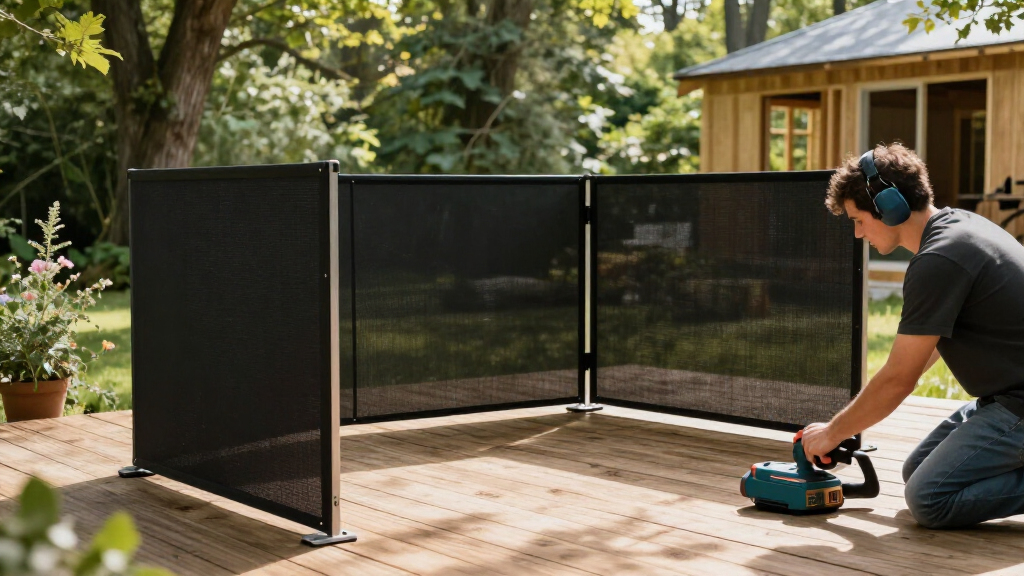
Temporary acoustic screens, enclosures, and curtains are the workhorses here. Modern collapsible acoustic barriers are far more flexible than the plywood-and-hope approach we used decades ago. But understand why they underperform when they do: sound travels around and over barriers like water around a rock, a phenomenon called flanking. A barrier only helps the people in its acoustic shadow, which means its height, length, and closeness to the source matter more than the material itself. A 6-foot screen next to a 40-foot lift does nothing for the guy in the basket — the sound just goes over the top. The tradeoff to weigh: a barrier that’s big enough to work is big enough to be in the way, so placement becomes a site-logistics decision, not an afterthought.
Here’s the safety catch that separates pros from cowboys: barriers must never block ventilation, access, visibility, or emergency routes. This is the core tradeoff of path controls — every decibel you block with a physical structure, you pay for somewhere else. I’ve seen enclosures around generators get so hot the fuel system vapor-locked, and I’ve seen screen walls that turned a blind corner into a near-miss between a skid steer and a laborer. Noise control that creates a different hazard isn’t control — it’s swapping a chronic risk for an acute one, and the acute one will hurt someone faster.
| Control Method | Typical Reduction | Cost | Watch Out For |
|---|---|---|---|
| Distance (double it) | ~6 dB | Free | Needs the space; cable runs |
| Acoustic screen/blanket | 5–10 dB behind barrier | Low–moderate | Flanking paths; wind load |
| Full equipment enclosure | 10–20 dB | Moderate–high | Heat, exhaust, fuel access |
| Quieter equipment swap | Varies, often 5–15 dB | Capital or rental | Tool-end noise may persist |
Read that table as a portfolio, not a menu: the methods stack, and the cheapest layer (distance) should always be spent before the most expensive (enclosures). One more implication worth understanding — the reductions quoted are for the people behind or away from the barrier, not the operator. Barriers protect the many; source controls protect everyone including the operator. That’s a second reason the hierarchy runs the direction it does.
For neighbors, barriers plus placement matter most — and remember many municipalities set hard limits on permitted construction hours, because their standards are built around annoyance and sleep disruption, not occupational damage. That’s a different standard measuring a different harm, which is why a site can be OSHA-compliant and still generate municipal complaints. Check before the 6 a.m. concrete pour, not after the first complaint call.
Schedule the Noise: Work Planning That Costs Nothing
The cheapest noise control on any site is a calendar. Scheduling high-noise tasks when fewer people are nearby and separating noisy work from quiet trades cuts collective exposure without spending a dollar on equipment. It’s pure planning, and it’s the control most sites skip — partly because it requires cross-trade coordination nobody owns, and partly because its results are invisible. A barrier you can see; two-thirds of an exposure you never took doesn’t photograph well. But dose is the metric that damages hearing, and dose is the one thing scheduling attacks directly: the same tool, run in a concentrated window with fewer people present, delivers a fraction of the collective dose.
Real scenario: a kitchen-gut job where the framers ran a demo hammer in the same room, same hours, as the electrician pulling wire and the painter prepping walls. Three trades exposed to one tool’s noise for no reason — and none of them could have been protected by PPE choices, because the problem wasn’t their tools, it was the overlap. Sequencing the demo into a two-hour block — with everyone else off-site or in another zone — would have cut exposure by two-thirds for the crew. Coordinating trades so multiple loud tasks don’t overlap is half the game; the other half is resisting the schedule pressure that stacks trades to save a day, because the compressed schedule quietly externalizes its cost onto everyone’s ears.
- Map the week — identify which tasks are high-noise and how long each runs, since hours of use drives dose as much as decibel level
- Block loud work into concentrated windows when occupancy is lowest — fewer people present means less collective dose even if the task itself is unchanged
- Zone the site — loud operations physically separated from quiet trades, so distance does work you’d otherwise pay for with barriers
- Sequence, don’t stack — one loud task at a time where possible, because overlapping sources add together into an exposure no single control was sized for
- Post the schedule — everyone knows when to be elsewhere; a plan nobody can see is a plan nobody follows
This also matters for the neighborhood, and the mechanism is worth understanding: complaint risk isn’t driven by how loud you are, it’s driven by whether the noise was expected. Advance notice of noisy days, a clear contact for complaints, and honest scheduling go further than any barrier. A neighbor who got a heads-up about Thursday’s saw-cutting tolerates it; a neighbor ambushed by it at 7 a.m. calls the city — and once the city is involved, you’re working inside someone else’s constraints instead of your own. Preventing that call is worth twenty minutes of planning.
Earplugs vs. Earmuffs: Picking Protection People Actually Wear
After engineering and scheduling, whatever exposure remains gets handled with hearing protection — and here’s the truth from thirty years on sites, plus the reason it’s true: PPE is the only control in the entire program whose effectiveness is decided minute-by-minute by the person least informed about the risk. A barrier works while you sleep. An earplug works only while a worker who can’t feel the damage happening chooses, every time, to keep it in. That’s why the best-rated protector on paper is worthless if it’s uncomfortable enough that people take it off — and they will, because humans reliably prioritize present comfort over invisible, decades-later harm. Fit and consistent use beat spec-sheet numbers every single time.
Neither earplugs nor earmuffs is universally better, because each solves a different failure mode of the other. Plugs are cheap, comfortable in heat, and compatible with helmets and glasses — and their weakness is that fitting them correctly is a learned skill most workers were never actually taught, so real-world performance is all over the map. Muffs are easier to put on correctly, easier to share sanitized, and easier to verify at a glance — a supervisor can see from across the room who’s protected — but their weakness is heat, weight, and clamping force over a ten-hour shift, which is exactly what drives people to take them off. High-noise situations may call for both worn together — and note the catch that few people know: dual protection doesn’t add the two ratings together; the combined effect is far less than the sum. An exposure assessment tells you when dual protection is actually needed.
The ratings trap deserves explanation, not just a warning: protection numbers (like NRR in the US) assume a perfect fit that almost nobody achieves, in a laboratory with none of the dust, sweat, jaw movement, or safety glasses stems that break a seal in the field. Real-world performance is typically well below the label — sometimes by half. The implication cuts two ways: don’t shop for the biggest number on the box, and don’t trust that a “29 NRR” plug is delivering 29 dB of anything on your site. And consumer noise-canceling headphones are not hearing protectors — cancelation electronics reduce steady, predictable background noise but don’t block sudden impulse noise from a nail gun, which is precisely the kind of noise that does the fastest damage. Use products rated and approved for hearing protection in your jurisdiction, full stop.
Then there’s the situational-awareness problem, and it’s a genuine tradeoff, not a solved problem: how do workers hear alarms through protection? The naive answer — pull the plugs off when you need to listen — reintroduces the exact hazard the protection exists for, and impulse damage can happen in the minutes it’s off. The real answer is a site-specific system: protection selected for the task, alarms suited to noisy conditions (visual beacons, more of them, distributed so no one works outside their coverage), and communication procedures that don’t depend on shouting. Modern communication-enabled protectors with built-in radio or level-dependent mics let crews talk while staying protected — they’re an investment, but the tradeoff they resolve is the one that’s been forcing workers to choose between hearing the foreman and keeping their hearing, and on a loud site that choice has been going the wrong way for decades.
- Plugs: long wear, heat, helmet compatibility — train the fit or forfeit the rating
- Muffs: quick on/off, shared use, verifiable fit — watch heat fatigue on long shifts
- Dual protection: sustained 100+ dBA work — adds less than the labels sum to, but it adds
- Communication-enabled: coordinated crews in loud zones — solves the talk-versus-protect tradeoff at a price
Train the fit, check the condition, and replace crushed or hardened plugs without mercy — a crushed plug delivers a fraction of its rating while still feeling like something’s in the ear, so the wearer has no way to know it’s failing. Training also means people know the warning signs — ringing, muffled hearing — and how to report them without feeling like a complainer, which matters because the reporting culture on most sites punishes exactly the early warnings that would catch damage while it’s still minor.
Build It Into the Program: Documentation, Monitoring, and Review
The sites that actually keep hearing intact treat noise like any other hazard: planned, documented, and reviewed. A written noise element in your safety program — equipment selection, exposure assessment, training, and a review of whether controls are working — is the difference between noise control and noise luck. Here’s why the paperwork earns its keep: hearing loss develops over years, so a site can run unsafe the entire time and look fine, right up until the audiograms come back. The documentation is what forces the question “are the controls working?” before the damage ledger closes, instead of after.
Connected noise monitoring is the newest tool worth knowing about. Networked sensors on a site can log noise levels continuously and flag high-exposure periods and patterns — data you’d never catch with a spot meter, because spot measurements are snapshots of a moving target. Continuous logs reveal the things that actually drive dose: the Friday afternoons when three trades stack, the compressor fault that’s added 4 dB over three months, the subcontractor whose tool discipline evaporates when the superintendent isn’t around. But the tradeoff is interpretation: measurements need the right equipment and someone qualified to read them. Data without interpretation is just a spreadsheet — and worse, it’s a false sense of confidence that can stand in for actual control.
Document the loop, because controls decay. If the meter says the east zone still runs hot after your barrier went up, that’s not a failure — that’s the system telling you to check for flanking paths or add a layer. This is the mindset shift that separates programs from purchases: a control is a hypothesis, and the re-measurement is the test. Barriers sag, mufflers wear, trades change, and the schedule you optimized in March is chaos by August. A quarterly review keeps the program honest.
A noise program isn’t a purchase, it’s a habit. The sites that win are the ones that measure, fix, and re-measure.
And keep your compliance claims current. Occupational exposure limits, municipal noise ordinances, and hearing-conservation requirements differ by location and change over time — and the trend across jurisdictions is toward stricter limits, not looser ones, so a standard you met five years ago may not protect you today. Verify current local regulations and manufacturer specs before you stake your record on them.
Frequently Asked Questions
How loud is too loud on a construction site?
It depends on both level and duration, plus your local occupational rules. In the US, OSHA’s action level is 85 dBA averaged over an eight-hour shift, with permissible exposure halving roughly every 5 dB increase. A qualified noise assessment with calibrated instruments — not your ears or a phone app — determines whether controls are legally required on your site.
Can jobsite noise cause permanent hearing loss?
Yes. Repeated or intense noise exposure damages the hair cells in your inner ear, and that damage is irreversible — hearing aids help but don’t restore hearing. It’s cumulative across years, which is why crew members often don’t notice until the loss is significant. Ringing ears or muffled hearing after a shift are warning signs worth reporting.
What is the best way to reduce construction noise?
Start at the source: quieter or battery-powered equipment, good maintenance, and manufacturer-approved mufflers or damping. Then add barriers, distance, and scheduling to cut what reaches people. Use hearing protection only for remaining exposure — it’s the last line of defense, not the first move.
Do noise-canceling headphones protect hearing at work?
No, not automatically. Consumer noise-canceling headphones use electronics that reduce steady background noise but don’t block sudden impulse sounds like a nail gun or saw blade. Workers should use products rated and approved for hearing protection in their jurisdiction, chosen for the task and noise environment.
Are earplugs or earmuffs better?
Neither is universally better. Plugs win for long wear, heat, and compatibility with helmets and glasses. Muffs win for quick correct fitting and easy verification. Sustained high-noise work may call for both together. The real deciding factor is which one people will actually wear correctly, all shift, every shift — fit and consistency beat ratings.
Can workers hear alarms while wearing hearing protection?
Yes, with planning. Select protection compatible with the site’s alarm types, add visual signals like strobe beacons in loud zones, and establish communication procedures that don’t rely on shouting. Never solve the problem by removing protection in hazardous areas — some modern protectors have level-dependent microphones or built-in radios that keep speech audible while blocking harmful noise.
Conclusion
If you remember one thing, make it this: the quietest site isn’t the one with the best earplugs — it’s the one that never needed them for most of the day. Audit your five loudest tools, fix the maintenance items, move or screen the worst offenders, and schedule loud work so it doesn’t stack on top of three other trades. Then hand out protection for what’s left and train people to wear it right.
Your hearing doesn’t send pain signals when it’s being destroyed. It just quietly stops coming back — one muffled conversation at a time. Control the noise now, so you can still hear the words “nice work” thirty years from now.