
Choosing wood flooring for a concrete slab is less about plank appearance alone and more about how the floor handles moisture, installation constraints, and the slab beneath it. My strongest starting points are the Bruce Natural Statement engineered hardwood for its click-lock design and stated below-grade suitability, the multi-ply engineered hardwood for wider, longer planks and a layered build, and the warm-brown solid bamboo for buyers who want a hard-wearing, water-resistant surface. Each has a different compromise: Bruce is narrow and has limited finish information, the multi-ply product needs careful installation planning, and bamboo’s tongue-and-groove joints leave less room for installation mistakes.

Get business pricing on tools and workshop supplies
- Business-only prices and quantity discounts
- Tax-exempt purchasing
- Multiple users, one account, clear invoices
These are not interchangeable choices for every slab. Concrete can transmit moisture, and a product described as waterproof or water-resistant does not automatically make the whole floor system safe over any slab. I rank these options by the installation information supplied, the stated moisture-related features, and how clearly each can fit a concrete-floor project. Before buying, verify the manufacturer’s approved substrate, moisture limits, and underlayment or vapor-control requirements for your exact installation.
Complete the kit


Key Takeaways
- Bruce Natural Statement is the clearest fit for slab shoppers seeking a floating installation: it has click-lock joints and is described as suitable for below-grade rooms.
- The multi-ply engineered floor offers the widest planks and longest listed length here, but its at-or-above-ground application limits make it a poor choice for below-grade slabs.
- Warm-brown solid bamboo is described as waterproof and offers a durable surface, though the supplied details do not establish its suitability for every concrete slab or below-grade space.
- Light-honey bamboo is the refinishing-oriented pick, but its tongue-and-groove installation and light finish call for careful fitting and realistic expectations about visible wear.
- All four packages cover roughly 20 to 22 square feet, so I would calculate room area plus cutting waste and confirm moisture-control instructions before ordering.
| Bruce Natural Statement 3″ Wide x 3/8″ Thick Click-Lock Engineered Hardwood Flooring |  | Best Overall for Click-Lock Slab Projects | Material: Maple engineered hardwood | Plank size: 3 inches wide x 3/8 inch thick | Coverage: 22 square feet per case | VIEW LATEST PRICE | See Our Full Breakdown |
| Multi-Ply Engineered Hardwood Flooring, 47.64″ L x 6.5″ W x 0.59″ T |  | Best Wide-Plank Look for At- or Above-Grade Slabs | Construction: Multi-ply engineered hardwood | Plank dimensions: 47.64 inches long x 6.5 inches wide | Thickness: Title lists 0.59 inch; supplied spec lists 15 mm | VIEW LATEST PRICE | See Our Full Breakdown |
| Solid Bamboo Flooring, 40.15″ L x 5.11″ W x 0.6″ T, Warm Brown Oak Grain |  | Best Water-Resistant Surface Claim | Material: Solid bamboo | Plank dimensions: 40.15 inches long x 5.11 inches wide x 0.6 inch thick | Coverage: 20 square feet | VIEW LATEST PRICE | See Our Full Breakdown |
| Solid Bamboo Hardwood Flooring Planks, 37.8″ x 3.78″ x 0.6″, Light Honey |  | Best Refinishable Bamboo Option | Material: 100% natural bamboo | Plank dimensions: 37.8 inches long x 3.78 inches wide x 0.6 inch thick | Coverage: 19.84 square feet | VIEW LATEST PRICE | See Our Full Breakdown |
| wood flooring for concrete slab | Coverage | Installation | Material | Plank dimensions |
|---|---|---|---|---|
| Bruce Natural Statement 3" Wid | 22 square feet per case | Click-lock; no glue or nails listed | Maple engineered hardwood | — |
| Multi-Ply Engineered Hardwood | 21.5 square feet | Tongue and groove | — | 47.64 inches long x 6.5 inches wide |
| Solid Bamboo Flooring | 20 square feet | Tongue and groove | Solid bamboo | 40.15 inches long x 5.11 inches wide x 0.6 inch thick |
| Solid Bamboo Hardwood Flooring | 19.84 square feet | Tongue and groove | 100% natural bamboo | 37.8 inches long x 3.78 inches wide x 0.6 inch thick |
More Details on Our Top Picks
Bruce Natural Statement 3″ Wide x 3/8″ Thick Click-Lock Engineered Hardwood Flooring
The Bruce Natural Statement earns my top position because it gives concrete-slab shoppers the most useful installation clue in this group: a click-lock system that needs no glue or nails. That floating approach may suit a slab where fastening directly into concrete is not part of the plan, and the listing also identifies it for below-grade installation. Its Densitek core is described as harder and more water resistant, making it a more purposeful slab candidate than either bamboo product, whose descriptions do not specify below-grade approval.
That advantage is about the information provided, not a blanket promise that it can go over any concrete. I would still check the product’s current installation instructions for permitted underlayment, slab moisture limits, and any vapor retarder requirement. Water resistance is not the same as waterproofing the full floor assembly. Compared with the multi-ply engineered option, Bruce is narrower at 3 inches and has a much shorter stated plank width profile, but it provides clearer installation and below-grade claims. Compared with the warm-brown bamboo, it offers a more explicit click-lock route rather than tongue-and-groove fitting.
The tradeoff is a relatively narrow plank and limited detail about finish and color choices. Buyers focused on a broad, contemporary plank appearance may prefer the 6.5-inch multi-ply floor, if their installation is at or above grade. Bruce also covers 22 square feet per case, only modestly more than the other packages, so room measurements and cutting waste still matter. I see it as the most defensible starting point for someone who prioritizes a floating installation and explicit below-grade language over plank width or a particularly detailed style description.
Pros:- Click-lock installation avoids glue or nails according to the product details.
- The listing specifically states suitability for below-grade installation.
- Densitek core is described as harder and more water resistant.
- At 22 square feet per case, it has the largest stated coverage of these four.
Cons:- The 3-inch plank width is narrower than the multi-ply engineered option.
- The supplied information gives limited detail about color and finish choices.
- Below-grade suitability does not remove the need to verify slab moisture and installation requirements.
Best for: Buyers planning a floating engineered-wood floor over a concrete slab who need click-lock installation and a product listing that explicitly mentions below-grade suitability.
Not ideal for: Shoppers who want wide planks, detailed color and finish choices, or a floor they can install without checking moisture, underlayment, and slab requirements.
- Material:Maple engineered hardwood
- Plank size:3 inches wide x 3/8 inch thick
- Coverage:22 square feet per case
- Installation:Click-lock; no glue or nails listed
- Core:Densitek core, described as harder and water resistant
- Use level:Listing states suitability for below-grade installation
- Grade:Residential
Our verdict“I rank Bruce first for its useful click-lock and below-grade details, provided you confirm the slab requirements before installing.”
Multi-Ply Engineered Hardwood Flooring, 47.64″ L x 6.5″ W x 0.59″ T
If a concrete slab sits at or above ground level and the goal is a more expansive plank appearance, this multi-ply engineered hardwood is the strongest style-led option in the group. Its listed planks are 6.5 inches wide and 47.64 inches long, substantially wider and longer than either bamboo choice and the 3-inch Bruce boards. That format can create fewer visible seams across a room, although it also calls for a flat, properly prepared substrate and careful layout.
The layered construction and water-resistant description make it more relevant to slab shopping than an unspecified solid wood product. The listing also mentions underfloor heating, which may matter when planning a compatible floor assembly. But its own application description says it is suitable for at- or above-ground installation. I would not select it for a below-grade basement based on the information provided. Bruce is the better-defined choice for below-grade use because it explicitly names that setting and supplies a click-lock method; this product’s tongue-and-groove system needs more installation clarification before it can be considered a straightforward slab fit.
There is also a specification inconsistency: the product title lists a thickness of 0.59 inch, while the supplied spec lists 15 mm. Those figures are close, but I would confirm the final product documentation rather than rely on a rounded listing. The package covers 21.5 square feet with ten planks, so project planning remains similar to the other small-case options. This is my pick for buyers who value wide, long boards and an engineered multi-ply build, but it ranks below Bruce because its installation system and grade restrictions are less reassuring for concrete-specific needs.
Pros:- Wide 6.5-inch planks and 47.64-inch length create a broad-board look.
- Multi-ply engineered construction is described as water resistant.
- The listing identifies compatibility with underfloor heating.
- Covers 21.5 square feet per package.
Cons:- The listed application is at or above grade, not below grade.
- Tongue-and-groove installation details do not specify whether to float, glue, or use another method.
- The supplied thickness figures vary between 0.59 inch and 15 mm.
Best for: Homeowners with an at- or above-grade slab who want a wide-plank engineered-wood appearance and are prepared to verify the approved installation assembly.
Not ideal for: Basement projects below grade, buyers who need a clearly documented click-lock floating installation, or anyone unwilling to resolve the thickness and installation details before purchase.
- Construction:Multi-ply engineered hardwood
- Plank dimensions:47.64 inches long x 6.5 inches wide
- Thickness:Title lists 0.59 inch; supplied spec lists 15 mm
- Coverage:21.5 square feet
- Planks per package:10
- Installation:Tongue and groove
- Application:At or above ground level
- Additional stated feature:Suitable for underfloor heating
Our verdict“I would choose this for its wide engineered planks over an approved at- or above-grade slab, not for an unverified basement installation.”
Solid Bamboo Flooring, 40.15″ L x 5.11″ W x 0.6″ T, Warm Brown Oak Grain
The warm-brown bamboo stands apart with the group’s clearest waterproof surface claim and a finish designed to resemble oak grain. Its 5.11-inch width gives it a broader look than Bruce’s 3-inch boards, while remaining narrower than the multi-ply engineered floor. The product description also emphasizes resistance to dents, scratches, and moisture, so it may appeal to households seeking a hard-wearing surface in busy living spaces.
For concrete, though, I would separate a water-resistant or waterproof plank finish from a floor system approved for installation on a slab. The listing describes tongue-and-groove installation but does not explain the permitted attachment method, required moisture barrier, or below-grade approval. That leaves more unanswered than Bruce, which is explicitly click-lock and described for below-grade use. The warm-brown bamboo could still suit a slab project if the manufacturer’s instructions approve the substrate and assembly, but I would not infer that approval from the finish claim alone.
Its package covers 20 square feet with 14 planks. That is a little less than Bruce’s 22 square feet and close to the light-honey bamboo’s 19.84 square feet, so buyers should add a cutting allowance rather than ordering to exact room area. The medium brown color and embossed grain may hide some everyday marks better than the light-honey option, though no finish can make a poor installation or persistent moisture harmless. The stated need for professional refinishing after years of use is another ownership consideration. I place it behind the engineered choices because its concrete installation details are thinner, but it is the bamboo pick for buyers who put surface durability and a darker wood look first.
Pros:- The product description identifies a waterproof finish and moisture resistance.
- Embossed oak grain and warm brown coloring offer a wood-like appearance.
- Described as resistant to dents and scratches for higher-traffic areas.
- Tongue-and-groove construction gives the planks a defined joining system.
Cons:- The listing does not specify below-grade approval or a concrete-slab moisture assembly.
- Tongue-and-groove planks may show gaps if fitted poorly.
- The 20-square-foot package provides limited coverage, and professional refinishing may be needed later.
Best for: Buyers who prefer bamboo, want a warm medium-brown oak-style appearance, and value the product’s stated waterproof surface and wear resistance.
Not ideal for: Anyone needing explicit click-lock or below-grade instructions, a larger package quantity, or a floor system already confirmed for a particular slab and moisture condition.
- Material:Solid bamboo
- Plank dimensions:40.15 inches long x 5.11 inches wide x 0.6 inch thick
- Coverage:20 square feet
- Planks per package:14
- Finish:Waterproof finish with embossed oak grain
- Color:Warm medium brown
- Installation:Tongue and groove
Our verdict“I would shortlist this bamboo for its durable, water-resistant surface and warm color only after confirming the slab installation method in writing.”
Solid Bamboo Hardwood Flooring Planks, 37.8″ x 3.78″ x 0.6″, Light Honey
The light-honey bamboo has a different long-term appeal from the warm-brown version: the listing says it can be sanded and refinished multiple times. That offers a possible path to refreshing the surface as wear accumulates, whereas the darker bamboo description says professional refinishing may be needed after several years without making the same repeated-refinishing claim. The 30-gloss finish and pale color also bring a brighter look to a room, but they shift attention toward careful upkeep and scratch visibility.
For a concrete slab, the main concern is not its 100% natural bamboo claim or the residential room list; it is the absence of slab-specific installation information. Like the warm-brown bamboo, this floor uses tongue-and-groove joints, and the supplied details do not identify an approved floating or glue-down method, moisture limits, or below-grade use. Bruce is a clearer choice when installation clarity matters because its click-lock system and below-grade suitability are stated. The multi-ply engineered product gives a broader plank, while this bamboo is only 3.78 inches wide and 37.8 inches long.
Coverage is 19.84 square feet across 20 planks, nearly the smallest package here. Its light color may make scratches easier to notice, according to the product notes, and replacement planks may take careful measurement because of the specified size. Those are manageable tradeoffs for someone who values a renewable material and the possibility of refinishing, but they matter in a busy household or a room where plank matching is likely. I rank it fourth because it offers less concrete-specific guidance than Bruce and less moisture-focused surface language than the warm-brown bamboo, even though it has the most explicit refinishing story.
Pros:- Made from natural bamboo, described as a sustainable material.
- The product description says it can be sanded and refinished multiple times.
- Light-honey coloring can brighten a room compared with the warm-brown bamboo.
- Twenty planks provide flexibility for arranging a small area.
Cons:- No concrete-slab moisture limits or installation method beyond tongue and groove are supplied.
- The light finish may show scratches more readily.
- At 19.84 square feet, the package has the least listed coverage.
Best for: Buyers seeking a light, natural bamboo appearance and a floor described as suitable for sanding and repeated refinishing, after confirming slab compatibility.
Not ideal for: People who want explicit slab or below-grade installation guidance, a forgiving finish for visible scratches, or a wide-plank look.
- Material:100% natural bamboo
- Plank dimensions:37.8 inches long x 3.78 inches wide x 0.6 inch thick
- Coverage:19.84 square feet
- Planks:20
- Finish:30-gloss
- Color:Light honey
- Installation:Tongue and groove
- Refinishing:Product description states it can be sanded and refinished multiple times
Our verdict“I would pick this for refinishing potential and a light bamboo look, but only when slab preparation and installation approval are clearly documented.”

How We Picked
I ranked these products for the specific demands of flooring installed over concrete slabs, not as general wood-flooring recommendations. My first filter was whether the product information names an installation method that could work as a floating floor or otherwise explains how it attaches. A click-lock floor can avoid fastening into concrete, while tongue-and-groove planks may need an approved glue-down, floating, or other assembly. Since the supplied details do not specify every permitted method, I treat that uncertainty as a real drawback rather than filling in missing instructions.
Next, I compared each product’s stated relationship to moisture. Concrete slabs can release moisture, and a water-resistant finish or waterproof plank surface does not necessarily protect seams, edges, or the slab-floor assembly. I gave weight to explicit below-grade language, water-resistant core details, and the described construction, while avoiding claims that any product is suitable for a damp slab without testing. The Bruce listing is the clearest on below-grade use; the multi-ply listing specifically says at or above ground, so its ranking reflects that limitation.
I also considered build and serviceability. Engineered construction can be a practical category to investigate for slab projects, but the product descriptions still need to provide installation approval and moisture instructions. The bamboo options offer a distinct material and surface profile, yet their tongue-and-groove fitting leaves joint quality dependent on careful work. The light-honey product claims repeated sanding and refinishing; the warm-brown product instead emphasizes a waterproof finish and resistance to dents and scratches. Those differences shape their roles.
Finally, I compared plank dimensions, coverage, and the amount of decision-making a buyer must do before installation. Wider or longer planks affect appearance and cutting patterns, while case coverage helps estimate the scale of an order but does not include a waste allowance. I did not treat broad claims such as “waterproof” as a substitute for a slab moisture test, a vapor-control plan, or manufacturer approval. My ranking favors the option with the most directly relevant installation details, then separates the remaining products by their stated limits and buyer fit.
| wood flooring for concrete slab | Installation | Color |
|---|---|---|
| Bruce Natural Statement 3" Wid | Click-lock; no glue or nails listed | — |
| Multi-Ply Engineered Hardwood | Tongue and groove | — |
| Solid Bamboo Flooring | Tongue and groove | Warm medium brown |
| Solid Bamboo Hardwood Flooring | Tongue and groove | Light honey |
Factors to Consider When Choosing Best Wood Flooring For Concrete Slabs
I would choose flooring for a slab by working outward from the concrete’s condition and the product’s written installation rules. Color and plank size matter, but they come after checking that the flooring system can be installed over that particular slab without trapping moisture or violating its instructions.
Start with slab moisture, not the plank finish
Concrete can retain or transmit moisture even when the surface looks dry. Before selecting any of these products, ask the flooring supplier or manufacturer what moisture test is required and what limits apply. A waterproof plank surface does not necessarily protect the joints, underside, or surrounding materials. That distinction matters especially for the two bamboo options: the warm-brown product claims a waterproof finish, but its supplied details do not establish approval for a particular concrete slab.
Ask whether a vapor retarder or another moisture-control layer is required, and confirm whether it is compatible with the chosen installation method. Do not assume that a generic underlayment solves a moisture problem. If a slab has a history of seepage, standing water, or unresolved dampness, address that condition before installing wood flooring. My ranking recognizes helpful product claims, but none replaces a site-specific moisture check.
Match the installation method to the slab
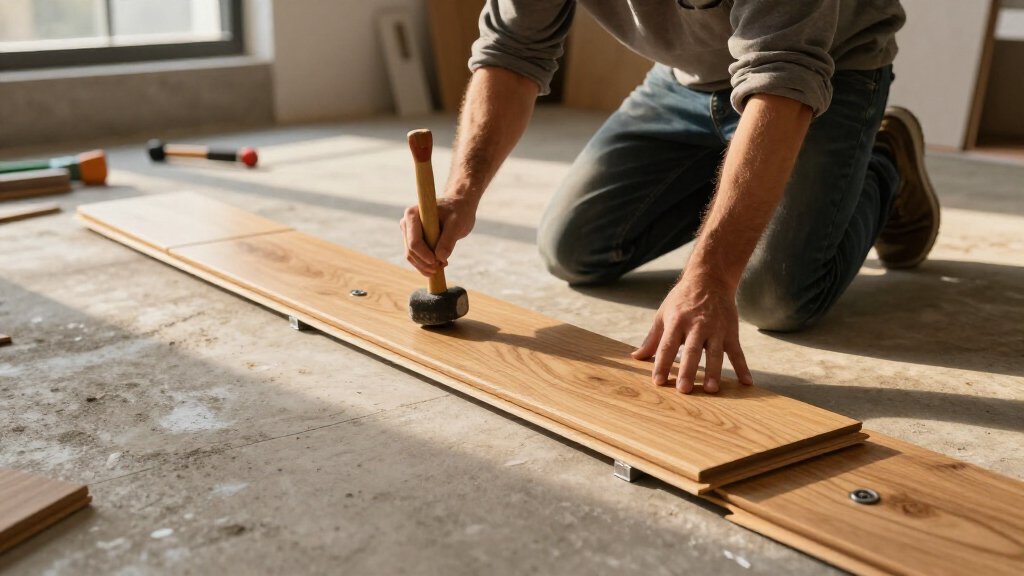
The Bruce option is the most straightforward on paper for a floating installation because it uses click-lock joints and is described as needing no glue or nails. That can avoid fastening directly into concrete, although the exact underlayment and expansion requirements still need confirmation. The other three products list tongue-and-groove construction. That describes how plank edges join; it does not, by itself, tell you whether the finished floor should float, be glued down, or use another approved system.
Before ordering, locate the current installation instructions and check the approved substrate, below-grade limitations, acclimation directions, expansion gaps, and transitions at doorways. If those details are not available, ask the seller or manufacturer rather than guessing. A poor fit between the slab and installation system can lead to movement or visible gaps, concerns specifically relevant to tongue-and-groove bamboo when the planks are not fitted carefully.
Separate engineered construction from grade approval
Engineered construction may be a useful category to investigate for concrete, but the label alone does not establish where a particular product can be installed. Bruce is explicitly described as suitable for below-grade use, while the multi-ply floor is specified for at- or above-ground installation. That difference makes Bruce the stronger candidate for a basement slab and the multi-ply product a better fit for an eligible slab on or above grade.
The multi-ply floor’s wider 6.5-inch boards may appeal to buyers seeking fewer seams and a broad-plank look. Its listing also mentions underfloor heating, but compatibility still depends on the system’s temperature and installation rules. Bruce’s 3-inch width creates a more traditional narrow-board appearance. I would choose between them based on grade, approved installation method, and room style—not on the general assumption that one engineered floor suits every slab.
Choose bamboo with realistic maintenance expectations
The two bamboo products serve different priorities. The warm-brown option emphasizes a waterproof finish, resistance to dents and scratches, and an embossed oak-like grain. The light-honey option highlights repeated sanding and refinishing, plus a brighter appearance. Neither product’s supplied description gives the concrete-specific detail available for Bruce, so both need careful verification before purchase.
Finish color affects how wear reads in daily use: the light-honey listing warns that scratches may be easier to see, while a darker, textured surface may be less visually revealing. Refinishing claims also deserve a check against the product’s construction and manufacturer instructions; ask what sanding limits and professional services apply. Do not treat bamboo’s durable or sustainable positioning as a substitute for slab moisture approval.
Calculate coverage and account for cuts
These packages cover close to 20 to 22 square feet: Bruce lists 22, the multi-ply floor 21.5, warm-brown bamboo 20, and light-honey bamboo 19.84. Measure the room’s usable floor area, then add a practical waste allowance for cuts, layout, and any planks set aside for future repairs. The right allowance depends on room shape and installation pattern, so a simple room-area division may understate what you need.
Confirm that the case coverage and plank dimensions match the current product listing before ordering. The multi-ply floor’s title and spec give slightly different thickness figures, a detail worth resolving with the seller. For future repairs, retain product and batch information and keep spare planks in suitable storage. Bamboo products may require careful size matching if replacement pieces are needed.
Check finish, room use, and underfloor heating
Decide how much appearance variation and maintenance you are comfortable with. Bruce provides limited color and finish detail in the supplied information, so request a sample or finish documentation if visual matching is a priority. The multi-ply product is brown and smooth, while the bamboo options offer contrasting warm-brown and light-honey tones. A sample can help reveal how the finish reads beside cabinetry and natural light.
For rooms with radiant heat, rely on explicit manufacturer limits rather than a general compatibility statement. The multi-ply product is described as suitable for underfloor heating, but the system still needs to match its instructions. In areas where moisture is likely, distinguish routine spill resistance from protection against persistent dampness or flooding. None of these products should be used outdoors based on the supplied details, and the light-honey bamboo is specifically described for residential interior rooms.
Frequently Asked Questions
Can I install any of these floors directly over a concrete slab?
Not on the information supplied alone. Bruce has the clearest stated route, with click-lock installation and a listing that names below-grade suitability, but you still need to follow its substrate, moisture, and underlayment instructions. The two bamboo products and the multi-ply engineered floor use tongue-and-groove joints, which do not by themselves specify how the floor attaches or floats over concrete. Check current installation documents and confirm slab moisture conditions before purchasing.
Does a waterproof finish mean the flooring is safe for a damp basement?
No. A waterproof or water-resistant surface claim does not prove that the complete floor assembly, seams, edges, and underside can tolerate a damp slab. Moisture may affect materials below or around the planks even if the exposed face resists spills. Test the slab as directed by the flooring maker and confirm its moisture limits and any vapor-control requirements. If moisture is persistent or unexplained, resolve the source before installing wood flooring.
Which option is the best fit for a below-grade concrete floor?
Bruce Natural Statement is the clearest candidate here because its listing specifically says it is suitable for below-grade installation and gives a click-lock method. That does not make it automatically approved for every basement or slab condition. Confirm the current product instructions, moisture limits, and required underlayment before proceeding. The multi-ply floor is described for at- or above-ground use, so I would not choose it for a below-grade room based on the available details.
How do the bamboo options differ for long-term care?
The warm-brown bamboo emphasizes a waterproof finish and wear resistance, but its description says professional refinishing may be needed after multiple years. The light-honey bamboo is the one described as suitable for sanding and repeated refinishing, though its lighter surface may show scratches more readily. Their plank sizes and colors differ as well. I would compare the care instructions and verify the slab installation method before deciding that refinishing potential or surface protection is the priority.
How much extra flooring should I buy for a concrete-slab project?
Start with the room’s measured floor area and compare it with the package coverage: these products list roughly 19.84 to 22 square feet per package. Then add an allowance for cuts, the room’s shape, and the layout pattern. A simple rectangular room may need less extra material than one with alcoves or multiple doorways. Follow the flooring maker’s recommendation, and consider keeping spare planks for later repairs, especially when matching a specific finish or plank size could be difficult.
Conclusion
For the broadest range of concrete-slab projects, I would start with Bruce Natural Statement because its click-lock design and stated below-grade use provide the clearest slab-related guidance in this lineup. Buyers with an at- or above-grade slab who want wider boards should compare it with the multi-ply engineered hardwood, while confirming the tongue-and-groove installation method and resolving its listed thickness difference. For a bamboo surface and warm oak-like look, the warm-brown option is the better fit if its slab approval checks out; choose the light-honey bamboo instead when refinishing potential and a brighter color matter more. Whichever product you favor, I would make the final choice only after checking slab moisture, grade restrictions, and written installation requirements.