

This checklist is for DIY woodworkers building a useful tool setup for accurate cuts, secure joinery, and smoother finishing. It covers six roles, from drilling and breaking down sheet goods to shaping edges and checking angles, so you can match each pick to the work you actually plan to do. Start with your projects and the tools you already own.

Get business pricing on tools and workshop supplies
- Business-only prices and quantity discounts
- Tax-exempt purchasing
- Multiple users, one account, clear invoices
The sections follow distinct jobs in a woodworking workflow: fastening, cutting, sanding, routing, clamping, and measuring. Each one explains why the tool matters, what to check before choosing it, and where the named pick may fit. Compatibility and fit deserve attention, especially for cordless tools, blades, router setups, and clamps.
Use the checklist to compare the pick with your workspace, materials, and preferred way of working. Read the buying notes before committing, then prioritize the gaps that most often slow down your projects. Buy for your next real task, and add specialized tools as your work calls for them.
Cordless drill driver
A cordless drill driver is a frequent-use tool for drilling pilot holes and driving screws during assembly. A combo can cover both drilling and fastening jobs, but check what the kit actually includes and whether its batteries and charger fit your existing setup. The Milwaukee M18 FUEL 18V Brushless Hammer Drill and Impact Driver Combo is the named pick here; confirm the package configuration before purchase. Battery compatibility can matter as much as the tool itself if you already use a cordless platform.
A common buying mistake is choosing a kit without considering the fasteners, bits, and workpieces you use most. Check that the included or separately available accessories suit your projects, and consider whether the drill’s size and weight feel manageable for overhead or close-in work. The hammer function is a capability to assess against your needs; for typical wood drilling and screwdriving, make sure the modes and controls are clear and comfortable to operate. Try the grip and controls if you can, and verify that the kit’s contents match the listing before checking out.
What to look for:
- Confirm batteries and charger are included in the package.
- Check compatibility with batteries from tools you already own.
- Make sure the chuck accepts the bit sizes you use.
- Assess the grip, balance, and control placement for your work.
- Verify which accessories and operating modes come with the kit.
Milwaukee M18 FUEL 18V Brushless Hammer Drill and Impact Driver Combo Kit

This two-tool cordless kit includes a brushless hammer drill and impact driver designed for a wide range of drilling and fastening applications. It comes with two 5.0Ah lithium-ion batteries, a charger, and a tool case.
Pros:
- Brushless motors provide power for a wide range of applications
- Includes two 5.0Ah batteries
- Impact driver is described as delivering fast driving speed without sacrificing power or control
- Mechanical clutch supports consistent fastening
Cons:
- Availability can vary
Best for: DIYers who want one cordless combo for drilling and fastening tasks
Not ideal for: Shoppers who need only one tool or already have a compatible setup
Bottom line: Choose this combo if its included components and battery platform match your projects.
Track saw
A track saw is useful when you want guided, straight cuts in sheet goods or large panels. The track helps define the cut path, but the saw and track must work together as a system, so confirm which track is included or sold separately. The named pick is the Festool TSC 55 KEB-Basic Cordless Plunge-Cut Circular Saw, 18/36 V, 5. Check the full listing for the blade and package details, since the title alone may not describe everything in the box. Track and accessory fit are central to getting the setup you expect.
Buyers can overlook the space needed to support a full panel, or assume a cordless saw includes batteries and a track. Plan where the material will rest, how you will secure the guide, and whether the saw’s cutting depth suits the thicknesses you work with. Verify the blade specification and whether it is appropriate for your materials and desired cut. If you already own compatible batteries or guide rails, confirm the exact system compatibility rather than relying on brand name alone. Plan the complete cutting setup—saw, track, blade, power, and work support—before choosing this pick.
What to look for:
- Confirm whether a guide track is included or sold separately.
- Check the blade type and included blade details.
- Match the cutting depth to the material thickness you use.
- Verify battery and charger inclusion and compatibility.
- Plan stable support for the panels you intend to cut.
Festool TSC 55 KEB-Basic Cordless Plunge-Cut Circular Saw, 18/36 V, 5.2 Ah

This battery-powered plunge-cut circular saw is designed for precise cuts up to 55 mm deep in wood and metal, including door trimming, panel cutting, and joint work. It has a brushless motor, adjustable speed, and comes with a blade, dust bag, hex key, and Systainer case.
Pros:
- Cuts up to 55 mm deep
- Brushless, battery-powered design
- Suitable for wood and metal
- Includes a carrying case and useful accessories
Cons:
- Listed weight reaches 5.3 kg with two 18 V batteries
- Requires batteries for operation
Best for: Woodworkers who regularly make straight cuts in sheet goods
Not ideal for: Shoppers without room to support larger panels or a compatible track setup
Bottom line: Confirm the track, blade, and power details so the saw fits your cutting workflow.
Random orbital sander
A random orbital sander helps prepare surfaces for finishing and smooth transitions between woodworking steps. The Bosch GET75-6N 6-Inch Dual-Mode Random Orbit Sander is the pick in this slot, with a six-inch sanding disc size stated in its name. Before buying, check which sanding modes it offers in practice, what accessories are included, and whether the disc attachment suits the abrasive sheets you can readily use. Disc compatibility affects how easily you can keep the tool supplied for your projects.
A frequent mistake is focusing on the sander alone while overlooking dust collection and the abrasives required for the job. Check the dust-port connection and whether your extractor or shop vacuum can connect; verify any adapter needs. Consider the size of the surfaces you sand and whether a six-inch pad is convenient for them. Look at the handle and controls, since a comfortable hold can help when sanding for extended periods. Also confirm what “dual-mode” means for the specific listing, rather than assuming the included functions or settings. Match the sander to your surfaces, abrasive supply, and dust-management setup before purchasing.
What to look for:
- Confirm the included pad and sanding accessories.
- Check abrasive disc attachment and availability in the size required.
- Verify dust-port fit with your vacuum or extractor.
- Assess whether a six-inch pad suits your workpieces.
- Confirm the modes and controls described in the listing.
Bosch GET75-6N 6-Inch Dual-Mode Random Orbit Sander

This corded 6-inch sander offers standard random-orbit and turbo modes for smooth finishing or faster material removal. Its variable-speed motor, multi-hole pad system, auxiliary handle, and vacuum-compatible dust collection support a range of sanding and polishing tasks.
Pros:
- Two sanding modes for finishing and aggressive material removal
- Variable-speed motor
- Compatible with a wide variety of 6-inch abrasive discs
- Vacuum-compatible dust collection system
Cons:
- Vacuum cleaner and hoses are required for dust collection and may be sold separately
Best for: DIY woodworkers preparing broad surfaces for finishing
Not ideal for: Shoppers whose projects mostly involve tight corners or very small parts
Bottom line: Choose it when the pad size, abrasives, and dust connection suit your sanding work.
Router table
A router table holds a router beneath a work surface so you can guide stock past the bit for edge profiles and other repeatable operations. The Kreg Precision Router Table System, Woodworking Router Table, PRS1045, is the named pick. Before choosing it, check exactly what the system includes: table, fence, insert plate, stand, and any router or accessories may be listed separately. Included components determine how much of a working setup you are actually getting.
Compatibility is a common stumbling block. Confirm that your router can mount to the plate, that the opening accommodates the bits you plan to use, and that the fence and adjustment features suit your work. Check the table’s footprint and height against your available space and preferred working position. If you expect to move or store the system, account for how it will fit in your shop. Buyers can also assume a table is ready to use without checking whether a router, insert rings, or other pieces are required. Match the table to your router and workspace, then verify the complete package contents before ordering.
What to look for:
- Check whether the stand, fence, plate, and router are included.
- Verify mounting compatibility with your router model.
- Confirm the opening and inserts suit the bits you plan to use.
- Measure available shop space and working height.
- Review what setup accessories are needed for your intended operations.
Kreg Precision Router Table System, Woodworking Router Table, PRS1045

The Kreg PRS1045 is a precision woodworking router table designed for accurate and repeatable routing setups. It features a 24" x 32" top with a router insert plate, a micro-adjust fence, and an adjustable steel stand for versatile workshop use.
Pros:
- Precise micro-adjust fence for accurate setups
- Adjustable height stand for ergonomic use
- Large 24" x 32" work surface
Cons:
- Casters set not included
- Assembly may require some effort
- Limited to indoor workshop use
Best for: Woodworkers who want repeatable routing with stock guided across a table
Not ideal for: Shoppers with limited space or no compatible router
Bottom line: Verify router fit and included components to know whether this system suits your shop.
Parallel clamps
Parallel clamps help hold assemblies together while glue sets and can keep pressure distributed along a joint. The POWERTEC 71602-P4 8-Pack 48-Inch Woodworking Parallel Clamps names an eight-pack with 48-inch clamps, making capacity and storage key considerations. Check the maximum opening and throat depth in the listing, since the stated length alone does not tell you whether a clamp will reach around your workpiece. Opening capacity should match the largest assemblies you expect to glue.
A common mistake is buying clamps by quantity without considering the size and shape of the projects they need to secure. Measure typical panel widths and glue-ups, and consider whether shorter clamps would be more useful for smaller parts. Confirm how the clamps are adjusted and locked, and check their weight and storage needs if you will handle them frequently. Also plan how you will keep clamp bars from marking or bowing your work; cauls or protective pads may be useful depending on the assembly. Check capacity and handling against your bench space and project scale before choosing this pack.
What to look for:
- Confirm the maximum opening and throat depth.
- Match the 48-inch length to your largest typical glue-ups.
- Check adjustment and locking operation.
- Consider clamp weight and storage space.
- Plan pads or cauls to protect and align assemblies.
POWERTEC 71602-P4 8-Pack 48-Inch Woodworking Parallel Clamps

This set includes eight 48-inch parallel jaw clamps designed for woodworking, furniture, and tabletop glue-ups. They feature ergonomic handles, non-marring jaw pads, and a quick-action spreader for precise, high-pressure clamping at 90 degrees.
Pros:
- High clamping force for secure hold
- Non-marring jaw pads protect workpieces
- Versatile with quick spreader tool and ergonomic handles
Cons:
- Heavy and potentially cumbersome for extended use
- Limited to 48-inch size, not suitable for larger projects
Best for: Woodworkers assembling wider panels and larger projects
Not ideal for: Shoppers whose work is mostly small parts or who lack storage space
Bottom line: Select this pack if its reach, quantity, and storage needs match your glue-ups.
Digital angle finder
A digital angle finder can help check or transfer angles during layout, setup, and fitting work. The Klein Tools 935DAGL Digital Level Angle Finder with Programmable Angle is the pick for this measuring role. Read the product details to confirm its measuring range, display behavior, resolution, and how the programmable angle feature is used. Readable measurements and a useful range matter more than features you will not use.
One buying mistake is assuming every angle finder will fit the surfaces or tools you need to measure. Check its dimensions and how it attaches or rests against a blade, fence, or workpiece, and verify whether it can be zeroed in the way your tasks require. Consider whether its display is easy to read in your usual workspace and whether the controls are straightforward. If you intend to use it for machine setup, confirm it suits that tool and the relevant measuring surface; do not infer compatibility from the product name alone. Test the intended measuring routine against the device’s stated functions before relying on it for layout or setup.
What to look for:
- Confirm the measuring range and stated resolution.
- Check how the device is positioned or attached during measurement.
- Verify zeroing and programmable angle functions.
- Assess display readability in your workspace.
- Confirm suitability for the tools or surfaces you plan to measure.
Klein Tools 935DAGL Digital Level Angle Finder with Programmable Angles
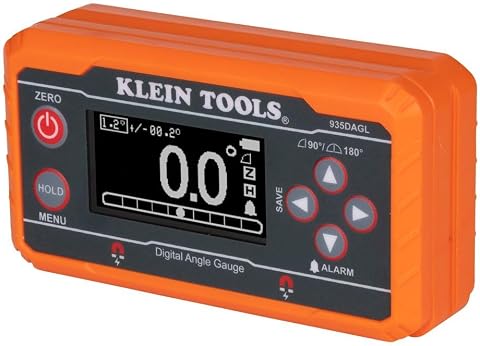
The Klein Tools 935DAGL is a digital level that accurately measures angles from 0 to 90 or 180 degrees, with a rotating display for horizontal or vertical use. It features an audible alarm for target angles, a magnetic base for attachment to ferromagnetic surfaces, and a versatile display for precise alignment in various applications.
Pros:
- Accurate angle measurement with programmable target angles
- Rotating display enhances usability in different orientations
- Magnetic V-groove base allows secure attachment to ferromagnetic surfaces
- Audible alarm ensures precise target angle detection
Cons:
- Limited to measuring angles up to 180 degrees
- Requires batteries for operation
- Designed primarily for professional use, may be complex for casual users
Best for: DIYers who frequently measure or transfer angles during setup
Not ideal for: Shoppers who rarely work with angled cuts or adjustments
Bottom line: Check its range, display, and measuring method against the angles you need to set.
Build your setup in the order your projects demand: start with the tool that removes a recurring bottleneck, then add the next most useful capability. For many DIY workflows, drilling and cutting support frequent construction steps, while clamps, sanding, routing, and angle measurement become priorities as project types call for them. Let your current work set the order, and account for the batteries, tracks, accessories, abrasives, and workspace each tool needs.
You do not need every item at once to make progress. Choose one clear next step, check fit and package contents carefully, and keep a list of the tasks you want to handle more confidently. A well-matched tool earns its place by helping you do the work you actually take on.