
For most buyers searching for the best cordless rotary hammer drill, the DEWALT 20V MAX Brushless DCH273B is the strongest all-around choice thanks to its 2.1J impact energy, brushless motor, and proven durability on job sites. If you want to spend less without sacrificing much performance, the Seesii 2.8J 4-Mode model delivers more impact energy than anything else here at a lower price, while the DCH172B is the lightest, most compact option for occasional anchor work. The main tradeoff in this category is power versus weight versus battery ecosystem: high-joule budget brands like Seesii and Deshuo hit hard but use proprietary batteries, while DeWalt models cost more but ride on a battery platform professionals already own. Read on for the full breakdown of all ten drills and who each one suits best.

Get business pricing on tools and workshop supplies
- Business-only prices and quantity discounts
- Tax-exempt purchasing
- Multiple users, one account, clear invoices
Complete the kit

Key Takeaways
- Impact energy is the single biggest differentiator: the Seesii 2.8J model hits nearly 40% harder than the DeWalt DCH172B, which changes what size holes each drill can realistically handle in a day.
- Battery ecosystem emerged as the hidden cost in this roundup — the DeWalt models cost more upfront but share batteries with existing 20V MAX tools, while the Greenworks and NANWEI include batteries that work with nothing else.
- Only four of the ten models offer a true 4-mode selector (hammer drilling, drilling only, chipping, and chiseling position adjustment), which matters a lot for light demolition work.
- The budget 1-inch SDS-Plus drills (Deshuo, NANWEI, the unbranded 2.6J) cluster closely in performance; their real differences show up in chuck smoothness, vibration damping, and included accessories.
- Bare-tool versus kit pricing splits this list in half: casual users get better value from the Greenworks and NANWEI kits, while anyone already on the DeWalt platform saves more buying bare tools.


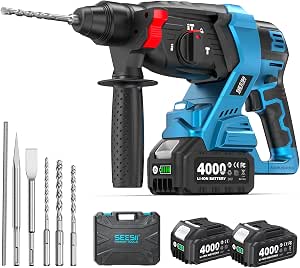


| cordless rotary hammer drill | Impact energy | Motor | Modes | Chuck type |
|---|---|---|---|---|
| 20V Brushless SDS-Plus Cordles | 2.5 joules | Brushless | — | — |
| DEWALT 20V MAX Cordless SDS Pl | — | — | — | — |
| Seesii 1-Inch Cordless SDS-Plu | 2.5J | Brushless, 900W | 4 | — |
| Seesii 1-Inch Cordless SDS-Plu | 2.8 J | Brushless | 4 (drill, hammer drill, chisel, chisel positioning) | — |
| DEWALT 20V MAX Brushless SDS R | 2.1 joules | Brushless | Drill, hammer drill, chip | — |
| Deshuo 1-Inch SDS-Plus Rotary | 2.21 ft-lbs (3 J) | — | Rotary hammer, rotary only, hammer only, chisel position adjustment | SDS-Plus |
| NANWEI Cordless SDS-Plus Rotar | 2.0 J | Brushless | Hammer only, hammer drill, rotary drill | SDS-Plus |
| DEWALT 20V MAX SDS Plus 1-Inch | 2.6 joules | Brushless | Drill, Hammer Drill, Chip | SDS Plus |
| SDS-Plus Cordless Rotary Hamme | 2.6 J | Brushless | Drill, hammer drill, chisel, chisel angle adjustment | SDS-Plus |
| Greenworks 24V Cordless Rotary | 2.1 Joules | Brushless | 4: Drilling, Hammer Drilling, Chisel, Chisel Rotation Lock | 1" SDS Plus |
More Details on Our Top Picks
20V Brushless SDS-Plus Cordless Rotary Hammer Drill, Compatible with DeWalt Batteries
This model makes the most sense for anyone already sitting on a pile of DeWalt 20V batteries, because it runs on the same packs — DCB200 through DCB206 — that power the rest of a DeWalt jobsite kit. That is a genuine money-saver compared with the Seesii 2.5J kit, which forces you into its own battery platform. With 2.5 joules of impact energy and four modes including chisel positioning, it has roughly 78% more hitting power than the DeWALT DCH172B, so it handles bigger anchors and light demolition where that lighter tool would stall. The tradeoff is straightforward: no battery, no charger, and no published weight, so buyers starting from scratch should probably look at a complete kit instead.
Pros:- Runs on standard DeWalt 20V batteries many tradespeople already own
- 2.5J impact energy handles larger concrete anchors and light chiseling
- Four modes including chisel angle adjustment
- Safety clutch, shock absorption, and 360° auxiliary handle improve control
Cons:- Battery and charger not included
- No published weight or dimensions make it hard to judge handling before buying
Best for: DeWalt 20V battery owners who want 2.5J hammer power and chiseling without buying a new battery platform
Not ideal for: Buyers with no existing DeWalt batteries — the tool-only format plus separate charger purchase erases the value advantage
- Battery compatibility:DeWalt 20V (DCB200–DCB206)
- Battery included:No
- Motor:Brushless
- Impact energy:2.5 joules
- Chuck:SDS-Plus
- Operating modes:4 (drill, hammer drill, chisel, chisel positioning)
- Included accessories:5 drill bits and gloves
Our verdict“If your shelf already holds DeWalt 20V packs, this is the cheapest route to serious 2.5J hammer performance — everyone else should buy a full kit.”
DEWALT 20V MAX Cordless SDS Plus Rotary Hammer Drill, 5/8 in. (DCH172B), Tool Only
The DCH172B is built around one idea: lightweight precision for repetitive mounting work. Its 1.4-joule output is less than half the hitting power of the Seesii 2.8J model, but that is the point — it trades brute force for a lighter, more controllable package suited to running rows of anchors for strut, hangers, and electrical boxes, especially overhead where arm fatigue is the real limit. SHOCKS active vibration control goes further than the passive shock absorption on the generic 20V brushless model, which matters over a full day of drilling. Note that OSHA Table 1 compliance depends on pairing it with the DWH200D shroud and DWH161D1 dust extractor — sillica rules add real cost if you drill indoors professionally. And like the DCH273B below, it arrives as a bare tool.
Pros:- Very lightweight for all-day overhead work
- SHOCKS active vibration control reduces hand fatigue
- Brushless motor delivers efficient runtime on 20V MAX batteries
- OSHA Table 1 compliant path with matching shroud and extractor
Cons:- 1.4J impact energy limits hole size and drilling speed in hard concrete
- Tool only, plus additional dust-extraction equipment needed for compliance
Best for: Electricians and installers doing repetitive overhead anchoring who need a light tool with strong vibration control
Not ideal for: Anyone drilling large-diameter holes or doing chiseling — 1.4J and drill/hammer-drill-only modes rule out demolition work
Our verdict“This is a specialist — the right pick for installers who drill many small holes, and the wrong pick for anyone who needs chiseling or big anchors.”
Seesii 1-Inch Cordless SDS-Plus Rotary Hammer Drill, 2.5J Brushless, 4-Mode
Unlike the bare-tool DeWalt options, this Seesii arrives ready to work out of the case: two 4.0Ah batteries, a charger, drill bits, chisels, a depth gauge, and a carry bag. That completeness is what earns it a slot, because a first-time buyer comparing it against the DCH273B avoids roughly the cost of a battery and charger on top of the tool price. The 2.5J output matches the generic 20V brushless model’s power while adding the accessories, and the LED work light and tool-free chuck are thoughtful touches for occasional users working in closets and basements. The catch is runtime — heavy continuous hammer drilling on 4.0Ah packs will drain them quickly, and the Makita-style battery interface is worth verifying before you assume it fits other tools.
Pros:- Complete kit with two batteries, charger, bits, chisels, and case
- 2.5J impact energy handles 1-inch concrete holes
- Four modes including chisel positioning
- Safety clutch and LED work light add control and visibility
Cons:- Runtime under sustained heavy drilling is not specified
- Battery platform compatibility needs checking before mixing with existing tools
Best for: DIYers and first-time rotary hammer buyers who want everything included in one purchase
Not ideal for: Contractors running the tool continuously all day — the 4.0Ah batteries and unspecified heavy-load runtime won’t keep pace with pro demands
- Impact energy:2.5J
- Motor:Brushless, 900W
- Impact rate:4800 BPM
- Modes:4
- Max capacities:1 in concrete / 1-3/16 in wood / 1/2 in metal
- Batteries:2 × 4.0Ah included
- Chuck:SDS-Plus, tool-free
Our verdict“The easiest one-click entry into rotary hammer ownership — power and accessories included, as long as your workload stays in DIY-to-light-contractor territory.”
Seesii 1-Inch Cordless SDS-Plus Rotary Hammer Drill, 2.8 J, Brushless Motor
This is the hardest-hitting tool in this batch at 2.8 joules and up to 5,000 BPM, yet it still ships as a full kit with two 4.0Ah batteries, charger, bits, and chisels — the same completeness as its 2.5J Seesii sibling but with more punch for dense concrete. Against the DCH273B’s 2.1J, it offers roughly a third more impact energy and a chisel-positioning mode that the DeWalt lacks, which matters when you need to set a chisel at a specific angle for tile or mortar removal. The honest limitation: Seesii positions it for homeowners, DIYers, and light contractors, so daily commercial demolition work is beyond its design intent, and the Makita-referenced battery interface is another compatibility point to confirm before buying.
Pros:- Highest impact energy in this group at 2.8J with 5,000 BPM
- Full kit: two 4.0Ah batteries, charger, bits, chisels, and case
- Four modes with chisel angle positioning
- 24 months of technical support included
Cons:- Positioned for light-duty use, not continuous professional demolition
- Battery interface compatibility with existing Makita packs needs verification
Best for: Budget-minded buyers who want maximum impact energy and a full accessory kit for occasional serious concrete and chiseling work
Not ideal for: Full-time masonry or demolition professionals who need a duty-rated tool for daily abuse
- Impact energy:2.8 J
- Impact rate:Up to 5,000 BPM
- Motor:Brushless
- Modes:4 (drill, hammer drill, chisel, chisel positioning)
- Max capacities:1 in concrete / 1-3/16 in wood / 1/2 in metal
- Batteries:2 × 4.0 Ah included
- Warranty support:24 months
Our verdict“The strongest hitter here with everything in the box — ideal for the serious DIYer who occasionally punches big holes or chips mortar, not for daily site demolition.”
DEWALT 20V MAX Brushless SDS Rotary Hammer Drill, 3 Modes, Bare Tool (DCH273B)
The DCH273B sits in the sweet spot between the light-duty DCH172B and the heavier-hitting Seesii kits. Its 2.1J German-engineered mechanism hits hard enough for everyday concrete anchoring and through-hole work, while the 6.4-pound weight and vibration control keep it manageable all day — the balance the 1.4J DCH172B sacrifices power for and the Seesii 2.8J trades away in durability confidence. Three modes (drill, hammer drill, chip) cover the mix of tasks pros actually encounter, and the DWH303DH onboard dust extractor provides an OSHA Table 1 compliance path that no Seesii option offers. It is a bare tool, though, so the total cost climbs once you add a battery — the classic DeWalt ecosystem play.
Pros:- German-engineered mechanism built for professional durability
- Balanced 2.1J power at only 6.4 pounds
- Three modes cover drilling, hammer drilling, and chipping
- Onboard extractor option provides an OSHA Table 1 compliance path
Cons:- Bare tool — battery and charger sold separately
- OSHA compliance requires the additional DWH303DH extractor purchase
Best for: Tradespeople already on the DeWalt 20V platform who need one balanced rotary hammer for daily fastening, drilling, and light chipping
Not ideal for: Budget buyers or anyone without DeWalt batteries — the bare-tool format plus battery cost makes it the most expensive route into this category
- Voltage:20V MAX
- Motor:Brushless
- Impact energy:2.1 joules
- Max rotational speed:1,100 rpm
- Modes:Drill, hammer drill, chip
- Weight:6.4 pounds
- Included:Bare tool only
Our verdict“If you earn a living with a rotary hammer and already own DeWalt batteries, this is the balanced, durable pick that outlasts the budget kits.”
Deshuo 1-Inch SDS-Plus Rotary Hammer Drill
First, a caveat: this Deshuo is corded, not cordless, so it belongs on this list only if you value raw bang-for-buck over portability. For a DIYer working near an outlet, that tradeoff pays off — it delivers 2.21 ft-lbs (3 J) of impact energy, which actually beats the 2.0 J NANWEI cordless and the 2.1 J Greenworks, at a lower price point. The four modes, including chisel-angle adjustment, cover light tile removal and patch chiseling that a basic hammer drill can’t touch. Compared with the DEWALT DCH133B, you give up brushless efficiency and untethered freedom, but you never wait on a battery. The safety clutch and vibration control are welcome at this price, though the SDS-Plus-only chuck and 7.19 lb body limit its ceiling for serious demolition work.
Pros:- 3 J of impact energy outperforms pricier cordless rivals in this lineup
- Four modes including chisel-position adjustment for light tile and mortar work
- Safety clutch and vibration control are unusual at this price
- Tool-less SDS-Plus bit changes speed up task switching
Cons:- Corded design conflicts with the cordless premise of this roundup
- Not built for sustained heavy demolition despite its power rating
Best for: Budget-minded DIYers anchoring shelves, mounting TVs, or doing light masonry work within reach of an outlet
Not ideal for: Anyone working on ladders, rooftops, or job sites without reliable power — the cord defeats the purpose
- Power source:Corded electric (120V, 9A)
- Chuck type:SDS-Plus
- Impact energy:2.21 ft-lbs (3 J)
- Max speed:1,100 RPM
- Impact rate:Up to 5,300 BPM
- Modes:Rotary hammer, rotary only, hammer only, chisel position adjustment
- Weight:7.19 lbs
- Warranty:24 months
Our verdict“Buy it only if an outlet is always within reach and you want maximum concrete-drilling power per dollar.”
NANWEI Cordless SDS-Plus Rotary Hammer Drill, 3-Mode, 2.0 J, with Two 6.0 Ah Batteries
This is the only cordless option in this batch that arrives truly ready to work: two 6.0 Ah batteries, a fast charger, auxiliary handle, and work light are all in the box. Compare that with the DEWALT DCH133B and the Milwaukee-compatible bare tool, which require you to supply (or buy) batteries separately — a hidden cost that can change the math entirely for first-time buyers. The tradeoff is power: at 2.0 J of impact energy, it sits at the bottom of this group alongside the Greenworks’ 2.1 J, so expect slower going in dense concrete. The brushless motor and electric brake are genuine strengths for the money, but the published wood-drilling capacity is inconsistent (30 mm versus 38 mm depending on where you look), which hints at loose quality control.
Pros:- Two 6.0 Ah batteries and fast charger included — a genuine complete kit
- Brushless motor with electric brake for control and longevity
- Safety clutch, auxiliary handle, and work light add real usability
- Three modes cover drilling in wood, metal, and masonry plus chiseling
Cons:- 2.0 J impact energy is the lowest in this batch, slowing concrete work
- Conflicting published specs (30 mm vs 38 mm wood capacity) suggest inconsistent documentation
Best for: First-time rotary hammer buyers who want everything included in one purchase without hidden battery costs
Not ideal for: Pros or frequent users — the 2.0 J output and unproven brand track record won’t keep pace with the DEWALT picks
- Power source:20V lithium-ion battery
- Motor:Brushless
- Impact energy:2.0 J
- Max speed / impact rate:1,050 rpm / 6,200 ipm
- Batteries included:2 × 6.0 Ah lithium-ion
- Chuck type:SDS-Plus
- Modes:Hammer only, hammer drill, rotary drill
- Max concrete capacity:26 mm rotary / 20 mm hammer drill
Our verdict“The most hassle-free entry point here — just accept modest power and an untested brand.”
DEWALT 20V MAX SDS Plus 1-Inch Cordless Rotary Hammer with D-Handle (DCH133B)
The DCH133B earns the top spot by pairing DEWALT’s proven 20V MAX platform with a brushless motor and 2.6 J of impact energy — a full 30% more punch than the NANWEI and enough to drill 1-inch holes in concrete all day. Its D-handle layout and light weight make overhead anchoring far less fatiguing than wrestling the corded Deshuo, and the three-mode setup (drill, hammer drill, chip) covers the tasks most buyers actually perform. Unlike the Milwaukee-compatible bare tool, which matches its 2.6 J output, this model is backed by DEWALT’s service network and fits one of the largest battery ecosystems in the industry. The catch is straightforward: it’s a bare tool, so if you don’t already own 20V MAX batteries and a charger, the real cost climbs considerably. Chisel-angle adjustment, found on the Greenworks and Deshuo, is also absent.
Pros:- 2.6 J brushless performance leads this batch for real-world concrete speed
- D-handle and lightweight body excel at overhead and repetitive anchoring
- Fits the massive DEWALT 20V MAX battery ecosystem
- Trusted brand support and parts availability
Cons:- Bare tool — battery and charger sold separately
- No chisel-angle adjustment mode unlike several cheaper rivals here
Best for: Tradespeople and serious DIYers already invested in DEWALT 20V MAX batteries who want dependable concrete-drilling power
Not ideal for: Buyers starting from zero tools — the battery-and-charger add-ons can push the total well past a complete kit like the NANWEI
- Voltage:20V MAX
- Motor:Brushless
- Chuck type:SDS Plus
- Impact energy:2.6 joules
- Max drilling diameter:1 inch
- Modes:Drill, Hammer Drill, Chip
- Included accessories:360° side handle, depth rod
Our verdict“If you own DEWALT batteries already, this is the strongest all-around cordless choice in the lineup.”
SDS-Plus Cordless Rotary Hammer Drill, Brushless, 2.6 J, 4 Functions (Tool Only)
This model makes the list for one decisive reason: it runs on Milwaukee 18V batteries, letting M18 owners add a capable rotary hammer without buying into another platform. It matches the DEWALT DCH133B blow-for-blow on paper — same 2.6 J brushless output, 1,100 RPM — but pulls ahead on features with four modes including chisel-angle adjustment, plus thermal shutdown and shock absorption the DEWALT lacks. At just 3.7 lbs, it’s also the lightest tool in this batch, beating even the 5.44 lb Greenworks for ladder and overhead work. The compromises are real, though: it’s a tool-only purchase, it’s locked to Milwaukee batteries (unlike the DeWalt-compatible option elsewhere in this roundup), and an unbranded build with a plastic housing won’t inspire confidence the way a nameplate does when the going gets tough.
Pros:- Runs on existing Milwaukee M18 18V batteries
- Matches the DEWALT DCH133B at 2.6 J while adding a fourth chisel-angle mode
- Lightest tool in this batch at 3.7 lbs
- Overload clutch, thermal shutdown, and shock absorption protect both tool and user
Cons:- Tool only — battery and charger not included
- Locked to Milwaukee 18V batteries with no adapter flexibility
- Generic brand with plastic housing raises durability questions
Best for: Milwaukee M18 battery owners who want maximum features and minimum weight for anchoring and light chiseling
Not ideal for: Buyers with no Milwaukee batteries, or anyone who wants a recognized brand behind the warranty
- Power source:Milwaukee 18V lithium-ion (not included)
- Motor:Brushless
- Impact energy:2.6 J
- No-load speed / impact rate:1,100 RPM / 4,800 BPM
- Chuck type:SDS-Plus
- Modes:Drill, hammer drill, chisel, chisel angle adjustment
- Max capacities:1 in concrete / 1-3/16 in wood / 1/2 in metal
- Weight:3.7 lbs
Our verdict“A feature-dense, featherweight pick — but only if M18 batteries are already in your garage.”
Greenworks 24V Cordless Rotary Hammer Drill with Brushless Motor, 4Ah Battery & Charger
The Greenworks splits the difference between the NANWEI and the bare-tool premium options: unlike the DCH133B, it ships with a 4Ah battery and charger included, but unlike the NANWEI, it comes from an established brand with a 3-year tool and battery warranty. Its four modes — including chisel rotation lock, which the DEWALT lacks — and 5.44 lb compact body make it well suited to homeowner tasks like mounting brackets, running anchors in a basement, or occasional light chiseling. The honest limitation is power: at 2.1 J, it drills concrete adequately but falls clearly behind the 2.6 J DEWALT and Milwaukee-compatible models, and its largely plastic construction won’t shrug off job-site abuse. It’s also tethered to the Greenworks 24V ecosystem, which is thinner than DEWALT’s or Milwaukee’s if you plan to expand later.
Pros:- Battery and charger included, backed by a 3-year tool and battery warranty
- Four modes with chisel rotation lock offer more versatility than the DEWALT DCH133B
- Compact 5.44 lb brushless design suits tight spaces and overhead work
- Tool-free SDS Plus chuck enables one-handed bit changes
Cons:- 2.1 J impact energy trails the 2.6 J leaders in this roundup
- Plastic-heavy construction is less durable than metal-bodied rivals
- Locked into the smaller Greenworks 24V battery ecosystem
Best for: Homeowners who want a warrantied, ready-to-run cordless rotary hammer for occasional masonry and anchoring projects
Not ideal for: Contractors or heavy users — the 2.1 J output and plastic body are built for weekend duty, not daily site work
- Voltage:24V
- Motor:Brushless
- Impact energy:2.1 Joules
- Chuck type:1″ SDS Plus
- Modes:4: Drilling, Hammer Drilling, Chisel, Chisel Rotation Lock
- Battery:4Ah lithium-ion (included)
- Max rotational speed:1,000 rpm
- Weight:5.44 lbs
- Warranty:3-year tool and battery
Our verdict“A sensible, warranty-backed middle ground for weekend masonry work — just don’t expect pro-grade power.”

How We Picked
I evaluated each drill against the factors that actually decide whether a cordless rotary hammer is a good buy: impact energy in joules, motor type (brushed versus brushless), mode count and versatility, weight and handling, vibration control, and the practical reality of battery compatibility and cost of ownership. A drill that hits hard but lives on a proprietary battery ecosystem carries hidden long-term costs, so I weighed platform lock-in alongside raw performance figures. Chipping mode, variable speed control, and the quality of the SDS chuck mechanism separated models that look similar on paper.
The ranking logic follows use case rather than price alone. Proven durability and platform value pushed the DeWalt DCH273B to the top, while raw impact energy earned the Seesii 2.8J the runner-up slot. Lighter-duty models like the DCH172B and the Greenworks kit earned their places by serving occasional users and beginners better than a heavier, more expensive tool would. Budget models ranked lower not because they underperform on concrete — several punch above their weight — but because of shorter track records, weaker vibration damping, and less refined chucks.
| cordless rotary hammer drill | Motor |
|---|---|
| 20V Brushless SDS-Plus Cordles | Brushless |
| DEWALT 20V MAX Cordless SDS Pl | — |
| Seesii 1-Inch Cordless SDS-Plu | Brushless, 900W |
| Seesii 1-Inch Cordless SDS-Plu | Brushless |
| DEWALT 20V MAX Brushless SDS R | Brushless |
| Deshuo 1-Inch SDS-Plus Rotary | — |
| NANWEI Cordless SDS-Plus Rotar | Brushless |
| DEWALT 20V MAX SDS Plus 1-Inch | Brushless |
| SDS-Plus Cordless Rotary Hamme | Brushless |
| Greenworks 24V Cordless Rotary | Brushless |
Factors to Consider When Choosing Best Cordless Rotary Hammer Drill
Choosing a cordless rotary hammer drill comes down to matching the tool to the holes you actually drill. These are the factors that separate a satisfying purchase from a regrettable one.Impact Energy: Why Joules Matter More Than Watts
Impact energy, measured in joules, determines how fast a rotary hammer punches through concrete — not motor power. The gap between a 2.0J drill and a 2.8J drill sounds small, but over twenty anchor holes it means the difference between finishing in an hour and nursing a dead arm all afternoon. As a rough guide, 2.0J handles occasional 1/4-inch to 3/8-inch anchors, 2.5J to 2.8J covers regular 1/2-inch work, and anything heavier calls for an SDS-Max tool entirely. A common mistake is buying a hammer drill (a drill with a hammer function) instead of a rotary hammer — the mechanisms are completely different, and a hammer drill on concrete is slow punishment. If you drill into masonry more than a handful of times a year, stepping up a joule class pays for itself in time saved.
Battery Ecosystem: The Real Long-Term Cost
The cheapest drill in this category is rarely the cheapest to own. Tools sold as bare tools assume you already have batteries and a charger from the same platform; if you don’t, factor in $100 or more to get running. DeWalt’s 20V MAX ecosystem is enormous, meaning batteries are easy to source and shared across dozens of other tools — that’s why a bare DeWalt often beats a budget kit on total cost for anyone building a workshop. Conversely, brands like Seesii, Deshuo, and NANWEI use proprietary batteries that pair with nothing else, so a kit with two batteries included is genuinely good value only if this is your one and only cordless tool. Also check whether the included batteries are slim 2.0Ah packs or genuine 4.0Ah-plus units: slim batteries drain fast under hammering loads and shorten runtime dramatically.
Mode Count and Chipping Function
Every drill here does hammer-drilling, but only some offer drill-only, chipping-only, and chisel-position modes. Chipping mode turns the tool into a light demolition hammer for busting tile, removing mortar, or chiseling channels — a genuinely useful fourth function that extends the tool’s value well beyond drilling. Chisel position adjustment lets you rotate a chisel bit to the ideal angle and lock it there, which matters more than most buyers expect during extended chipping work. If you only ever drill anchor holes, three modes are plenty and paying for four is unnecessary. But anyone doing renovation work should treat 4-mode capability as a hard requirement, not a bonus.
Brushless Motors and Vibration Control
Brushless motors run cooler, last longer, and squeeze noticeably more runtime from each battery — under a hammering load, that efficiency gap is larger than in ordinary drills because the motor works continuously at high load. Nearly every model in this roundup is brushless now, which tells you how quickly brushed rotary hammers are disappearing. Vibration control deserves equal attention: rotary hammers transmit shock through the handle, and cheap models with no damping leave your hands tingling after twenty minutes. Look for mentions of anti-vibration handles or soft grips, and take unspecified vibration behavior on budget listings as a warning sign. For anyone using the tool professionally all day, vibration damping is arguably worth more than an extra fraction of a joule.
Weight, Handle Design, and Chuck Size
Rotary hammers in the SDS-Plus 1-inch class range from about 5 to 9 pounds with a battery attached, and that weight difference shapes how the tool gets used. Lighter models excel overhead and in tight spots; heavier D-handle designs give better two-handed control for downward drilling into slabs. D-handles (as on the DeWalt DCH133B) are the traditional choice for floor work, while inline barrel-style bodies balance better for vertical drilling. On chucks: everything here is SDS-Plus, which accepts bits up to 1-inch nominal but performs best at 1/2-inch and below — trying to run 3/4-inch or 1-inch bits regularly will strain a compact tool. Match the handle style to where your holes actually are, not to which photo looks more rugged.
Bare Tool Versus Kit: Avoiding the Starter Trap
The most common buying error in this category is ordering a bare tool assuming batteries are included. Listings clearly marked tool only or bare tool ship without battery, charger, or case, and first-time buyers get burned by this constantly. The math works out differently depending on your situation: existing platform owners should almost always buy bare, while first-time buyers get better value from kits like the Greenworks or NANWEI that bundle two batteries and a charger. Also verify what else is in the box — side handles, depth rods, and blow-molded cases vary widely between brands at the same price. A cheap drill plus a mandatory battery purchase can end up costing more than a better drill that came complete.
Frequently Asked Questions
Is a 2.8J Seesii really better than a 2.1J DeWalt for heavy concrete work?
On raw hole-drilling speed, yes — 2.8 joules punches through concrete noticeably faster than 2.1 joules, and that advantage compounds over a full day of anchor holes. But impact energy isn’t the whole story: the DeWalt DCH273B brings a refined brushless drivetrain, better vibration damping, and a chuck mechanism with a much longer service track record. The Seesii makes sense for users who drill hard and often but don’t rely on the tool for their livelihood. Professionals tend to accept lower joules in exchange for the durability and platform benefits the DeWalt provides. Choose based on whether you value raw output or long-term reliability more.
Should I buy a bare tool or a kit if I don’t own any batteries yet?
If you own no batteries at all, a bare tool forces you to buy a battery and charger separately, which usually erases any savings and often costs more than a complete kit. The Greenworks 24V and NANWEI listings in this roundup both ship with batteries and a charger, making them the true entry points for battery-system newcomers. The exception is if you plan to buy more cordless tools soon — then starting a DeWalt 20V MAX collection with one battery purchase makes long-term sense, because that battery will power future purchases too. Buying into a platform one tool at a time is cheaper than buying into two platforms separately. Do the math on a two-battery setup, since hammering drains packs fast and a spare keeps you working.
Do I actually need 4-mode capability, or is 3-mode enough?
If your work is strictly drilling anchor holes, 3 modes (hammer drill, drill only, hammer only) cover everything you’ll ever do. The fourth mode — chisel position adjustment — only earns its keep when you’re running chisels for tile removal, mortar chasing, or light demolition, because it lets you rotate the bit to the right working angle and lock it in place. Without it, the chisel rotates freely and constantly drifts out of position during chipping. The Seesii models and the unbranded 2.6J drill include this; the DeWalt DCH172B does not. Renovators should treat 4 modes as required; pure drillers can ignore it and save money.
Can these 1-inch SDS-Plus drills handle 3/4-inch or 1-inch bits?
Nominally yes, and occasionally, absolutely — a 1-inch class rotary hammer will punch a 3/4-inch hole in block or brick without complaint. The problem is sustained use: running large-diameter bits repeatedly pushes these compact tools near their thermal and mechanical limits, slowing you down and shortening motor and chuck life. If your regular work involves 3/4-inch-plus holes in solid concrete, the honest answer is that you’ve outgrown the SDS-Plus compact class entirely and should look at an SDS-Max rotary hammer. For the occasional large hole, any of the 2.5J-plus models in this roundup will get it done. Match the tool class to your hole size distribution, not to your biggest rare hole.
Are the budget brands like Deshuo and NANWEI reliable enough to trust?
For light and intermittent use, they generally deliver honest performance — the impact energy figures are real, and most users drilling the occasional anchor hole will be satisfied. The tradeoffs appear at the margins: chuck mechanisms can be grittier, vibration damping is minimal, replacement parts and service networks are thin, and long-term durability is unproven compared with DeWalt’s service infrastructure. NANWEI softens the risk by including two 6.0Ah batteries, which is generous at its price point. My guidance: if the tool failing would cost you a day’s work, buy the proven brand; if it would only cost you mild annoyance, the budget options are reasonable bets.
Conclusion
Matching the right cordless rotary hammer to your situation comes down to three questions: how often you drill, how big the holes are, and what batteries you already own. For best overall, the DeWalt DCH273B balances impact energy, brushless efficiency, and platform durability in a way no budget model matches. The Seesii 2.8J 4-mode drill takes best value with the hardest-hitting motor in the lineup at a budget price, while the NANWEI with two 6.0Ah batteries is the value runner-up for first-time buyers who need everything in one box. For a premium pick, the DeWalt DCH133B with its D-handle and 1-inch capacity suits pros doing slab work. Beginners get the gentlest entry through the Greenworks 24V kit, which includes battery, charger, and four functional modes at a beginner-friendly weight. And for specific needs: overhead and tight-space work favors the compact DCH172B, renovation and light demolition favors any 4-mode Seesii, and occasional light-duty drilling is covered by the Deshuo or the unbranded 2.6J model. Whatever you pick, buy the tool that matches your hole sizes and battery shelf — not the one with the biggest number on the box.
Halloween Picks

11.2-Foot Halloween Inflatable Pumpkin with LED Lights

Spirit Halloween Scary Sitting Scarecrow Animatronic, 4 ft 6 in

Thuodo 8 FT Tall Halloween Inflatable Three-Headed Dragon with LEDs
As an affiliate, we earn on qualifying purchases.