
TL;DR

Get business pricing on tools and workshop supplies
- Business-only prices and quantity discounts
- Tax-exempt purchasing
- Multiple users, one account, clear invoices
For roof access, use a correctly sized extension ladder rated for your body weight plus tools (Type IA, 300 lb, is a sensible floor for roofing work), set at a 4:1 angle, extending at least 3 feet above the roof edge, and secured top and bottom. Falls from ladders remain a leading cause of home-improvement injuries, and a ladder gets you onto the roof but never protects you from falling off it — for long or heavy work, rent a scaffold or lift instead.
The most dangerous tool on most job sites is also the cheapest one in the truck. Falls from ladders send more than half a million Americans to emergency rooms in a typical year, according to the American Ladder Institute, and a big share of those falls happen during exactly what you’re planning: getting onto a roof or working up high. Not framing. Not demolition. Climbing.
Here’s the part most people get wrong: selecting a ladder for roofing is not simply a matter of reaching the eaves. It’s a chain of decisions — ladder type, length, duty rating, material, angle, and anchoring — and any weak link in that chain puts you on the ground in a way you didn’t plan. I’ve spent two decades on renovation sites, and I’ve watched a grown carpenter fold like a lawn chair off a ladder set four degrees too shallow.
In this guide, you’ll learn how to match a ladder to the actual job, what the ratings on the label really mean, how to set an extension ladder so it won’t kick out or tip back, and — just as important — when a ladder is the wrong tool and you should rent a scaffold instead. Let’s get into it.
Match ladder type to the task: an extension ladder for getting onto the roof, a roof ladder hooked over the ridge for working on the slope — never one in place…
Size for reach, not advertised length: account for the 4:1 angle and require at least 3 feet of extension above the roof edge as a handhold.
The duty rating covers you plus everything you carry — Type IA (300 lb) is a sensible minimum for roofing work.
Set the ladder at 4:1, on firm level ground, tied off top and bottom — and never rest it against a gutter.
A ladder is access equipment, not fall protection; for long, heavy, high, or steep work, rent a scaffold or lift, or hire a professional.
Choosing the Right Ladder for Roofing and High Work
A ladder gets you onto the roof — it never protects you from falling off it. Selecting a ladder for roofing isn’t about reaching the eaves. It’s a chain of decisions: type, length, duty rating, material, angle, and anchoring. Any weak link puts you on the ground in a way you didn’t plan.
Extension vs. Roof Ladder vs. Everything Else
Getting up there and working up there are two different jobs that need two different tools. A roof ladder hooked over the ridge and an extension ladder leaned against the structure do not substitute for each other.
Extension Ladder
The standard for reaching a roof from the ground. Two or three sliding sections leaned against the structure, long enough to extend at least 3 ft above the roof edge as a handhold.
Roof Ladder
A different animal: lies flat on the pitched slope and hooks over the ridge so you can work shingles without sliding. Used only after safe access is already established.
Stepladder
For lower, self-supporting work — gutter cleaning on a single story, interior heights. Never lean a folded stepladder against a wall unless the manufacturer rates it for that load path.
Multi-Position / Telescoping
Convenient to store and transport. A certified model is fine for occasional access — but every locking pin must fully engage, every time. Cheap imports often make certification claims that don’t survive a close look at the label.
Platform / Podium Ladder
A more stable working position for appropriate lower-level tasks, but not a substitute for roof-access equipment.
Scaffold, Lift, or Platform
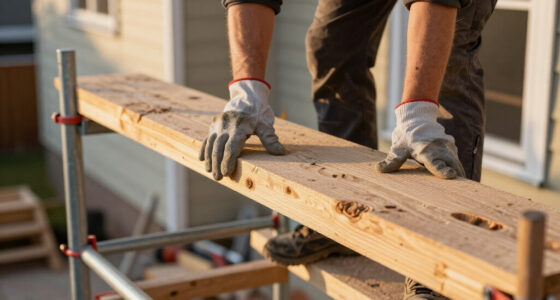
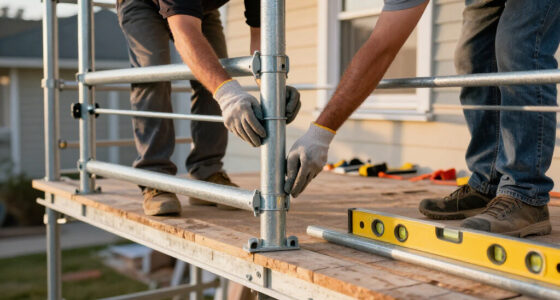
For anything longer than a quick look, a scaffold or aerial platform beats every ladder on the market. Re-flashing a chimney for four hours? A rented scaffold section is cheaper than an ambulance ride.
Your Ladder Length Isn’t Your Reach
A 24-foot extension ladder gives you roughly 17–19 feet of usable reach once you account for the 4:1 angle and the rungs you can’t stand on. The step-by-step used on every job:
Measure the eave height
Vertical distance from ground to the roof edge — the support point. Not the number of storeys, which varies wildly.
Divide by 4
That’s how far the base sits out from the wall — the 4:1 rule that produces a ~75° lean.
Add 3 feet
OSHA requires the ladder to extend at least 3 ft above the roofline. It’s your handhold on the most dangerous step of the climb.
Round up one size
Between lengths? Buy the next size up. A slightly longer ladder set lower on its extension beats a maxed-out one.
Worked example: a two-story house with a 22-foot eave line needs a 28-foot extension ladder, not a 24. And don’t assume taller is safer — a 40-footer one person can’t control creates its own hazards. Correct length, not maximum length.
Duty Ratings: You + Everything You Carry
The duty rating stamped on the rail covers your body weight plus clothing, PPE, tools, and materials. A 195 lb homeowner with a 40 lb bundle of shingles overloads a 200 lb Type III ladder before the second step.
| Duty Rating | Max Load | Intended Use | Roofing? |
|---|---|---|---|
| Type III | 200 lb | Light household duty | ✗ Never |
| Type II | 225 lb | Light trade, occasional | ✗ No |
| Type I | 250 lb | General trade work | ~ Marginal |
| Type IA | 300 lb | Professional / industrial — industrial-grade rails, rungs, rung locks | ✓ Minimum |
| Type IAA | 375 lb | Heavy industrial, heavy materials | ✓ Ideal |
Aluminium, Fiberglass, or Wood
Fiberglass
Far less conductive when clean and dry — the default near electrical service masts. But it reduces risk; it does not make work around live electricity safe. Keep the clearance your utility requires, full stop.
Aluminium
Light, durable, and cheap — and it conducts current. If there’s any chance of contact with overhead service lines, aluminium is out. No ladder of any material may contact energized lines.
Wood
Nonconductive when clean and dry, but wood splits, rots, warps — and conceals damage beneath paint. Wood ladders belong in a museum.
Label Literacy
ANSI classes aren’t universal — European EN 131 standards classify differently. Read the actual label and applicable local standard, not the marketing words “professional” or “heavy duty” on the box.
The 4:1 Angle: Steep Tips, Shallow Slides
Set too steep, the ladder tips backward with you on it. Set too shallow, the feet slide out and you drop like the bottom hinge of a gate. One unit out for every four units up is the accepted rule.
Too steep
The ladder — and you — tip backward away from the wall during the climb.
4:1 rule · correct
Base one unit out per four units of vertical height to the support point. Stable against both tipping and slide-out.
Too shallow
Feet slide outward; excessive horizontal loading on the rails. The classic kick-out fall.
Six Links — Any Weak One Puts You on the Ground
Match the Ladder Type to the Job (Extension vs. Roof Ladder vs. Everything Else)
The right ladder for roofing depends on what stage of the work you’re doing: getting up there, or working up there. An extension ladder is the standard tool for accessing a roof from the ground — two or three sliding sections, leaned against the structure, long enough to extend above the roof edge. A roof ladder is a different animal entirely: it lies flat on the pitched slope and hooks over the ridge so you can work on shingles without sliding. One does not substitute for the other, and I’ve seen homeowners try to span from the ground to the ridge with a roof ladder. It doesn’t hold a hook at that angle. It holds a fall.
Stepladders are for lower, self-supporting work — gutter cleaning on a single-story, interior heights. Never lean a folded stepladder against a wall unless the manufacturer explicitly rates it for that; the feet aren’t designed for that load path and the spreader bars will let go. Multi-position and telescoping ladders are tempting for storage and transport, and a certified model is fine for occasional access — but every locking pin must fully engage, every time, and the market is full of cheap imports making certification claims that don’t survive a close look at the label.
Then there’s the honest answer nobody selling ladders will tell you: for anything longer than a quick look, a scaffold or mobile elevating platform beats every ladder on the market. If you’re re-flashing a chimney for four hours, a rented scaffold section at $60 a day is cheaper than an ambulance ride.
Popular right now

Ninja Specialty Coffee Maker CM401, 10-Cup Carafe, Fold-Away Frother, Black

Bose QuietComfort True Wireless Earbuds with Active Noise Cancellation, Black

DeLonghi Rivelia Automatic Espresso Machine Bundle with Grinder and Frother, Beige
As an affiliate, we earn on qualifying purchases.
Size It Right: Why Your Ladder Length Isn’t Your Reach
Your ladder’s total length is not its safe working height — not even close. An extension ladder needs to be set at an angle, and you can’t stand on the top rungs, so a 24-foot extension ladder gives you roughly 17–19 feet of usable reach. Buy by advertised length and you’ll come up short, or worse, stand on rungs the manufacturer painted red for a reason.
For roof access, the rule that matters: in the United States, OSHA requires an access ladder to extend at least 3 feet (0.9 m) above the landing surface [1]. That three feet isn’t decoration — it’s your handhold when you step off the roof and swing your leg back onto the ladder, which is statistically the most dangerous moment of the whole climb. Without it, you’re groping for a rail that isn’t there with a 30-foot drop under your boot.
Here’s the step-by-step I use on every job:
- Measure the vertical height from the ground to the roof edge (support point) — not the number of storeys, which varies wildly.
- Divide by 4 — that’s how far the base sits out from the wall (the 4:1 rule).
- Add 3 feet for the extension above the roofline.
- Buy the next size up if you’re between lengths. A slightly longer ladder set lower on its extension is safer than a maxed-out one.
Example: a two-story house with a 22-foot eave line needs a 28-foot extension ladder, not a 24. And don’t talk yourself into a taller ladder being “safer” automatically — a 40-footer that one person can’t lift and control creates its own hazards. Correct length, not maximum length.
Duty Ratings and Materials: Read the Label Before You Buy
The duty rating stamped on the rail is the most ignored safety number in the hardware store. It covers your body weight plus everything you carry — clothing, tool belt, shingles, bundle of ridge cap. Not just you. This is where DIY buyers get burned constantly: a 195 lb homeowner grabs a Type III (200 lb) ladder because “I weigh less than that,” then walks up with a 40 lb pack of shingles and a drill. That ladder is overloaded before the second step.
The ANSI duty classifications used in North America:
| Duty Rating | Max Load | Intended Use |
|---|---|---|
| Type III | 200 lb | Light household duty — not roofing |
| Type II | 225 lb | Light trade, occasional |
| Type I | 250 lb | General trade work |
| Type IA | 300 lb | Professional/industrial — my floor for roof work |
| Type IAA | 375 lb | Heavy industrial, heavy materials |
For roofing, I won’t go up anything under Type IA (300 lb) for myself or anyone I’m responsible for. The margin covers tools and material, and industrial-grade rails, rungs, and rung locks are simply built better. Note that these ANSI classes aren’t universal — European EN 131 standards classify differently, so read the actual label and applicable local standard, not the marketing words “professional” or “heavy duty” on the box.
Material matters too, mostly for one reason: electricity. Aluminium is light, durable, and cheap — and it conducts current. If there’s any chance of contact with overhead service lines, aluminium is disqualified. Fiberglass is the default for pro roofers and anyone working near electrical service masts, because it’s far less conductive when clean and dry. But hear me clearly: fiberglass reduces risk; it does not make work around live electricity safe. Keep the clearance your utility requires, full stop. Wood ladders still exist, rot quietly under paint, and belong in a museum.
Set It Like a Pro: The 4:1 Angle and Securing the Top
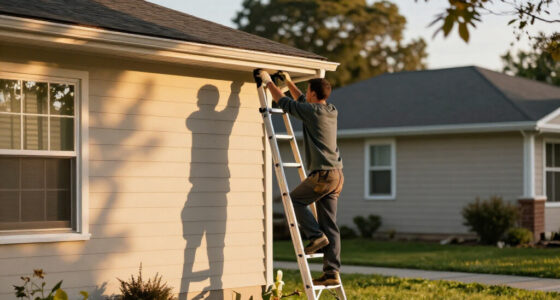
The single most common ladder setup error is the angle. Set too steep, the ladder tips backward with you on it. Set too shallow, the feet slide out and you drop like the bottom hinge of a gate. The accepted rule is 4:1 — one unit of horizontal distance from the wall for every four units of vertical height, which puts the ladder at roughly 75 degrees [1]. Quick field check: stand with your toes at the base rail and reach straight out; your fingertips should just touch the rungs at shoulder height.
Footing comes next. The ladder goes on firm, level, nonslip ground — never on boxes, loose bricks, a stack of pallets, or that piece of plywood you found behind the garage. On soft earth, use the ladder’s own flip-out feet or a manufacturer-approved leveller. On a sloping driveway, if an approved levelling system can’t make it stable, the answer is different equipment, not shims.
Then secure it. Top and bottom, every time, for roof access:
- Tie or clamp the top against sideways movement — to the structure, not the gutter.
- Block or stake the feet, or have a helper foot the base during setup and the first climb.
- Use a standoff/stabilizer (compatible with your ladder model) to keep pressure off the gutter and gain clearance to the wall. A standoff spreads the load to the fascia and gives you room to work — but it does not replace tying off.
- Barricade the area against doors swinging open, pedestrians, and vehicles.
And say it with me: a gutter is not a load-bearing support point. It bends, it pops off its hangers, and it lets the ladder slide sideways. A neighbor of mine learned this replacing a downspout bracket — the gutter let go at 18 feet and so did he. Compound wrist fracture. The standoff bracket that would have prevented it costs about $35.
Inspect Before Every Climb — Five Minutes That Prevents a Fall
A ladder is a structural system with no redundancy, so an inspection before every single use isn’t paranoia — it’s the whole game. A bent rail that held yesterday can fail today under the same load. Look for: cracked, bent, or corroded rails; damaged or missing rungs; worn or mud-caked feet; loose fasteners; frayed ropes; faulty rung locks; and on fiberglass, cracks or exposed glass fibers, which look like pale fuzz on the surface. Check hinges and locking indicators on multi-position models by hand — click them, don’t trust the sticker.
Also look at what’s on the ladder, not just in it. Oil, wet paint, mud, or ice on the rungs turns a rated ladder into a slip-and-fall machine, and so does muddy footwear. Give the boots a scrape before you go up.
If a ladder fails inspection, tag it and pull it from service. A DIY repair to a rail or rung creates a hidden weakness — you’re fixing the part you can see while compromising the part you can’t.
The failure mode I see most often in DIY situations is the cheap telescoping ladder with a lock that didn’t fully engage — grit in the mechanism, worn buttons, one section riding an inch high. If every lock doesn’t show its green indicator under your fingers, the ladder doesn’t go up. And ignore unsupported “EN 131 certified” claims on no-name imports; a certification you can’t trace is a certification you don’t have.
The Ladder Gets You Up — It Doesn’t Keep You Up There
Here’s the distinction that saves lives, and it’s the one almost every homeowner misses: a ladder is access equipment, not fall protection. A perfectly set, perfectly rated extension ladder gets you onto the roof. Once you’re walking that roof, the ladder has done everything it can for you. Falls from roof edges and through fragile surfaces are a leading cause of serious injury in construction and home improvement alike [1], and skylights are the killer nobody expects — many will not support a person’s weight even when they look solid. Treat every skylight as a hole in the roof.
Depending on height, slope, task, and your jurisdiction, working on a roof may call for guardrails, scaffolding, safety nets, travel-restraint systems, or personal fall-arrest gear with rated anchors. And note the word “system”: a harness is only protection when it’s anchored to a rated point with compatible components, adequate fall clearance, and a rescue plan. Tying a lanyard to a portable ladder is not an anchor — it’s theater.
Be honest about conditions, too. Wet, icy, mossy, or dusty roofing; steep pitches; loose tiles; gusty wind — any one of these turns a routine job into an emergency. Wind deserves special mention because it destabilizes both the ladder and you, and carrying an extended ladder in a crosswind has put people in the ER without a single climb. If the forecast says gusts, the roof says not today.
And the biggest honesty check of all: homeowners face the exact same physics as professional roofers, even where workplace regulations don’t apply to you. Gravity doesn’t check whether OSHA covers your Saturday.
When to Skip the Ladder Entirely and Rent Something Better
Sometimes the right ladder decision is deciding not to use a ladder. If any of the following describe your job, rent or hire alternative access equipment instead — a scaffold, a mobile elevating work platform (MEWP), or a professional roofer:
- The work will last more than about 30 minutes in one spot.
- You need both hands for forceful work — prying, nailing, cutting.
- You’re handling heavy or awkward materials up high.
- You have to move sideways repeatedly — that means constant repositioning or, worse, overreaching.
- The ground can’t be leveled, or the roof edge can’t be safely accessed.
- Weather is bad, or the site is near traffic or energized equipment.
The math favors renting more often than people think. A one-person scaffold tower rents for roughly the cost of a cheap ladder per day, and an aerial lift for a weekend is a rounding error against a roof-job budget. On my own crews, anything involving torch-down mod-bit or full tear-off gets scaffold or lift, no discussion — productivity jumps because you’re working from a platform, not balancing on rungs with one hand occupied.
And hire a licensed professional outright for steep, high, fragile, wet, or electrically exposed roofs, or any time you lack the training, rated anchorage, or rescue plan that real fall protection requires. Pride is a terrible piece of safety equipment. The best contractors I know are the ones who know exactly which jobs to walk past.
Frequently Asked Questions
What size extension ladder do I need for a two-story roof?
Measure the vertical height from the ground to the point the ladder rests against (the eave), then add at least 3 feet for the extension above the roofline. A typical two-story house with a 22-foot eave line calls for a 28-foot extension ladder, not a 24. Remember that usable reach is shorter than the ladder’s advertised length because of the setup angle.Is fiberglass or aluminium better for roof work?
Fiberglass is the default for roofing because it does not conduct electricity when clean and dry — important near service masts and overhead lines. Aluminium is lighter and cheaper but is disqualified anywhere contact with electrical lines is possible. Neither material is an excuse to work within restricted clearances of live lines.What does a ladder’s duty rating actually mean?
The duty rating is the maximum total load — your body plus clothing, PPE, tools, and materials. Type III is 200 lb, Type II is 225 lb, Type I is 250 lb, Type IA is 300 lb, and Type IAA is 375 lb. For roofing, most professionals won’t go below Type IA, because carrying shingles or tools quickly eats the margin on lighter-duty ladders.Can I lean my ladder against the gutter?
No. Gutters are not load-bearing support points — they bend, pop off their hangers, and let the ladder slide. Use a compatible standoff/stabilizer to spread the load to the fascia and provide wall clearance, and tie the ladder off to solid structure.When should I rent a scaffold instead of using a ladder?
Rent a scaffold or lift when the work lasts more than about 30 minutes in one spot, requires both hands or heavy materials at height, involves repeated sideways movement, or happens on uneven ground or in poor weather. For steep, high, fragile, or electrically exposed roofs, hiring a professional roofer is the safer call.Conclusion
Choosing a ladder for roofing comes down to a handful of decisions made correctly, in order: the right type for the stage of work, the right length for your actual eave height plus 3 feet, a duty rating that covers you and your tools, fiberglass anywhere near electricity, and a 4:1 setup tied off top and bottom on solid ground. Get those right and the climb itself becomes the safest part of the day.
But remember what the ladder is and isn’t. It is access equipment — a way onto the roof. It is not fall protection, and no purchase at any price changes that. When the job is long, heavy, steep, high, or conditions turn, the professional move is to put the ladder back on the truck and rent a scaffold, book a lift, or call a roofer. The best safety decision you’ll ever make on a ladder is knowing when not to climb one.